US Debt News: Debt Hits $40T as Treasury Doubles Buyback


US Debt News: National Hits $40 Trillion As Doubles Bond
In the biggest US debt news of the week, the US national has officially crossed $40 trillion for the first time in history.
Treasury Department data released on Wednesday showed the gross national reached $40,047,425,768,420.22 as of August 18, coming five months after the $39 trillion mark in March, which followed the $38 trillion threshold in October 2025.
This is one of the most significant pieces of US hits $40 trillion update for markets this year, and it arrives alongside fresh Crypto news today coverage of Bitcoin's price reaction as investors track how this national milestone is reshaping risk sentiment.
What Is Today's Biggest US Debt News Update?
The Treasury's daily cash and balances statement showed total public outstanding at $40.047 trillion, including securities held by the public of $32.266 trillion and intra-governmental holdings of $7.782 trillion.
This US national crosses $40 trillion confirms that America's federal government has more than doubled in under a decade.
The $40 trillion milestone has also drawn attention across financial markets, with The Kobeissi Letter highlighting the scale of the increase in total U.S. debt. 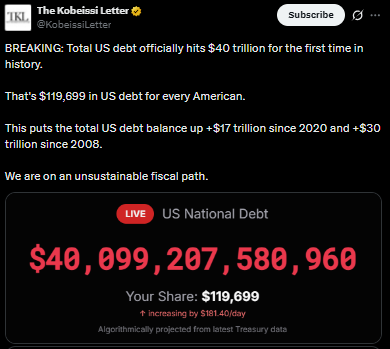
Milestone | Date Reached |
$38 trillion | October 2025 |
$39 trillion | March 2026 |
$40 trillion | August 18, 2026 |
Source: Treasury's Debt to the Penny Dataset
Why Did the Treasury Announce a Bond Buyback Update?
In a related buyback update, the Treasury announced it is increasing the size of liquidity support buyback operations for longer-dated nominal coupon securities from a maximum of $2 billion per operation to at least $4 billion, effective September 9 through November 4, 2026.
This US Treasury bond buyback news followed a sharp rise in long-term bond yields, with the 30-year Treasury yield hitting a 19-year high before easing.
Read the official Treasury buyback announcement for full details.
This counts as major US Treasury debt August 2026, as detailed in FXStreet's report on the Treasury's long-dated bond buyback, while feeding into broader discussions around the government's widening fiscal deficit.
Quick facts:
Buyback cap doubled: $2B $4B per operation
Sectors covered: 10–20 year and 20–30 year Treasuries
Window: September 9 – November 4, 2026
Purpose: improve bond market liquidity, not reduce total.
How Does US Debt Affect Bitcoin and Gold?
This US crisis news today has revived the debasement trade, where capital rotates into safe-haven assets.
The $40 trillion milestone has also become a talking point in crypto markets, with CryptosRUs highlighting the contrast between rising U.S. and Bitcoin's fixed supply. 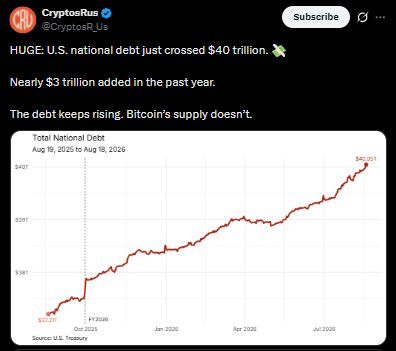
Bitcoin surged past $69,000 for the first time since early June, with the rally tied partly to the Treasury buyback and renewed risk appetite, according to CoinMarketCap's live pricing data.
This is exactly the kind of US $40 trillion Bitcoin news traders are watching closely.
Because Bitcoin is a fixed supply asset capped at 21 million coins, it's often framed within the inflation hedge narrative and the broader Bitcoin scarcity narrative whenever the debt-to-GDP ratio climbs.
This is textbook US crisis Bitcoin gold: when the US government 2026 cycle heats up, both gold and Bitcoin tend to benefit from easing macro liquidity conditions and a risk-on assets rally.
For anyone asking how does US debt affect Bitcoin, the short answer is indirect — falling yields and improving liquidity, not the figure itself, are what typically move crypto prices.
This remains among the most-read US national breaking stories of 2026 and an important topic in Crypto news, while this US debt news today update will likely be revised as new Treasury data comes in.
Expert Opinion
Market analysts note that the Treasury's buyback move is a debt-management and liquidity operation, not a reduction in total borrowing the government's underlying fiscal trajectory is unchanged.
While easing long-term yields could support Bitcoin and gold in the near term, analysts suggest the structural growth in national debt may continue to influence inflation expectations and future monetary policy debates.
Any short-term price reaction in risk assets should be read as a liquidity response, not a guaranteed trend.
Disclaimer: This article is for informational purposes only and does not constitute financial or investment advice. Markets and cryptocurrency prices are volatile, and readers should conduct independent research or consult a licensed financial advisor before making investment decisions.









