Fed Liquidity Treasury Bill: $15.6B Move Puts Crypto on Alert


Fed Liquidity Treasury Bill: Why Is Crypto Watching the Fed?
Something's shifted behind the scenes at the Federal Reserve, and it's exactly the kind of quiet, technical move that tends to ripple straight into risk assets.
Over the past several weeks, the Fed has gone from sitting mostly on the sidelines to actively scooping up billions of dollars in Treasury bills, and this Fed liquidity Treasury bill activity is now drawing real attention from crypto watchers tracking $BTC and $XRP.
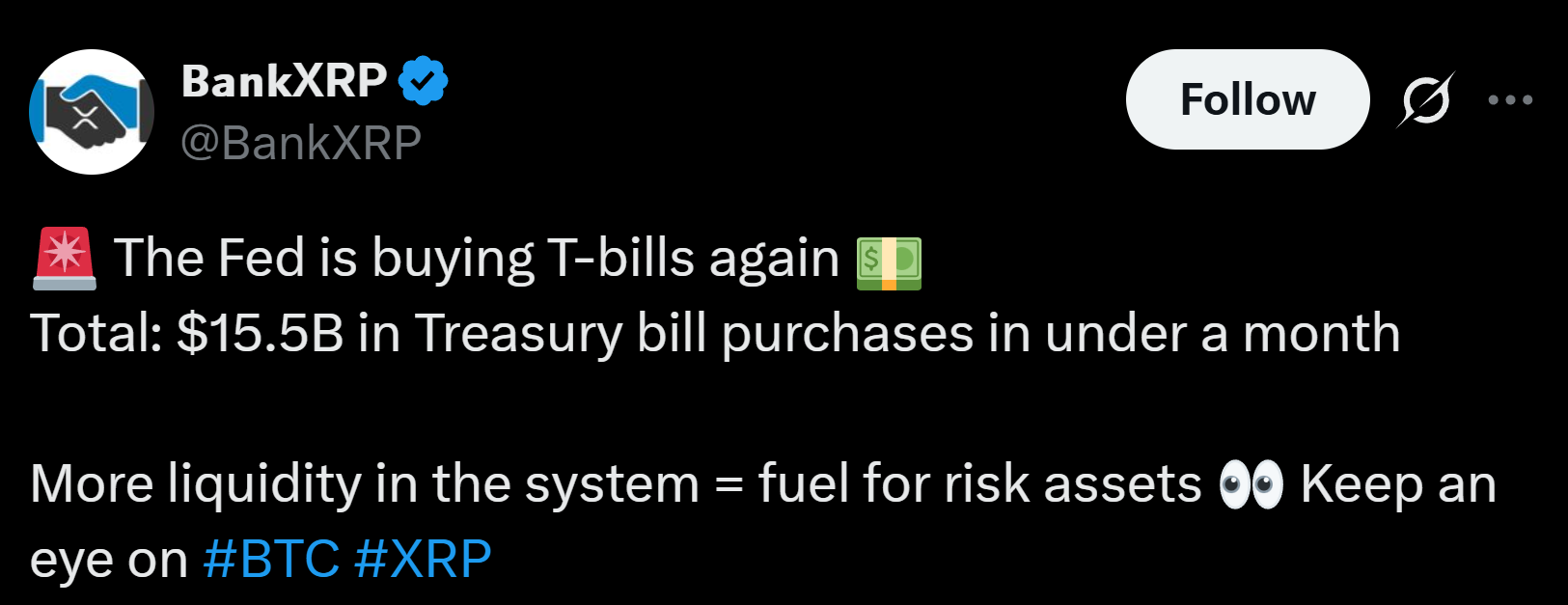
Source: BankXRP on X
What's Actually Happening, According to the Fed Itself
Per the New York Fed's own operational schedule, the Open Market Trading Desk is currently running a monthly operation period from September 15 through October 14, 2026, with a plan to conduct approximately $15.6 billion in reinvestment purchases of Treasury securities during that stretch.
This isn't guesswork or rumour; it's the Fed's own published plan, updated directly on its site.
The day-by-day operation calendar backs this up with hard numbers. Here's a snapshot of actual scheduled operations:
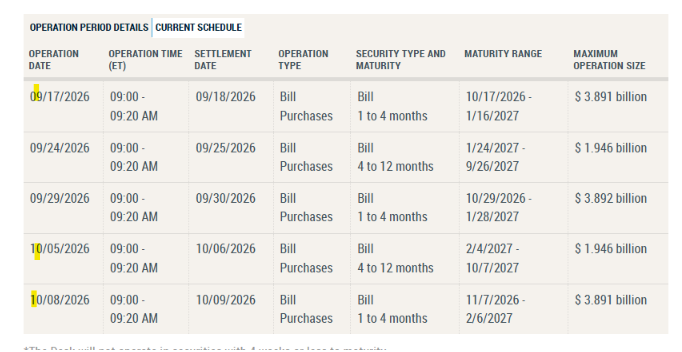
Add up just these five operations, and you're already looking at over $15.5 billion in short-term Fed liquidity treasury bill purchases packed into less than a month, which lines up closely with the Fed's own stated monthly target.
Why the Fed Stopped Sitting on the Sidelines
Here's where the story gets interesting. For much of 2026, the Fed's Treasury buying had slowed to a crawl.
Comparing recent monthly periods tells the tale clearly:
April to May 2026: $15.5B in reinvestment purchases, plus an extra $25B in reserve management purchases
March to April 2026: $13.8B reinvestment, plus $40B in reserve management purchases
August to September 2026: $17.0B in reinvestment, with zero reserve management purchases
Now (September to October 2026): $15.6B in reinvestment, still zero reserve management purchases
Notice the pattern: the big reserve management top-ups that were running tens of billions earlier in the year have quietly disappeared, but the baseline reinvestment buying, where the Fed reinvests maturing securities back into fresh T-bills, has stayed remarkably steady in the $15 to $17 billion range month after month.
This is the Fed's way of keeping bank reserves at an "ample" level rather than letting its balance sheet shrink further, a mechanism the Fed itself details in its reserve management FAQ.
What This Actually Means for Liquidity
A central bank buying Treasury bills effectively pumps cash back into the financial system in exchange for those bonds.
That cash doesn't just sit there; it flows through the banking system and often finds its way into assets that offer better returns than parking money in a bank account.
A few reasons this matters right now:
Steady, repeated T-bill purchases signal the Fed is actively managing liquidity rather than letting conditions tighten unchecked
More dollars circulating in the system historically correlates with stronger appetite for risk assets, stocks, gold, and crypto included
Watching this pattern monthly gives traders a genuine, dated signal rather than speculation, since the Fed publishes its own operation results
Why Crypto News Today Keeps Circling Back to This
It might seem strange that something as dry as Treasury bill purchases keeps showing up in crypto news today, but the connection is pretty direct.
Bitcoin and other crypto assets have historically been sensitive to shifts in overall dollar liquidity, since looser financial conditions tend to encourage capital to chase higher-risk, higher-reward opportunities.
With the Fed steadily running $15 to $17 billion a month in fresh T-bill purchases, that's a real, ongoing source of liquidity entering the system, month after month, not a one-time event.
Conclusion
The Fed's current Fed liquidity treasury bill buying spree is confirmed, documented, and running right now, with roughly $15.6 billion planned for this single monthly period alone.
Whether this steady cadence of purchases continues to build, holds flat, or eventually tapers off will likely stay one of the more useful signals for anyone trying to read where broader market liquidity, and by extension, risk appetite for assets like Bitcoin and XRP, might be headed next.
Disclaimer
This article is for educational and informational purposes only and should not be considered financial or investment advice. Always conduct your own research before making investment decisions.









