Crypto Advertising Metrics: 8 KPIs Web3 Brands Track


Crypto advertising fails more often from bad measurement than from bad creative. Campaigns get judged on impressions and clicks, budget flows toward whatever produces the biggest numbers, and nobody notices that the cost of acquiring a funded user has quietly doubled. These eight metrics fix that, and each one answers a different question about your spend.
Why Web3 measurement works differently
Two things separate crypto advertising from ordinary performance marketing.
The first is that a signup means very little. A wallet connection, a verified account and a funded account are three different outcomes with three different values, so a campaign optimised for registrations can look excellent while producing almost no revenue.
The second is that on-chain activity is the honest scoreboard. Deposits, transactions, total value locked and retained active wallets are verifiable in a way that platform-reported conversions are not. Measure toward those, not toward the metric that is easiest to report.
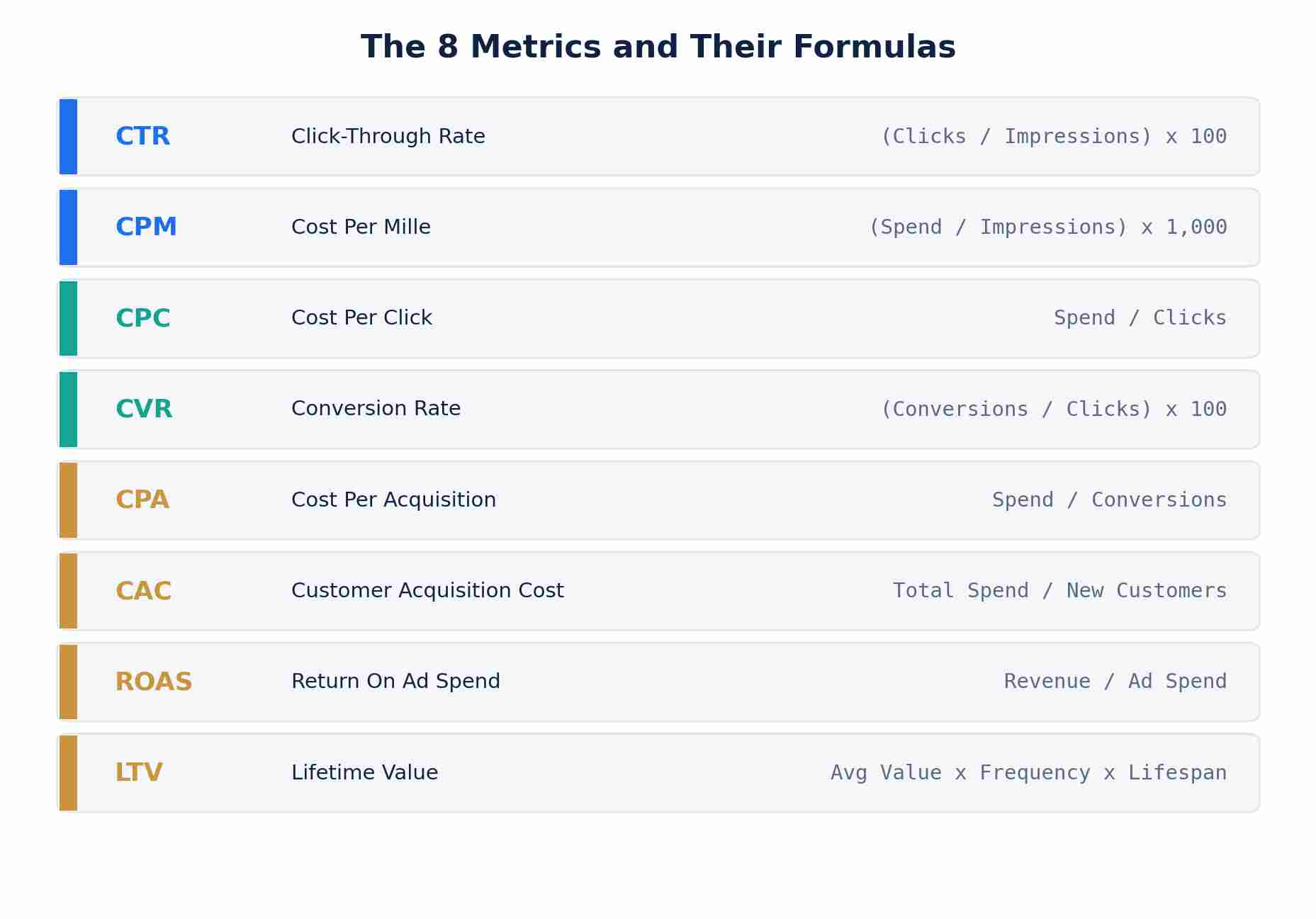
The 8 metrics
1. CTR (Click-Through Rate)
CTR = (Clicks / Impressions) x 100
CTR tells you whether your creative and targeting match the audience seeing it. It is a relevance signal, not a success measure. A high CTR on traffic that never deposits usually means your ad promised something the landing page does not deliver. Use CTR to compare creatives against each other, and never to judge a campaign on its own.
2. CPM (Cost Per Mille)
CPM = (Spend / Impressions) x 1,000
CPM is the cost of one thousand impressions, and it tells you how expensive your audience is to reach. It matters most for awareness campaigns and for comparing inventory quality. A cheap CPM on inventory nobody sees is not cheap, so always read CPM alongside viewability rather than on its own.
3. CPC (Cost Per Click)
CPC = Spend / Clicks
CPC tells you what you pay for each visit. It sits between reach and conversion, which makes it useful for spotting inefficiency early. Rising CPC with flat conversions usually means competition increased or creative fatigued. Falling CPC with falling conversion quality usually means you bought cheaper, worse traffic.
4. CVR (Conversion Rate)
CVR = (Conversions / Clicks) x 100
CVR measures how well your landing experience turns visits into action. This is where most crypto campaigns lose money, because ad platforms optimise delivery but cannot fix a confusing onboarding flow or a wallet connection that fails on mobile. Define the conversion precisely before you measure it, since a rate based on email signups is not comparable to one based on funded accounts.
5. CPA (Cost Per Acquisition)
CPA = Spend / Conversions
CPA is what one conversion costs you, and it is the first metric that connects spend to outcome. It is the right number for optimising individual campaigns and comparing channels against each other. Its limitation is scope, because CPA usually counts only paid media and only the conversion you configured.
6. CAC (Customer Acquisition Cost)
CAC = Total Spend / New Customers
CAC is CPA with the full cost included: media, tools, creative production and the team running it. That makes it the business number rather than the campaign number. CPA can look healthy while CAC is unsustainable, which is why finance and marketing frequently disagree about whether a channel works.
7. ROAS (Return On Ad Spend)
ROAS = Revenue / Ad Spend
ROAS tells you how much revenue each unit of ad spend produced. A ROAS of 3 means three units of revenue for every one spent. Treat it as a directional gauge rather than a verdict, because it measures revenue rather than profit and it usually credits only the last click. In crypto, tie ROAS to realised revenue such as fees or deposits, not to token price movement.
8. LTV (Lifetime Value)
LTV = Average Value x Purchase Frequency x Customer Lifespan
LTV estimates the total value a customer produces across the whole relationship. It is the metric that decides how much you can afford to spend on acquisition. Crypto LTV is volatile and cohort-dependent, so calculate it per cohort and per acquisition channel, and recalculate it as market conditions change rather than treating one figure as permanent.
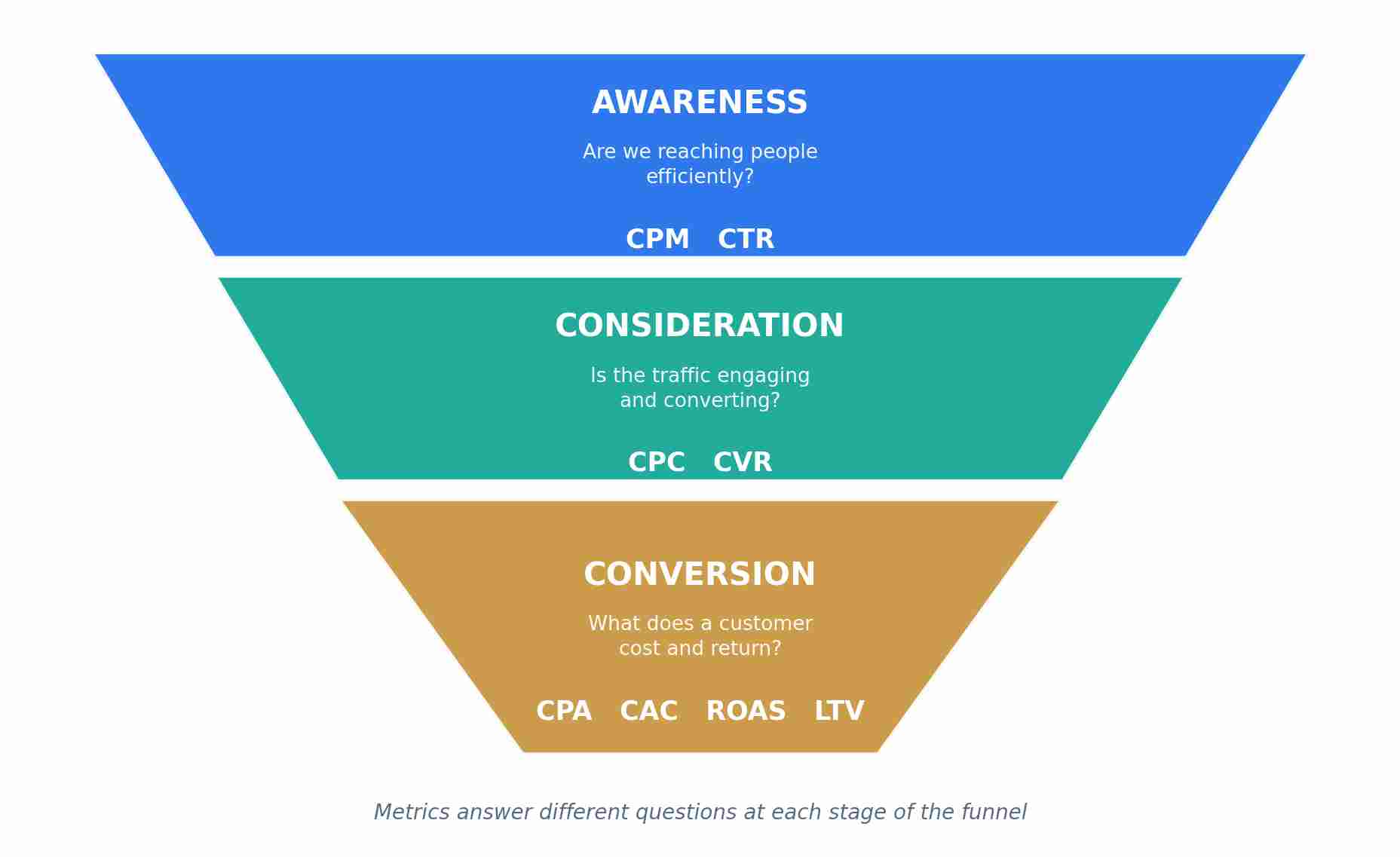
Which metrics matter at each stage
Judging every campaign by the same number is the most common measurement mistake.
At the awareness stage, you are buying attention. CPM tells you what reach costs and CTR tells you whether the creative resonates. Conversions here will look weak and that is expected, so do not kill an awareness campaign on CPA alone.
At the consideration stage, you are qualifying interest. CPC shows what engaged traffic costs and CVR shows whether your landing experience holds up. This stage is where creative and product meet, and where most fixable problems live.
At the conversion stage, you are buying customers. CPA and CAC show what they cost, while ROAS and LTV show what they return. Only these last two tell you whether the whole operation is profitable.
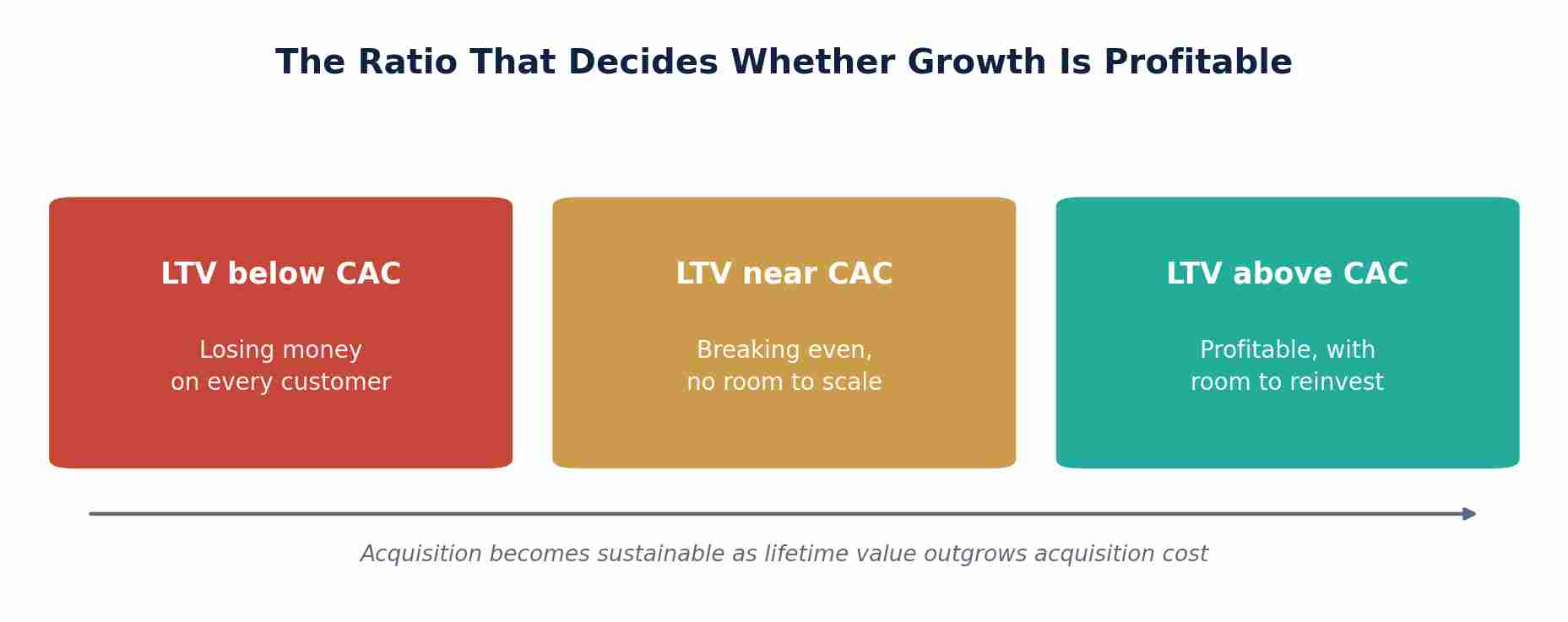
The ratio that matters most
No single metric decides whether your advertising works. The relationship between LTV and CAC does.
If lifetime value sits below acquisition cost, every new customer loses money and scaling accelerates the loss. If the two are close, you break even with no room to invest. When lifetime value comfortably exceeds acquisition cost, you can afford to spend more per customer and still grow profitably.
This is why a rising CAC is not automatically a problem. If the customers you acquire are worth proportionally more, a higher CAC can be the correct decision. Read the two numbers together, always.
Getting the tracking right
None of this works without reliable measurement infrastructure.
Install conversion tracking before launching, not after. Server-to-server tracking is more resilient than pixel-only setups in a privacy-restricted environment, and most serious platforms support both alongside tag manager integration. Define your conversion events explicitly, separating wallet connections from verified accounts from funded accounts, so the numbers mean what you think they mean.
Benchmarks are worth treating carefully. Crypto costs vary enormously by geography, product type and market conditions, so an average borrowed from an article is rarely a useful target. Platforms built for the vertical report these metrics directly, and AdsNetwork is one example of a crypto advertising platform providing real-time reporting on impressions, clicks, conversions and ROAS. The benchmark that matters is your own campaign history, not an industry average.
Segment everything. Aggregate numbers hide the answer, because one geography or placement usually carries most of the waste. Whether you buy through a crypto ad network, a general advertising network or a demand-side platform, break results down by geography, format, placement and device before deciding what to scale. A crypto advertising network will usually expose placement-level data, and that is where the waste becomes visible.
Conclusion
These eight metrics form a chain. CPM and CTR tell you whether you are reaching the right people. CPC and CVR tell you whether that traffic engages and converts. CPA, CAC, ROAS and LTV tell you whether any of it makes money.
Track the chain rather than a favourite number. Measure toward on-chain outcomes where you can, define conversions precisely, segment before you draw conclusions, and judge campaigns by the stage they were built for.














.webp)