Phina Network Tokenomics: PHN Supply, Token Sale and Distribution


How Does Phina Network Tokenomics Work for PHN Holders?
Before buying any token, investors should look at where the supply goes, who receives how much, when those tokens can be sold, and how many are already in circulation. These details can reveal more about a project than promotional claims.
Phina Network is a Web3 gaming project on BNB Smart Chain with publicly stated token figures. This guide examines the Phina Network Tokenomics, including PHN supply, allocation, token sale details, distribution, and key risks.
Key Takeaways
PHN has a total supply of 200,000,000, and 100,000,000 of that is listed as circulating.
Liquidity takes the biggest share at 30%, and the team's 10% is locked and vested over 36 months.
Many figures come from the project's own pages, so verify the contracts on BscScan before you buy.
What Is Phina Network?
Phina Network is a gaming ecosystem built on BNB Smart Chain. Players earn rewards, holders stake tokens, and builders use a launch suite called Phina Lab.
Its native token, PHN, powers gas, staking and the core ecosystem. You can read the project's own documentation.
Source: official website
What Is the PHN Token and What Is It Used For?
PHN is the native token of Phina Network. It is a BEP-20 token on BNB Smart Chain, so it works with standard BNB Smart Chain wallets.
According to the project, PHN has three main jobs:
Gas. It powers gas for the core ecosystem, so everyday activity on the platform runs on it.
Staking. Holders lock PHN to earn rewards, and the staking incentives are paid from the ecosystem and gaming pool.
Governance and the in-game economy. The project describes PHN as the token behind community voting and in-game activity.
PHN is the main token. A second one, PHNA, plays a separate platform role, and we cover it in the supply section below.
Why does this matter for tokenomics? Because demand for a token comes from real use. The more players, stakers and builders who need PHN, the more its supply split matters. So the numbers in the next sections are worth reading closely.
PHN Token Supply: The Core Numbers
Let's start with the basics. The first thing to know about PHN tokenomics is the scale: total supply is 200,000,000 coins, and half of them are listed as circulating today.
The project also runs a second token. PHNA is the platform token, and it is used for access, rewards and platform services. Both live on BNB Smart Chain as BEP-20 tokens.
Detail | PHN | PHNA |
Role | Native token | Platform token |
Total supply | 200M | 100M |
Circulating supply | 100M | 50M |
Network | BNB Smart Chain (BEP-20) | BNB Smart Chain (BEP-20) |
Notice the pattern. Each token has exactly half its supply in circulation. That is a clean ratio, but it also means a large amount of tokens could still reach the market later.
Official Token Contracts: PHN and PHNA
The official page lists one contract address for each token, both on BNB Smart Chain (BEP-20). Each card also has a View on BscScan button, as the image above shows.
Token | Role | Contract address |
PHN | Native token | 0x7d007dC77a8F6333Ed71EFbfB13C21D6C1339425 |
PHNA | Platform token | 0xbC6528f5697944c69b3007c2A32521AF0F81A00e |
Why does the address matter? It is the token's real identity on the blockchain. Fake tokens can copy a name and a logo, but they cannot copy the address.
So copy the address from the official page with its copy button instead of typing it. Then open it on BscScan and check that the token name and total supply match the 200M and 100M shown above.
Circulating Supply vs Total Supply: Why the Gap Matters
Two numbers matter on any token page: total supply and circulating supply. Total supply is the full amount the project lists. Circulating supply is what people can actually trade today.
For PHN, that is 200,000,000 against 100,000,000. So half the coins are out in the market and half are not. If the second half unlocks without a clear schedule, buyers can end up holding a much bigger pool than they expected.
Here is a simple example. If the $0.31 listing price held, the 100,000,000 circulating coins would be worth about $31 million, and the full 200,000,000 would be worth about $62 million. That is plain multiplication, not a valuation, but it shows why the unlock timing deserves as much attention as the headline split.
Phina Network Token Allocation: Six Buckets
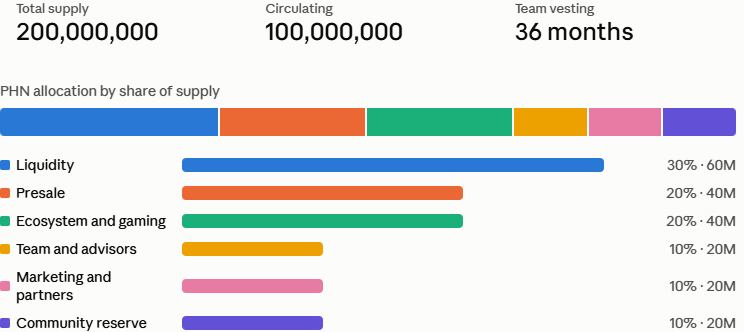
The 200,000,000 are split into six parts. Here is the full breakdown, with the token count worked out for each share.
Bucket | Share | PHN tokens | What it is for |
Liquidity | 30% | 60,000,000 | DEX and CEX liquidity for deep, stable markets |
Presale | 20% | 40,000,000 | Public sale for early supporters and backers |
Ecosystem and gaming rewards | 20% | 40,000,000 | Play-to-earn, staking incentives, in-game treasury pools |
Team and advisors | 10% | 20,000,000 | Core team, locked and vested over 36 months |
Marketing and partnerships | 10% | 20,000,000 | Exchange listings, campaigns, partnerships |
Community reserve | 10% | 20,000,000 | DAO-governed grants, airdrops and future plans |
Source: Official PHN tokenomics
PHN Token Distribution: Bucket by Bucket
Numbers on a table only go so far, so let's see how the Phina Network token distribution works in practice, one bucket at a time.
Liquidity (30%). This is the largest slice. It supports trading on decentralized and centralized exchanges, so buyers and sellers can move without wild price swings.
Presale (20%). Early supporters get access before the wider market. We cover the sale terms in the next section.
Ecosystem and gaming rewards (20%). This pool funds play-to-earn rewards, staking incentives and in-game treasuries. If the games grow, this bucket drains first.
Team and advisors (10%). These tokens are locked and vested over 36 months. A long lock like this keeps insiders from dumping early, which is a good sign.
Marketing and partnerships (10%). Money for listings, campaigns and partner deals.
Community reserve (10%). A DAO-governed pool for grants, airdrops and later plans.
Here is the same split at a glance.
Phina Network Presale and Token Sale Details
The sale sits at 20% of supply, or 40,000,000. Buyers can pay with BNB, USDT or USDC. The progress bar showed 70% when we checked the page.
Detail | What the site shows |
Listing price | 1 PHN = $0.31 USDT |
Payment options | BNB, USDT, USDC |
BNB rate | 1 BNB = 153,990 PHN (BNB at about $769.95) |
Sale progress | 70% |
Now a quick bit of math. At that BNB rate, one PHN costs about $0.005, which is far below the $0.31 listing price. The site does not explain the gap, so treat $0.31 as a stated target, and ask the team what the actual crypto presale price is before you pay.
The Phina Network token sale also sits awkwardly next to the circulating figure. Half the supply is shown as circulating while a sale is still running, and that is worth a question to the team.
Vesting and Lock-Ups: What We Know
Unlock timing is where the Phina Network Tokenomics get thin. Only one lock-up is stated clearly: the team and advisor tokens are locked and vested over 36 months.
For the other buckets, we found no vesting schedule on the pages we reviewed. That matters, because unlock dates decide when new supply hits the market.
Final Verdict
The Phina Network Tokenomics look tidy on paper. Six clear buckets, a big liquidity share and a 36-month team lock are all good signs.
The open questions are real too: half the supply is circulating, most unlock schedules are missing, and the price figures do not line up. Read the official site, check the contracts, and only put in what you can afford to lose.
Disclaimer: This article is for information only. It is not financial, investment, tax or legal advice. Crypto presales carry a high risk, including total loss. Details come from the project's public pages and may change, so verify everything yourself.









.webp)




