Phina Network Explained: Is PHN the Future of Web3 Gaming?

What Is Phina Network and How Does Its Web3 Gaming Ecosystem Work?
Most crypto projects talk about finance. A few try to mix it with games. Phina Network belongs to the second group, and that makes it a little different from the usual presale story.
The project calls itself a Web3 gaming ecosystem on BNB Smart Chain. It has a live presale, a native token called PHN, and a builder platform called Phina Lab. This guide walks through each piece in plain words, using the official site, and points out where readers should stay careful.
Key Takeaways
The project blends decentralized finance with gaming, and its token, PHN, is meant for staking, governance and the in-game economy.
The official tokenomics show a 200,000,000 total supply, with the largest share (30%) set aside for liquidity.
Many numbers and claims, such as audits and platform stats, come from the project itself. Readers should verify them before putting in money.
What Is Phina Network?
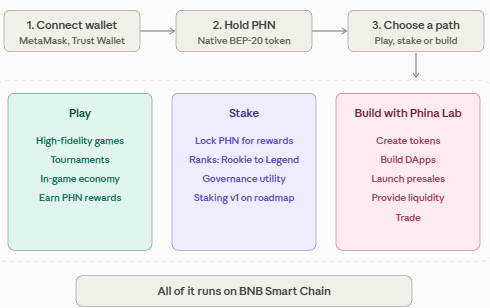
So, what is Phina Network? It is a Web3 gaming ecosystem built on BNB Smart Chain. The idea is simple: mix decentralized finance with games, so players can earn tokens while they play.
For readers asking what is Phina Network crypto, think of it as a game world with its own economy. One token, PHN, is used across the whole platform.
The project has three layers:
Play: Players compete in high-fidelity games and tournaments and earn PHN rewards.
Stake: Holders lock PHN for rewards. The game site also describes four ranks, from Rookie to Legend, based on the amount staked.
Build: Phina Lab lets users create tokens, build DApps, launch presales, add liquidity and trade.
That third layer is what sets it apart. Most gaming tokens stop at the game. Phina also offers tools for other builders.
Source: official website
What Is PHN Token?
Many searches ask what is PHN token. It is the native token of the project, issued as a BEP-20 token. According to the site, the PHN token powers governance, staking and the in-game economy.
A second token, PHNA, is listed as the platform token.
Token | Role | Contract address |
PHN | Native token | 0x7d007dC77a8F6333Ed71EFbfB13C21D6C1339425 |
PHNA | Platform token | 0xbC6528f5697944c69b3007c2A32521AF0F81A00e |
The site itself advises checking the contract on BscScan before trading.
How Does Phina Network Work?
How does Phina Network work in everyday use? A person connects a Web3 wallet, buys PHN, then uses it for staking, DeFi or games. Rewards flow back through play-to-earn features and tournaments.
The official feature list highlights six points: play-to-earn, token utility, audited contracts, BSC speed, decentralization and tournaments. It also mentions an "AI-powered banking" idea, with portfolio tools and transaction analytics. The site does not explain how these tools run, so that part remains unproven.
Everything sits on Phina Network BNB Smart Chain contracts, which keeps fees and wait times low.
Phina Network Presale and Token Price
The Phina Network presale is live on the site, with a progress bar that showed 70% at the time of the screenshots. Buyers can pay with BNB, USDT or USDC.
Source: official PHN presale page
Detail | What the site shows |
Listing price | 1 PHN = $0.31 USDT |
Payment options | BNB, USDT, USDC |
BNB rate | 1 BNB = 153,990 PHN (when BNB was about $769.95) |
Progress | 70% |
On the Phina Network token price, the $0.31 listing price is a stated target, not a guarantee. Earlier pages showed $0.30, so the figure may change. Readers should always check the live site.
PHN Tokenomics: Where the Supply Goes
The official page shows a total supply of 200,000,000 PHN, with 100,000,000 listed as circulating.
Allocation | Share | Purpose |
Liquidity | 30% | DEX and CEX liquidity for stable markets |
Presale | 20% | Public sale for early supporters |
Ecosystem and gaming rewards | 20% | Play-to-earn, staking incentives, treasury pools |
Team and advisors | 10% | Locked and vested over 36 months |
Marketing and partnerships | 10% | Listings, campaigns, partnerships |
Community reserve | 10% | DAO-governed grants, airdrops, future plans |
The same split is easier to see in a chart.
Token allocation (% of 200M supply)
Percent
Use the arrow keys to move between data points
Liquidity leads the split, and the team's 10% is locked for 36 months. That lock is a good sign. Still, the circulating figure of 100,000,000 is half the supply, which readers may want to ask the team about.
Phina Lab: Build, Launch, Trade, Earn
Phina Lab is the builder side of the project. The site describes it as a complete Web3 creation and launch suite on BNB Chain. Users can create tokens, build DApps, launch presales, provide liquidity and trade from one place.
The platform shows these numbers:
Metric | Shown on site |
Total projects | 1,500 |
Tokens created | 1,900 |
Trading volume | $89.40M |
Total liquidity | $24.70M |
Total users | 17,000 |
Transactions | 5,000 |
These are self-reported. One detail stands out: 17,000 users but only 5,000 transactions. Readers can check on-chain data on BscScan to see what the real activity looks like.
Phina Network Ecosystem
The Phina Network ecosystem has a few moving parts. Gaming and tournaments sit at the front, and Phina Lab covers the builder tools.
Phina Network staking is part of the plan. The roadmap lists a staking v1 launch, and a project blog mentions returns of 8% to 20% APY depending on the pool. These are claims, not promises.
Phina Network DeFi is described as lending, borrowing and staking features. The Phina Network NFT marketplace appears in a project blog as a place for minting and trading, and the roadmap also mentions NFT projects.
Phina Network Roadmap
The Phina Network roadmap on the site moves in phases.
Phase | What it covers |
Foundation | Project setup, whitepaper, tokenomics design, community building |
Launch | Token Generation Event, CEX and DEX listings, staking v1 |
Wallet | PHNA reward token, Phina Wallet (mobile and browser extension), KYC-verified accounts |
Growth | More DeFi integrations, NFT projects, staking programs, mainnet upgrades |
Source: Official roadmap page
Dates differ between sources, so each phase is best treated as a plan.
How to Buy PHN Token
The site lays out five steps for how to buy PHN token:
Set up a wallet. Install MetaMask or Trust Wallet and keep the seed phrase safe. Then open the site inside the wallet's dApp browser.
Add BNB. Buy BNB on an exchange and move it to the wallet on the BNB Smart Chain network.
Choose a currency. Enter the amount of BNB, USDT or USDC in the presale card.
Confirm the transaction. Review the details, approve it in the wallet, and add a receive address.
Receive PHN. Tokens are allocated once the transaction is confirmed on-chain.
Before paying, the contract address should be checked on BscScan.
Key Risks to Keep in Mind
Presale risk: Early-stage tokens can lose value quickly, and the listing price is not guaranteed.
Self-reported claims: Audits, platform stats and the "backed by Trust Wallet" line come from the project itself. They need independent proof.
Supply questions: Half the supply is shown as circulating while the crypto presale is still running.
Return claims: Staking figures of 8% to 20% are not guaranteed.
Look-alike scams: Fake sites and copied contracts are common, so every address needs checking.
Final Verdict
Phina Network is an interesting mix of gaming, DeFi and builder tools on BNB Smart Chain. The tokenomics are laid out clearly, and the team's 36-month lock is a plus.
Still, much of the roadmap is a plan, and many claims are self-reported. Readers interested in PHN should visit the official site, verify contracts on BscScan, and invest only what they can afford to lose.
Disclaimer: This article is for information and education only. It is not financial, investment, tax or legal advice. Crypto presales carry a high risk, including total loss. Details come from the project's public pages and can change, so readers should verify everything themselves.








.webp)




