Pi Network News: Protocol 28 Docker Image Goes Live As Mainnet Nears

Pi Network Protocol 28 Docker Image Prepares Mainnet for October 16
The official Docker image for Protocol 28 is now out, and Mainnet switches over on October 16. Pi Network News on October 6 centered on that date and an October 13 upgrade deadline for node operators, as previously announced by the Pi Core Team.

Source: Official Upgrade Guide
At the same time, a stablecoin partnership with OUSD still faces questions over real utility and smooth access.
Pi Network News: What the Protocol 28 Docker Image Actually Means
A Docker image is a ready-made software package. It bundles a program, its settings and its dependencies into one file, so an operator can launch a node without installing each piece by hand. For Pi, the image carries the node software that applies the network's rules.
Pi Protocol 28 is a core upgrade to a blockchain built on a customized version of the Stellar Consensus Protocol. It targets reliability, not anything visible in the mobile app. Three changes stand out:
-
Delayed transaction data: validators can keep agreeing on blocks without stalling
-
Batch contract upgrades: developers can update groups of smart contracts in one step
-
Safer data migration: stored app data can be modified more carefully as apps evolve
Builders gain the most. Everyday Pioneers will notice nothing new, though a steadier chain is a precondition for richer apps.
Node Operators Face an October 13 Deadline Before Mainnet Activation
Operators must pull the updated image from the pi-node-docker repository. Tags such as community-v1.0-p28.0.1 and organization-mainnet-v1.0-p28.0.1 carry the new version. Nodes left on older software risk losing connectivity once Mainnet moves to Protocol 28.
-
October 13, 2026: upgrade deadline for node operators
-
October 16, 2026: Mainnet activation
This is the latest in a run of mandatory upgrades rolled out through 2026, following the Open Mainnet phase. It does not alter PI supply, tokenomics or mining. As Pi Network News goes, it is technical housekeeping rather than a headline feature.
Open USD Partnership Puts Pi Network's Stablecoin Utility to the Test
On September 30, the day OUSD launched, the Pi Core Team announced a tie-up with Open Standard, the group behind the stablecoin. OUSD is pegged to the dollar and issued by Bridge, a Stripe company. Reserves sit with institutions including BlackRock, Lead Bank and BNY. Founding partners include Visa, Mastercard, Stripe, Coinbase and Shopify.
Pi says it will explore rewards for Pioneers and wider OUSD use across payments and apps. No integration details, timelines or reward mechanics have been published, so the deal remains exploratory.
Utility is the sore point. Critics cite years of promised tools such as a DEX and launchpad, heavy Core Team control over nodes, a large supply with steady unlocks, missing top-tier listings and KYC data concerns.
Supporters point to millions of verified Pioneers, a live Mainnet and no cash cost to join. The names on the partner list matter less than what Pi can actually do inside the ecosystem.
PI Token Price Edges Higher Near $0.087 as Old Doubts Still Linger
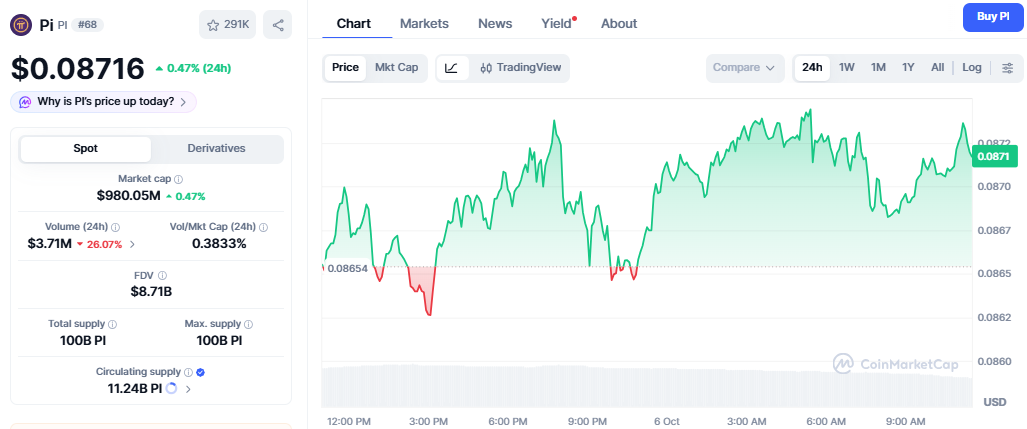
Pi Network price today was muted. Market data as of October 6, via CoinMarketCap:
-
Price: $0.08716, up 0.47% in 24 hours
-
Market cap: $980.05 million
-
24-hour volume: $3.71 million, down 26.07%
-
Fully diluted valuation: $8.71 billion
-
Circulating supply: 11.24 billion of 100 billion PI
The PI coin price held a narrow band, and shrinking volume suggests thin conviction behind the bounce.
What’s Next?
Protocol 28 will test whether Pi can pair steady engineering with real adoption. The October 16 switch should pass quietly if operators upgrade in time. The larger test is whether the OUSD plans become live payments and rewards before skepticism hardens. Pi Network News in the coming weeks will hinge on that follow-through.
Disclaimer: This article is for informational purposes only and does not constitute financial or investment advice. Crypto markets carry significant risk. Always do your own research before making any investment decisions.









