Binance Brazil to Block Withdrawals Without Counterparty Details


Who Is Affected by the Binance Brazil Crypto Withdrawal Rules 2026?
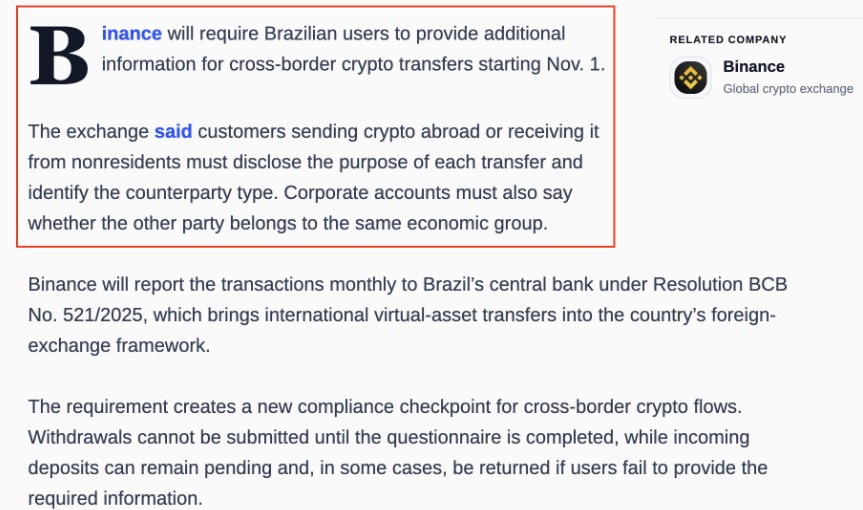
Binance will require a stated purpose and counterparty details for every cross-border crypto move made by Brazilian users from November 1, 2026. Withdrawals cannot be submitted until the form is complete.
Source: X Official
The new Binance Brazil crypto transfer rules, set out in the exchange's official blog, pull digital asset flows into the country's foreign-exchange system.
Here comes questions on domestic transfers between Brazilian residents.
What Binance Brazil Transfer Rules Require for Each Withdrawal Request
The policy covers individuals and companies. A pop-up questionnaire asks why the money is moving and who is on the other side. Counterparty types include individuals, companies, exchanges and other financial institutions, along with identifying details.
These Binance Brazil transfer requirements apply to funds sent abroad or received from non-residents.
-
Start date: November 1, 2026
-
Withdrawals: blocked until the questionnaire is finished
-
Deposits from non-residents: held pending, and in some cases returned
-
Self-hosted wallets: mainly an ownership confirmation
-
Own overseas exchange accounts: often pre-filled, needing only a check
-
Corporate accounts: an extra question on whether the counterparty belongs to the same economic group
The step is separate from the Travel Rule, which Brazil will phase in during 2027 and 2028, according to Binance.
Resolution 521 Brings Crypto Into Brazil's Foreign Exchange System
The change flows from Resolution BCB No. 521/2025, published by the Central Bank of Brazil. It treats certain international virtual asset payments as foreign-exchange operations. Binance will send transaction data to the regulator every month.
Regulators want clearer visibility into cross-border flows, particularly stablecoins, which make up a large share of volume. The aims include stronger anti-money-laundering controls and closer alignment with FATF and FSB standards. The Binance Brazil crypto rules are therefore a compliance step, not a ban.
Binance Brazil Transfer Requirements: Caps, Codes, and Thresholds
The questionnaire scales with transaction size:
-
Up to $50,000: a simplified list of 10 purposes, such as own-account transfers, purchases of goods or services, donations and travel
-
Above $50,000: one of 96 central bank classifications
-
$100,000 per transaction: the cap when the counterparty is not authorized in Brazil's FX market, which may rise to $500,000 with prior notice
The Binance Brazil counterparty check drives the limit. An unauthorized recipient triggers the lower cap, and larger sums fall outside the standard flow.
Who Feels It: Direct Impact on Brazilian Residents and Overseas Users
Brazilian residents:
-
Every international deposit or withdrawal needs the form, adding a step
-
Skipped forms mean blocked withdrawals, pending credits or returned deposits
-
Domestic transfers stay unchanged
-
The FX classification may bring more visibility for tax and IOF purposes
Overseas users and counterparties:
-
Senders abroad are not asked to complete the form, but transfers to Brazilian accounts may sit pending until the Brazilian recipient supplies the details
-
Other platforms seeking Brazilian authorization are expected to collect similar data
What Comes Next
Binance has promised more operational details before the November 1 start. The $500,000 counterparty ceiling, tax treatment of FX-classified operations and the Travel Rule rollout remain open items.
Other exchanges seeking authorization under the central bank's licensing framework face similar duties. Banks have long required purpose codes and beneficiary data on international wires, so the model is familiar.
What changes is that crypto now sits inside it. Licensed and compliant global players may gain ground, while purely offshore operations face a higher bar.
Disclaimer: This article is for informational purposes only and does not constitute financial or investment advice. Crypto markets carry significant risk. Always do your own research before making any investment decisions.









