CashCat Tokenomics: Supply, Allocation, Liquidity and Risks

CashCat Tokenomics: What You Need to Know About CASHCAT
CashCat tokenomics is a short read, and that's kind of the point. The project isn't running a presale, it hasn't published a whitepaper, and it doesn't claim any real-world use case. It's a meme coin called $CASHCAT, built around a joke about Robinhood's early working name, and it trades on something called the Robinhood chain.
People are searching for CashCat tokenomics because the coin already has a market cap in the nine figures and tens of thousands of holders. That's enough activity to make anyone want the numbers before going anywhere near it.
This article breaks down what's actually published — supply, liquidity, holder data, and the roadmap — and separates what CashCat states from what can't be confirmed. Research for this piece was carried out in August 2026, and figures like market cap and volume move constantly, so treat any dollar amount here as a snapshot, not a live quote.
What Is CashCat and How Does It Work?
CashCat is a memecoin themed around a real piece of crypto trivia: Robinhood's co-founder Vlad Tenev has said the trading app was originally going to be called "Cash Cat" before it became Robinhood. The project leans entirely into that story.
The token runs on the Robinhood chain, a blockchain that shares its name with the trading app but has no corporate connection to it. CashCat's own site is explicit about this — it states it is not affiliated with Robinhood Markets, Inc. or Vlad Tenev, and describes itself as "fan fiction with a ticker."
There's no product, no app, and no roadmap milestones tied to real utility. The project openly says the token has "zero utility, as promised." That's unusually blunt for a crypto project, and it's worth taking at face value rather than reading hidden ambition into it.
CashCat Tokenomics: A Closer Look at the Token Model
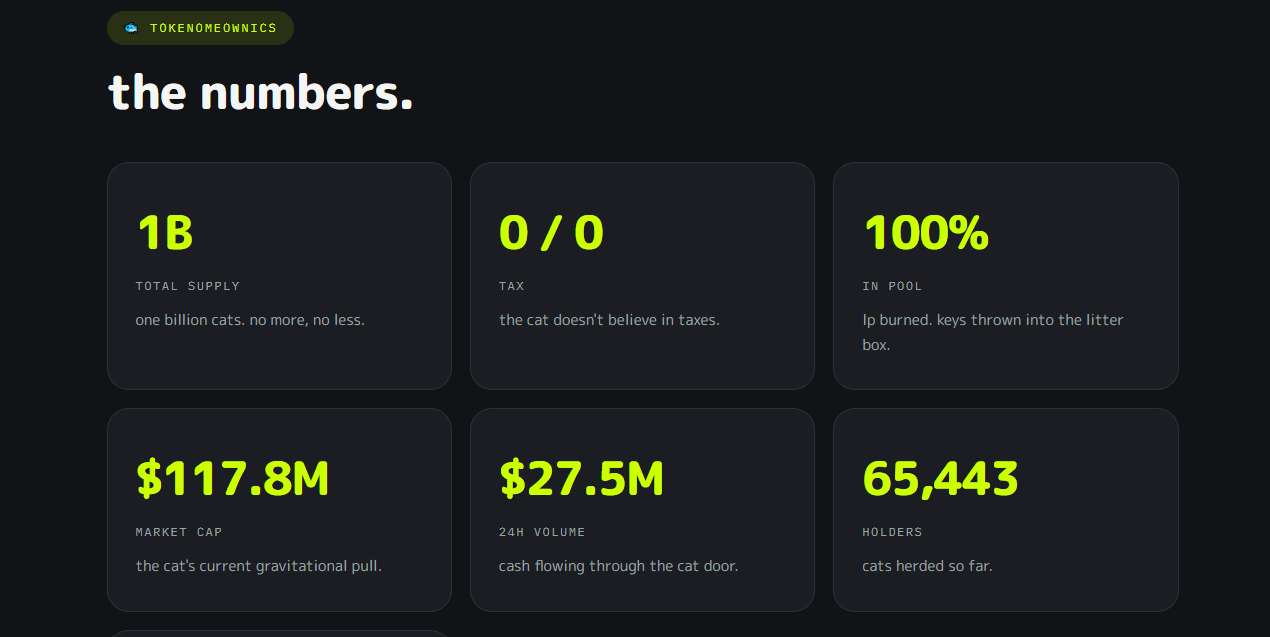
Here's what the project has published on its own site as of this research date:
Metric | Stated Figure | Notes |
Total supply | 1,000,000,000 CASHCAT | Fixed; the project says "no more, no less" |
Buy/sell tax | 0% / 0% | No transaction tax, per the project |
Liquidity pool | 100% in pool | LP tokens reportedly burned |
Market cap | Roughly $119.7 million | Snapshot figure, changes constantly |
24-hour volume | Roughly $27.8 million | Snapshot figure at research time |
Holders | 65,452 | As reported on the project's site |
Tokens burned | Not disclosed | Site shows this field but no confirmed number |
A couple of things stand out here. There's no presale allocation, no team allocation, no treasury, and no vesting schedule anywhere on the page. That's consistent with a fair-launch meme coin, where the entire supply reportedly goes straight into a liquidity pool rather than being split across a team, investors, and marketing wallets.
That's a meaningfully different structure from a presale-style token. There's nothing to unlock later, but there's also no visibility into whether any portion was set aside before launch. The project's claim of "100% in pool" hasn't been independently verified through a blockchain explorer or a third-party audit as of this writing.
How Is CashCat Supply Distributed?
Because it skips the usual presale format, there isn't a standard allocation breakdown to walk through — no separate team, treasury, or marketing buckets are listed. The project's own framing is that liquidity provider tokens were burned, meaning the ownership of that pool can't be reclaimed or moved by a single wallet.
If that claim holds up, it removes one common rug-pull risk: a team pulling liquidity out from under holders. But a burned LP doesn't say anything about how the initial supply was distributed among early wallets before the burn, and that detail isn't published anywhere on the site.
Circulating supply and total supply appear to be the same 1 billion CASHCAT, since there's no vesting or locked allocation mentioned. Readers should treat this as the project's stated position rather than a confirmed on-chain audit.
How Does Robinhood Chain Support CashCat?
The Robinhood chain is the network CashCat is built on, and the project confirms this is a real, separate chain rather than a typo or a joke. It's a detail worth double-checking independently, since a token's home network affects everything from wallet compatibility to how easily it can be tracked on an explorer.
Buying CASHCAT means adding this network to a wallet and bridging funds over before swapping through a decentralized exchange, according to the project's own instructions. That extra step is common for smaller or newer chains, but it also adds a layer of technical risk for anyone unfamiliar with bridging.
What Is the CashCat Roadmap?
The project describes its roadmap in four stages, and it doesn't pretend these are serious deliverables:
Phase 1 — Wake Up: token launches.
Phase 2 — Meme: community and social content push.
Phase 3 — Rebrand Robinhood: a tongue-in-cheek plan to ask Robinhood for its old name back.
Phase 4 — Valhalla: described as the token becoming the chain's mascot.
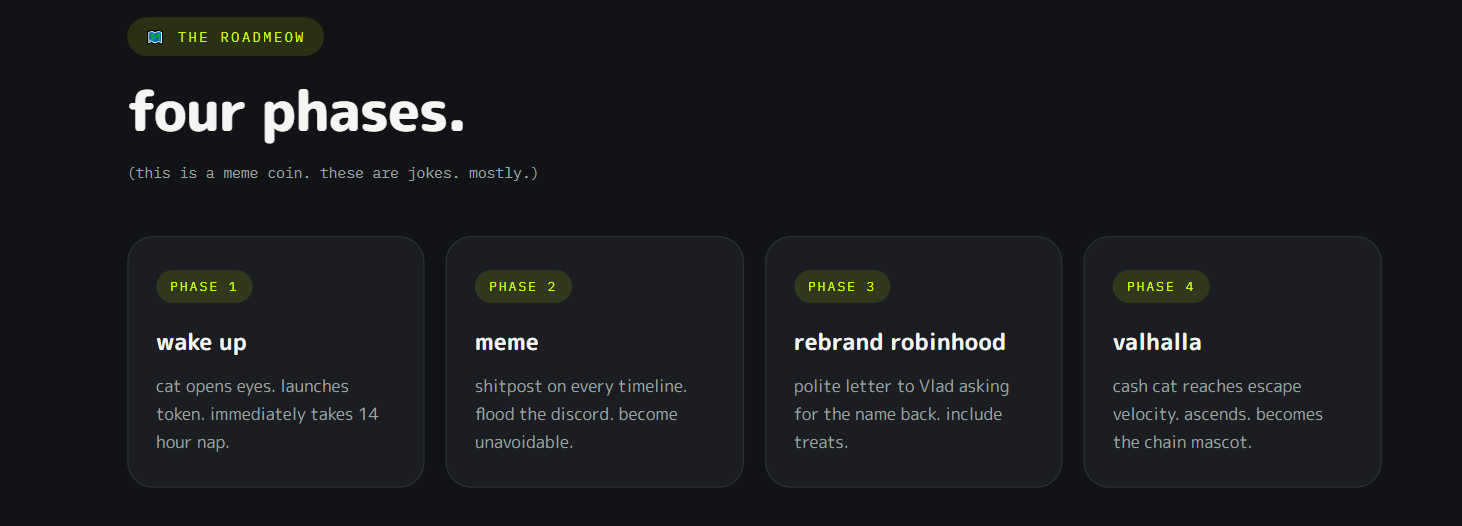
The project itself labels these as jokes, "mostly." There's no development timeline, no listing targets, and no partnership claims attached to any phase. That's consistent with the rest of the site's tone, but it also means there's no roadmap in the conventional sense to hold the project accountable to.
What Makes CashCat Different From Other Meme Coins?
Most meme coins still try to dress up a use case — staking, governance, or a future app. CashCat doesn't. It leans on a specific, checkable piece of crypto history instead of inventing utility, which at least gives it a clearer origin story than a lot of copycat tokens.
The trade-off is that there's genuinely nothing underneath the meme. No audit report is linked on the site, no team members are named, and no contract verification details are provided beyond the address itself. Readers comparing CashCat to other projects should weigh that absence directly rather than assuming a lack of information is neutral.
What Are the Main Risks to Consider?
No named team. The project describes itself only as "some people who really like cats and historical trivia." There's no way to verify who controls the contract or social accounts.
No audit disclosed. Nothing on the site links to a smart contract audit from a third-party firm.
Volatility. A meme coin with no utility depends almost entirely on ongoing attention and trading activity, which can fade quickly.
Unverifiable burn and distribution claims. The "100% in pool" and burn figures are stated by the project, not confirmed here through an independent explorer check.
Bridging risk. Moving funds onto a newer or smaller chain carries its own technical risk, separate from the token itself.
What Does the Data Say About CashCat?
The stronger signal here is transparency of tone: CashCat doesn't oversell itself, and its own FAQ discourages treating it as a serious investment. That's rarer than it should be in this part of the market.
The main concern is verification. Market cap, holder count, and burn status are all pulled from the project's own front end rather than an independent source, so none of it has been cross-checked against a blockchain explorer for this article.
The biggest unknown remains who is behind the project and whether the liquidity and supply claims match what's actually on-chain. Anyone looking closer should pull the contract address directly into a block explorer and check holder concentration before forming a view.
Conclusion
CashCat tokenomics comes down to a fixed 1 billion supply, no tax, a liquidity pool the project says is fully burned, and no presale, team allocation, or vesting schedule to track. It's a fair-launch meme coin riding a piece of crypto trivia about Robinhood's original name.
What stands out is the project's own bluntness about having no utility. What remains uncertain is everything the site doesn't publish — audit status, team identity, and independently verified distribution data. Anyone researching CashCat further should check the contract address on a block explorer and treat every figure on the project's site as a claim to verify, not a confirmed fact.
Disclaimer
This article is for informational purposes only and is not financial advice. CashCat is a high-risk meme coin with no confirmed audit or team disclosure; verify all figures independently and never invest more than you can afford to lose.







.webp)