What Is a DeFi Governance Attack? 2026 Explainer

Why DeFi Governance Attacks Matter in 2026
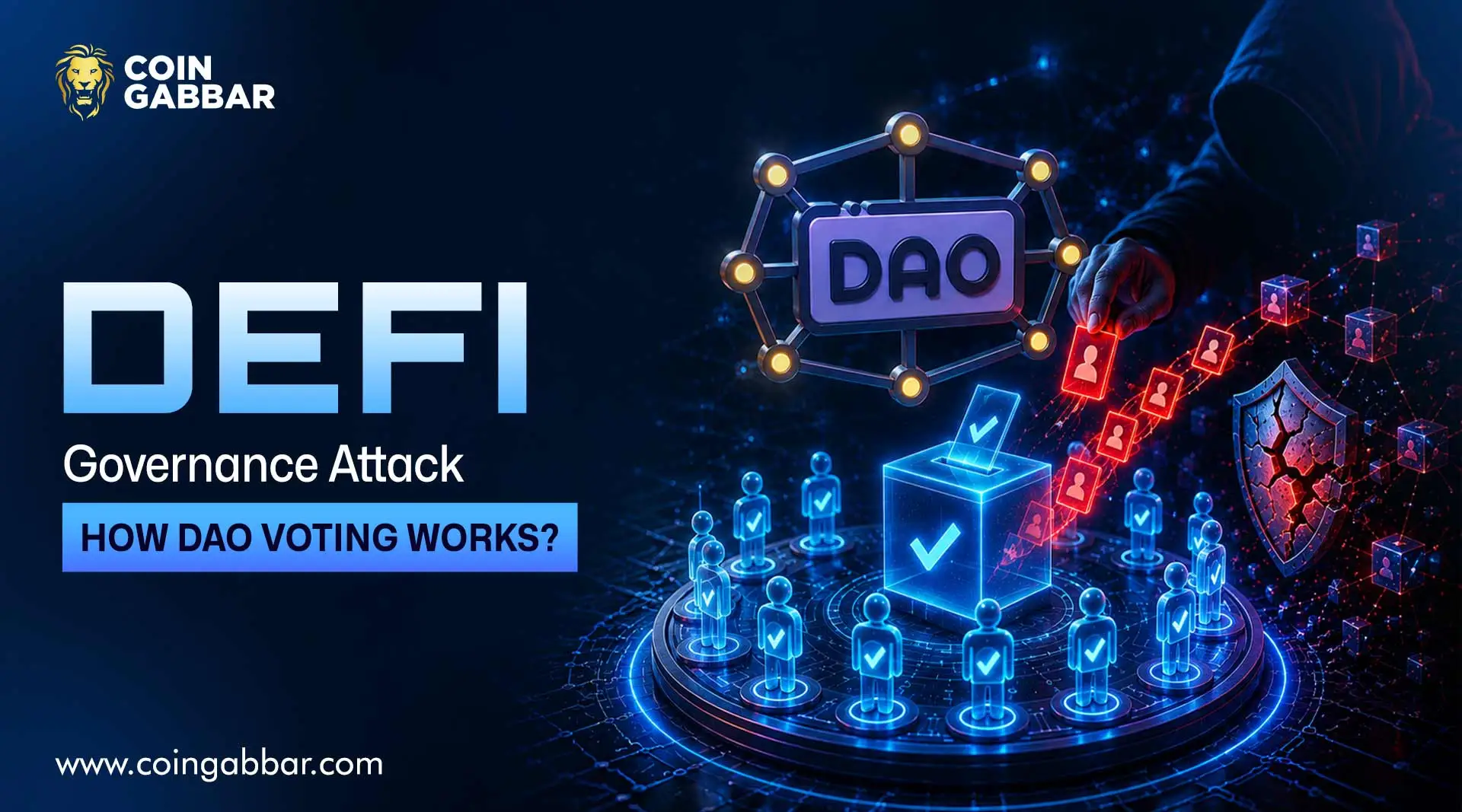
A DeFi governance attack happens when someone gathers enough voting power to push through a proposal that benefits them, not the community. It sounds simple. The damage isn't.
Most DeFi protocols hand decision-making to token holders. More tokens mean more votes. That system works fine until someone borrows or buys a huge pile of tokens for a short window, just long enough to pass a proposal that drains the treasury or hands them control.
Readers search for this topic because governance exploits keep showing up in DeFi hack reports, and the mechanics aren't obvious at first glance. This guide breaks down how a DeFi governance attack actually works, walks through two real cases, and covers what protocols are doing to stop the next one. It also flags what still needs watching if you hold governance-tokens yourself.
What Is a DeFi Governance Attack and How Does It Work?
Governance in DeFi usually runs on a simple rule: one token, one vote. Anyone holding enough governance-tokens can submit and vote on proposals.
The attack starts when someone accumulates outsized voting power. There are two common routes.
Flash loans: A flash loan lets someone borrow a large sum with no collateral, as long as they repay it within the same blockchain transaction. Attackers use these loans to buy or borrow governance-tokens, vote, and act, all in seconds.
Slow accumulation: Some attackers skip the loan and just buy up tokens over time, especially on protocols with low trading volume and thin voter turnout. If most holders don't vote, a comparatively small stake can still swing a proposal.
Either way, the goal is the same: reach the voting threshold needed to pass a proposal that moves funds, changes contract permissions, or hands control of the protocol to the attacker's wallet.
Why Do Low-Turnout DAOs Get Targeted?
Voter apathy is the quiet enabler here. Many DAOs see a small fraction of token holders actually vote on any given proposal.
If quorum is low, an attacker doesn't need majority ownership of the token supply. They just need more votes than whoever shows up.
This is why some of the most damaging governance-attacks hit smaller or mid-size protocols rather than the largest ones. Bigger protocols tend to have more active voters and stronger safeguards, though size alone is never a guarantee.
What Are Some Real Examples of Governance Attacks?
The Beanstalk Attack
Beanstalk Farms was a credit-based stablecoin protocol on Ethereum. On April 17, 2022, an attacker borrowed roughly $1 billion in flash loans from Aave and other liquidity sources. The loans let the attacker convert liquidity pool tokens into Stalk, Beanstalk's governance-token, giving them more than 67% of the protocol's voting power.
That stake was enough to trigger Beanstalk's emergency-commit function, which let a proposal skip the usual waiting period once a supermajority backed it. Two proposals, referred to as BIP-18 and BIP-19, had been submitted the day before, framed publicly as a charitable donation pitch.
Cointelegraph reported that the protocol lost its entire $182 million in collateral in the exploit. According to blockchain analytics firm Merkle Science, roughly $80 million of that ended up as attacker profit after the flash loans were repaid. Security researchers widely treat this as a clear example of a pure governance-exploit rather than a code bug: the contracts did exactly what they were built to do.
The Build Finance DAO Takeover
Build Finance DAO, a smaller venture-focused DAO, was hit in February 2022. An attacker put forward a proposal granting themselves control of the BUILD token contract, and because voter turnout was thin, there weren't enough opposing votes to stop it.
Once in control, the attacker minted and sold tokens and drained funds from liquidity pools on platforms including Balancer and Uniswap, netting an estimated $470,000 according to reporting from The Block and Decrypt. Build Finance's own team later acknowledged the DAO had technically followed its own rules, even though the outcome was clearly hostile — a reminder that "code is law" doesn't always mean fair.
Both cases show the same underlying weakness: governance-systems built for open participation can be turned against a project by whoever shows up with the most voting weight at the right moment.
How Can Protocols Prevent Governance Attacks?
There's no single fix, but several defenses have become standard practice across DeFi.
Time-locked execution- Adding a delay between a proposal passing and its taking effect gives the community time to notice and react.
Quorum requirements- Setting a minimum participation threshold makes it harder for a small group to push through changes unnoticed.
Governance-token vesting- Locking newly acquired tokens for a period reduces the value of flash-loan-based voting power.
Snapshot voting with on-chain execution checks- Separating the vote count from instant execution adds a review step.
Multisig oversight- Some DAOs keep a trusted multisig wallet as a backstop for emergency actions, trading some decentralization for safety.
None of these remove risk completely. Each one is a trade-off between speed, decentralization, and security.
What Does the Data Say About Governance Risk?
The stronger signal is that flash-loan-enabled governance attacks have become less common since 2022, as more protocols added time locks after Beanstalk's exploit became a widely cited case study.
The main concern is quieter: low-turnout DAOs remain exposed regardless of flash loans, because slow token accumulation doesn't need a single dramatic transaction to work.
The data suggests governance token distribution matters as much as the voting mechanism itself. A protocol with a small number of large holders carries more concentration risk than one with broad, active participation.
The biggest unknown remains how newer governance-models, including delegated voting and reputation-based systems, will hold up once they face a determined attacker. Readers should check a project's quorum rules, time-lock settings, and recent voter turnout before assuming its governance is safe.
What Should Users Watch in DeFi Governance in 2026?
Not every DeFi user interacts with governance-directly, but anyone holding a governance token or using a protocol's treasury-backed features is exposed to this risk indirectly.
Checking whether a protocol has a time lock, an active voter base, and a documented incident history takes a few minutes and can raise red flags before a hack happens, not after.
Conclusion
A DeFi governance attack turns a protocol's own decision-making process into its weak point. The Beanstalk and Build Finance DAO cases show two different paths to the same result: an attacker with enough voting power at the right moment can move a treasury or seize control, sometimes without breaking a single rule on paper.
Time locks, quorum thresholds, and active voter participation are the main defenses protocols now lean on. None of them make governance attack-proof. Readers should treat a project's governance-setup as part of their own research, not a background detail, and verify time-lock and quorum settings directly from the project's documentation rather than assuming they exist.
Disclaimer
This article is for educational purposes only and is not financial advice. DeFi protocols carry smart contract, governance, and market risks, and readers should do their own research before interacting with any protocol.










.webp)




