SEC Approves Franklin Templeton to Use BENJI in Mutual Funds and ETFs

SEC Approves Franklin Templeton's BENJI Fund Request
The SEC approves Franklin Templeton's request to bring its tokenized money market fund into the firm's own mutual-funds and ETFs. The SEC's Division of Investment Management issued a no-action letter on August 12, 2026.
Clearing a custody hurdle that had kept Franklin's conventional registered funds from directly holding shares of the Franklin-OnChain U.S. Government Money Fund, known by its token name BENJI.
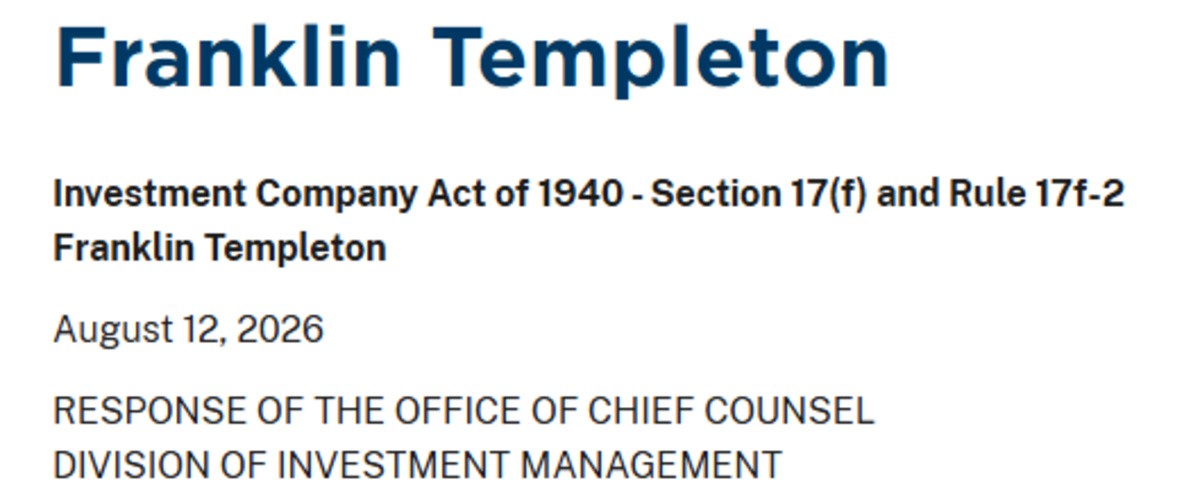
Source: Official SEC Report
What the SEC No-Action Letter Actually Confirms
Headlines say the SEC approves Franklin Templeton, but the letter itself is narrower than that. A no-action letter is not formal Commission approval. It is a staff position stating that SEC-enforcement staff will not recommend action against Franklin under the specific facts described in the letter.
The SEC was direct about this limit, noting the letter reflects a staff enforcement posture only and does not represent a legal conclusion by the Commission.
What it does confirm is real and specific. Franklin Templeton Investor Services (FTIS), the firm's affiliated transfer agent, can now act as custodian for Franklin's registered funds holding BENJI shares without meeting three physical-custody provisions of Rule 17f-2 under the Investment Company Act of 1940.
Those provisions were written for certificated-securities stored in a vault, a format that does not fit blockchain-recorded fund shares.
Why Franklin Templeton Needed This Relief
Rule 17f-2 exists to protect fund shareholders when a fund's own affiliate controls custody of its assets. Since FTIS is an affiliate of Franklin's-fund complex, any BENJI-holdings by Franklin's own funds counted as self-custody, triggering the rule's strict physical-safekeeping requirements.
Franklin-leaned on a 1992 precedent involving its own adjustable-rate securities-fund, where the SEC-allowed similar relief for an affiliated master-feeder structure using book-entry records instead of physical certificates. The new letter extends that logic to a blockchain-based recordkeeping system.
How the Underlying Custody System Works
Component | Function |
Integrated System | FTIS's proprietary recordkeeping combining internal book-entry data with public blockchain records |
Private keys | Held and secured by FTIS using multi-signature and multi-party computation controls |
Administrative Controls | Let FTIS freeze, correct, or migrate wallet records if a private key is compromised |
Independent verification | Fund accountants perform at least three yearly checks, two unannounced, against FTIS's records |
Because FTIS retains full administrative authority over the blockchain-recorded data, the SEC treated the arrangement as functionally similar to a traditional affiliated transfer-agent custody setup, rather than an unsupervised crypto holding.
What Changes for ETFs and Mutual Funds
With this relief in place, Franklin's-boards can now approve individual funds using BENJI-shares for two main purposes:
Cash management: parking idle fund-cash in BENJI instead of conventional money market vehicles, aiming for hourly NAV pricing and intraday trading
Securities-lending collateral using BENJI-shares as collateral in lending transactions, in place of cash
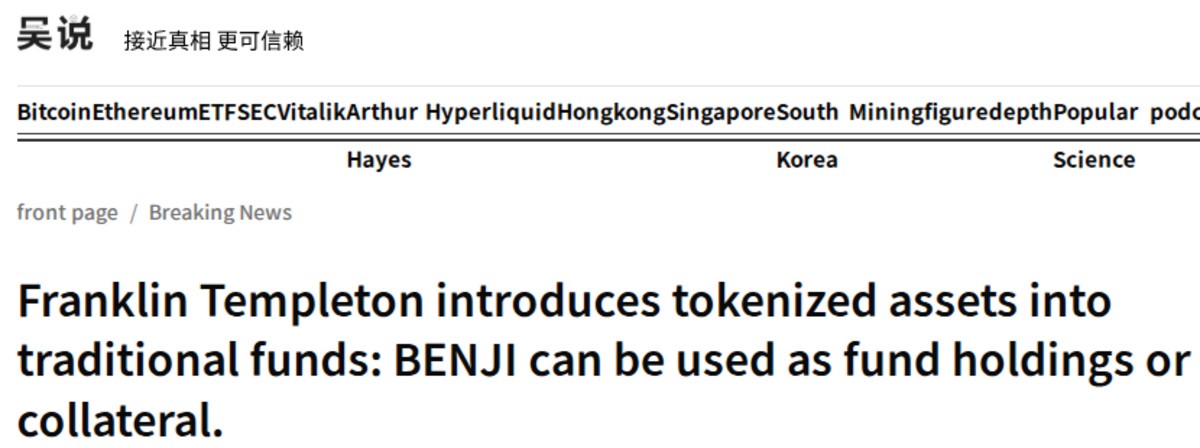
Source: WuBlockchain Report
SEC Approves Franklin Templeton's Wider Tokenization Push
This letter fits into a broader pattern of Franklin-building real-world use cases for BENJI beyond its own fund complex:
BENJI is used as off-exchange collateral for institutional clients trading on Binance, live since February 2026
Franklin integrated BENJI into MoonPay Trade for on-chain stablecoin-to-BENJI swaps
A separate integration brought BENJI onto Kraken's parent platform, Payward, for collateral and cash-management use
Franklin-plans to develop additional tokenized products designed to serve as cash or collateral across its fund lineup
Glossary
No-action letter: A statement from SEC staff saying they won't recommend enforcement action under specific described facts.
Rule 17f-2: A custody rule under the Investment Company Act governing how affiliated custodians may hold fund-securities.
BENJI- The blockchain token representing shares of Franklin's OnChain U.S. Government Money Fund (FOBXX).
Transfer agent: A regulated entity that maintains the official record of fund-share ownership.
Conclusion
The SEC approves Franklin Templeton's custody structure for BENJI, but shareholders and reporters should read that as staff-level enforcement relief, not a blanket commission endorsement of tokenized-funds.
Still, the practical effect is significant: Franklin now has a clear regulatory path to embed its blockchain-based money market fund inside conventional mutual funds and ETFs, a structure other asset managers exploring tokenization will likely study closely.
YMYL Disclaimer: This article is for informational purposes only and does not constitute investment, legal, or financial advice. Regulatory relief described here reflects SEC staff positions as of publication and may be subject to change. Readers should consult official filings and a licensed financial advisor before making investment decisions.
Also read:









