YeBlock News: Yeex Exchange Fee Split Favors YBT Token Holders

YeBlock News: New Yeex Exchange Sends Most Fees Back To Its Token
This YeBlock news update centers on a revenue chart, not a launch date. According to an official X post published on August 22, 2026, the company is adding a new ecosystem module called Yeex, a digital asset exchange. YBT will serve as the Yeex platform token and connect into YeBlock's RWA tokenization trading system.
The post did not confirm a launch date. What it did confirm is a full breakdown of how every dollar in Yeex trading fees will be split, and that split is the real story in this YeBlock news release.
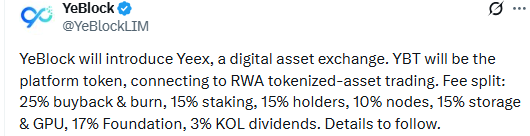
Source: Official X Post
The Full Yeex Fee Split
Per the official notice, Yeex trading fees will be divided across seven categories, totaling 100 percent:
Allocation | Share | Purpose |
YBT buyback and burn | 25% | Reduces circulating YBT supply |
YeBlock Foundation | 17% | Funds ongoing ecosystem development |
Staking ecosystem | 15% | Rewards YBT stakers |
YBT holders | 15% | Direct distribution to holders |
Storage and GPU leasing | 15% | Covers compute and storage costs |
Nodes | 10% | Rewards node operators |
KOL dividends | 3% | Paid to KOL account holdings |
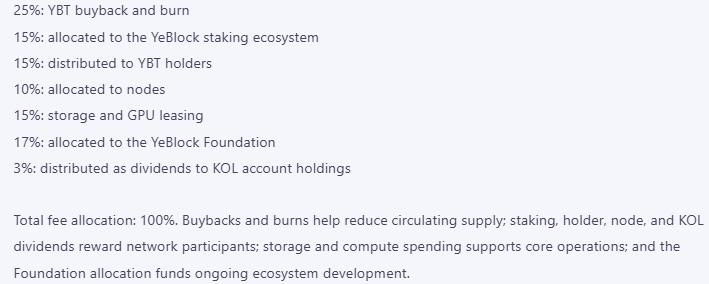
Source: Official Announcement
The Pattern Behind The Percentages
Most coverage of a fee split stops at the raw list. Grouped by function, the split in this YeBlock news release points somewhere specific.
Direct token economics (55%): buyback and burn, staking rewards, and holder distributions combined take more than half of every fee dollar.
Infrastructure costs (25%): nodes plus storage and GPU leasing cover the operational side of running the exchange.
Growth funding (17%): the foundation allocation, earmarked for ecosystem development.
Incentive payouts (3%): KOL dividends, the smallest slice.
That grouping shows more than half of Yeex's fee revenue is engineered to flow back toward YBT itself, either by shrinking supply through burns or by paying token holders and stakers directly, rather than covering the exchange's own operating costs or growth fund.
Why This YeBlock News Matters For YBT
A fee model that commits 40 percent of revenue toward buyback-and-burn plus direct holder payouts, on top of another 15 percent for staking, ties Yeex's success closely with YBT's own token economics.
If trading volume on Yeex grows, that growth carries a built-in mechanical link back to YBT supply and holder rewards, rather than only benefiting the exchange operator.
The RWA tokenization link adds another layer to this YeBlock news development. Connecting Yeex with real-world asset trading gives the exchange a use case beyond typical crypto pairs, positioning YBT as the settlement token for that category as well.
What Wasn't Announced
The official notice was specific about fee percentages but left out several operational details:
No exact launch date for Yeex
No published trading pairs or asset list
No confirmed fee currency or minimum trade size
No timeline for the RWA tokenization integration
Further implementation details would follow in future official announcements, the notice said.
How This Revenue Model Compares
Most centralized exchanges route the bulk of trading revenue toward the company operating margin or a general treasury, with token incentives, when they exist, treated as a smaller add-on.
The design outlined in this YeBlock news announcement inverts that pattern: infrastructure and growth funding together take just 42 percent, while direct token-focused allocations claim the majority.
That structure looks closer to decentralized fee-sharing models built around a native asset than to a typical centralized order book, even though the notice has not specified whether Yeex will operate as a centralized or decentralized platform.
Expert Take
A published revenue split before a launch date is unusual sequencing, and it signals that YeBlock wants the tokenomics story told first. Whether the 55 percent token-economics allocation translates into meaningful buyback and reward volume depends entirely on Yeex actually generating trading activity once it launches, something this update does not yet address.
Conclusion
This YeBlock news release is less about a product launch and more about a token-economics commitment made ahead of one. More than half of Yeex's planned fee revenue is designed to flow back into YBT through burns, staking, and holder payouts, a structure that will only be tested once trading actually begins.
The timing also follows closely on the heels of YeBlock's private sale, which closed its opening round with a sold-out allocation just a day before this announcement, adding fresh fundraising momentum to the project's expanding roadmap.
YMYL Disclaimer: This article is for informational and educational purposes only and does not constitute financial or investment advice. Cryptocurrency markets are volatile and carry risk. Always do your own research before making any investment decisions.









