Can Politicians Bet on Their Races? What US Election Betting Bill Says
US Election Betting Bill Would Fine Candidates for Trading Own Races
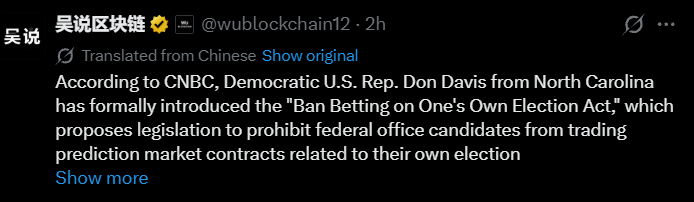
Rep. Don Davis, a North Carolina Democrat, has introduced a US election betting bill that would stop federal candidates from trading on their own races. In today's crypto news and policy updates, the move matters because the 2026 midterms are less than a month away.
The bill follows a Kalshi penalty for his Republican opponent, Laurie Buckhout. The big question for readers is simple: what would this proposal change for candidates and prediction market users?
At a Glance
-
No Betting on Your Own Race Act
-
Sponsor: Rep. Don Davis, D-N.C.
-
Target: Federal candidates trading contracts tied to their own elections
-
Penalty: $10,000 or three times the net gain, whichever is larger
-
Trigger: Buckhout's Kalshi penalty and three-year suspension
-
Status: Introduced, but unlikely to take effect before the midterms
What Does the New US Election Prediction Market Bill Propose?
The US election prediction market rules would bar candidates for federal office from trading event contracts linked to their own campaigns. An event contract is a market where people trade on whether something will happen, such as a candidate winning a race.
Anyone caught would face a fine of at least $10,000. If three times the net gain from the trade is higher, that larger amount applies instead.
Davis compared the idea to sports. He said athletes should not bet on their own games, and candidates should follow the same rule. The goal is to stop candidates from profiting on races where they have a personal stake.
Source: CNBC reporting on the bill, published October 5, 2026.
| Detail | What Readers Need to Know |
| Bill | No Betting on Your Own Race Act |
| Sponsor | Rep. Don Davis, D-N.C. |
| Applies to | Candidates for federal office |
| Targeted activity | Trading contracts on their own election |
| Penalty | $10,000 or three times net gain, whichever is higher |
| Main concern | Conflict of interest and insider information |
| Status | Introduced in the House |
Why Did Don Davis Introduce the Bill After the Kalshi Controversy?
The trigger was the Laurie Buckhout Kalshi penalty. Buckhout, who is running against Davis in North Carolina's 1st Congressional District, traded contracts tied to her own candidacy. Kalshi settled with her in August, fined her just under $2,600, and suspended her for three years.
Buckhout admitted, "I bet on myself," and called it a mistake. Davis later called the trades a breach of public trust. The case has now fed a wider debate over whether candidates should be allowed anywhere near these markets.
How Would the Bill Change Prediction Market Rules for US Candidates?
Platforms already police this behavior on their own. They worry about insider trading, so they ban or suspend users who trade on their own races.
The Don Davis prediction market rules would turn that platform policy into federal law. That changes the stakes. A platform can remove an account. A federal law brings a legal fine tied to the size of the trade. The bill covers only federal candidates and only contracts about their own elections.
Source: Wu Blockchain
What Existing US Prediction Market Rules Already Cover
In April, the Senate approved a resolution that bans senators and their staff from trading on prediction markets. Kalshi and Polymarket both praised that step.
However, the resolution does not cover non-incumbent candidates running for the CLARITY Act Senate vote. The House has not passed a similar ban either, though resolutions have been proposed. That leaves a gap between sitting lawmakers and people seeking office. Davis aims to close it.
Can the US Election Crypto Bill Become Law Before the 2026 Midterms?
Very unlikely. Davis introduced the measure during a pro forma House session, which is a brief meeting where no major business happens. Congress will not meet again until after the midterm elections.
Introducing this act is only the first step. It still needs committee review, votes in both chambers, and a presidential signature. For this reason, the US election crypto bill has little to no chance of applying to the current cycle.
Timeline: US Election Prediction Market Bill
| Date | Development |
| April 2026 | Senate approves ban on trading by senators and staff |
| August 2026 | Kalshi penalizes and suspends Buckhout |
| October 5, 2026 | Davis introduces the candidate-focused bill |
| October 2026 | Midterms approach with political markets in focus |
| After midterms | Congress returns and can consider the proposal |
What this Could Mean for Prediction Markets and Election Traders
For everyday users, the bill is narrow. It does not ban prediction market election betting in general. It only targets candidates trading on their own races.
The core issue is information. A candidate may know things about a campaign that ordinary traders do not. That edge could hurt market fairness. The proposal could also push platforms like Kalshi and Polymarket to tighten how they handle candidate accounts, which fits the wider debate on prediction market regulation 2026.
Remember that nothing has changed legally yet. The act has only been introduced, so US candidates' prediction market trading remains governed by platform rules for now. Those are the same Kalshi election betting rules that led to the Buckhout penalty.
Conclusion
Rep. Davis wants a federal ban on candidates trading their own election contracts, backed by a $10,000 or three times net gain fine. The Buckhout case prompted it. The Act will likely miss the 2026 cycle, but it could shape future rules for political prediction crypto markets and the people running for office.
Disclaimer: This article is for informational purposes only and is not financial or legal advice. Crypto assets and prediction market contracts carry high risk, including the loss of your entire investment. Rules can change quickly, so verify the current legal status and do your own research before you trade.









