AI and Gaming Nexus Singapore 2026: Major Event Highlights

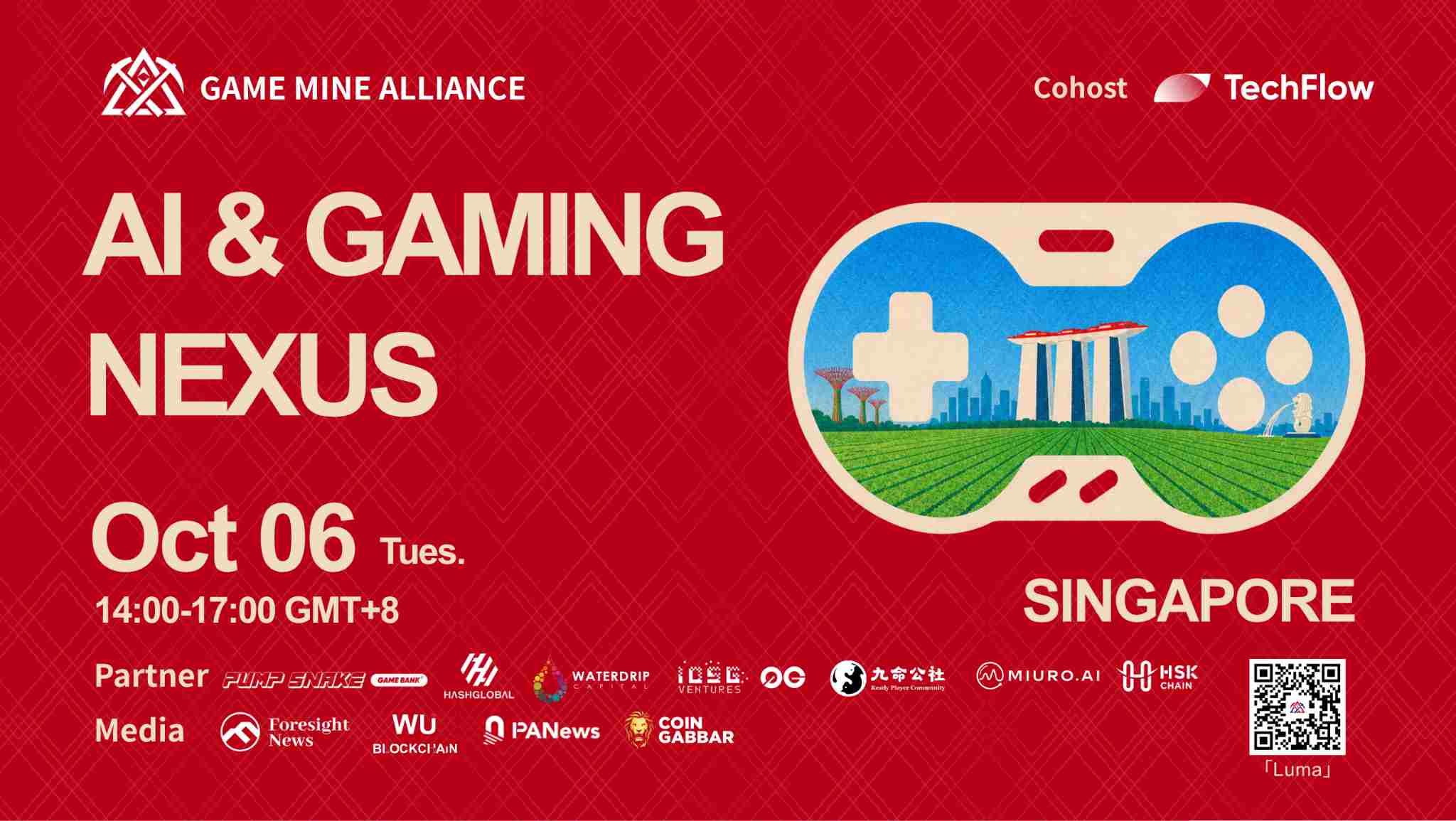
On October 6, Game Mine Alliance (GMA) hosted AI & Gaming Nexus in Singapore, bringing together professionals from AI, gaming, Web3, investment, and entrepreneurship to explore how AI is reshaping game development, player experiences, and business models.
The event received over 600 online registrations and was supported by partners including PumpSnake, the9bit, 0G, Waterdrip Capital, IOSG, AZverse, Miuro.AI, Cddjap, and Bifire Investment, as well as media partners Foresight News, TechFlow, and PANews.
GMA is a DAO focused on Web3 gaming and AI. It continues to develop the gaming ecosystem through in-depth collaboration with high-quality games and projects across the industry value chain.
The event featured two roundtable discussions: “Game Investment in the AI Era: After the Bubble” and “How Projects Survive in the AI Era.” From investment logic and product experiences to community building and economic models, the speakers shared a common view: AI is significantly lowering the barriers to game development and content production, but the real competition in gaming still comes down to playability, user retention, distribution efficiency, and long-term relationships.
After the Bubble: Game Investment Returns to Fundamentals
Over the past few cycles, Web3 gaming gained momentum through powerful narratives, token models, and high valuations. Yet many projects struggled to translate that attention into sustainable products and business models.
During the discussion, speakers noted that enthusiasm around “AI + gaming” cannot replace the need to answer fundamental questions: What value does a product create for users? Will users continue to engage with it? Can the project build a sustainable revenue model?
AI’s most immediate impact is cost reduction. Work that once required dozens of people may now be completed by a much smaller team with AI support. But greater supply does not necessarily mean greater demand. Players still have limited time, and attention remains scarce.
As a result, the focus for AI-era gaming projects is shifting from “Can it be made?” to “Is it worth continuing to play?” Gameplay, retention, community, publishing, and distribution are becoming even more important.
AI Is More Than a Tool It Could Become a New Kind of Game Participant
The discussion on project survival in the AI era went beyond production efficiency to examine how AI may reshape game experiences and economic relationships.
Today, AI’s role in gaming is still largely tool-oriented: supporting development, improving art and code production, generating content, and reducing testing and operational costs. But speakers also suggested that AI’s potential goes further.
In the future, AI NPCs may no longer be fixed-script characters. They could become long-term companions that interact and collaborate with players. Players may train their own AI characters, develop their abilities, and have them participate in missions, competitions, or in-game economic activities.
This shift could change the player’s role from consumer to participant in creation, production, community collaboration, and value distribution. Through the combination of AI and Web3, in-game assets, time investment, and community relationships may become more deeply connected over time.
From Content Abundance to Relationship Scarcity
The two roundtables ultimately converged on a broader question: when AI makes content easier to produce, what becomes truly scarce?
The answer may not be more content, but more meaningful relationships.
For gaming projects, defensibility is no longer only about technology. It is also about whether players choose to stay, whether creators want to co-create, whether communities can build trust, and whether the business model responds to real user needs.
AI can improve productivity, but it cannot automatically create playability, community recognition, or long-term operating capability.
AI & Gaming Nexus will continue connecting builders, creators, and investors across AI, gaming, and Web3. As technology evolves rapidly, the industry must keep returning to its most fundamental question: how can we build products that people genuinely want to play, stay with, and help shape together?