Crypto Presales Ethereum 2026: Mainnet & Layer 2 Tokens

Explore Ethereum crypto presales in 2026, including Mainnet and Layer 2 token projects. Compare ecosystem fit, Ethereum integration, smart contracts, and upcoming token sales.

Best crypto presales 2026

Crypto Presales Ethereum 2026

Apeing Presale Stage 9 APEING Token Price and Audit Details
Apeing $APEING
MEME Coin Ethereum
Smart Contract
Verified
Accepts USDT, ETH
ConConAI presale CON token AI crypto project review
ConConAI $CON
Artificial Intelligence Ethereum
Smart Contract
Verified
Accepts USDT, ETH
Kingz Casino Presale $KINGZ Casino Token and Staking Platform
Kingz Casino $KINGZ
Gaming Ethereum
Smart Contract
Verified
Accepts USDT, ETH, SOL
Ciforus presale token sale details and project overview
Ciforus $CIFORUS
Blockchain Ethereum
Smart Contract
Verified
Accepts USDT, USDC
Maxi Doge Presale MAXI DOGE token chart showing 50-stage price ladder
Maxi Doge $MAXI
MEME Coin Ethereum
Smart Contract
Verified
Accepts USDT, USDC
Key Takeaways
  • This page highlights crypto presales with a meaningful connection to the Ethereum ecosystem.

  • Each project is reviewed for its network, token standard, smart contract relevance, and Ethereum integration.

  • Product development and ecosystem utility are considered when evaluating Ethereum-focused projects.

  • Ethereum mainnet projects are distinguished from projects that are only broadly compatible with EVM networks.


Presale Risk Notice
  • Crypto presales involve high risks and are not a recommendation to buy, sell, or invest.
  • CoinGabbar's research is based on publicly available project information and may change as new data becomes available.
  • Always verify the latest project details, presale terms, and official links on the project's official website before making any decision.

Apeing ($APEING) – MEME Coin Powered Ecosystem

Last Updated:
Apeing Presale Stage 9 APEING Token Price and Audit Details
Apeing $APEING

Apeing ($APEING) is an Ethereum-based meme coin presale that combines community-driven growth with crypto meme culture. The project aims to reward early supporters through a multi-stage token sale while focusing on transparency and security.

Token Information

By CoinGabbar Research
Apeing Token Information
Token Name Apeing
Token Symbol $APEING
Presale Stage Stage 11
Audit Completed
Presale Price $0.00085
Total Supply 16750000000
Start Date Sep 08, 2026
Ethereum Ecosystem Fit Native
Ethereum Integration Strong
Contract Address
0x16558C58DfC7641C2b0cAa9EF9B5A188202e0F0E

Official Project Screenshot

Apeing official website screenshot

Apeing (APEING) Crypto Presale Overview

Apeing (APEING) is an ERC-20 meme coin on Ethereum that combines community rewards, staking tiers and stage-by-stage token burns. Its presale follows a 33-stage pricing model, with token prices increasing as the project advances through its planned rounds. The ecosystem includes the Ape Referral League, monthly Ape Wars contests and four staking tiers. The published original supply is 16.75 billion APEING tokens, with 40% allocated to the presale and 30% reserved for staking rewards.

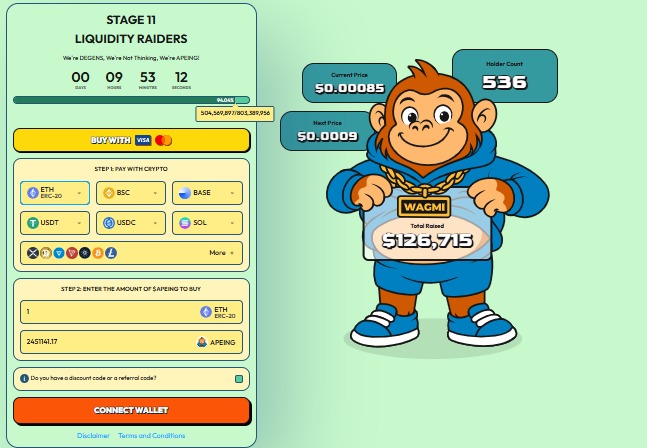
As of November 10, 2026, the official checkout snapshot advertises Stage 11 – Liquidity Raiders, with a reported presale price of $0.00085 per APEING and a planned next-stage price of $0.0009. The dashboard shows 94.04% progress alongside a token counter of 504,569,897 out of 803,389,956. These counter values equal approximately 62.81%, so the displayed percentage may represent a different stage metric. The figures are project-reported and require clarification.

The published Ethereum contract address is 0x16558C58DfC7641C2b0cAa9EF9B5A188202e0F0E. Apeing references reviews from Coinsult, SpyWolf and SCRL, while SCRL also reports identity verification covering one individual. The roadmap targets a decentralized exchange launch in Q1 2027, but the exact APEING listing date, opening price and token claim schedule remain independently unconfirmed.

Why This Presale Is Featured

Apeing provides a published Ethereum token contract, a 33-stage presale model, defined token allocations and community incentive programs. The latest supplied checkout snapshot identifies Stage 11, Liquidity Raiders, following Stage 10, Rug Survivors. Its reported current price is $0.00085, compared with the planned $0.0009 price for Stage 12. The project also publishes three security review references, an unsold-token burn policy and four staking tiers advertising annual reward rates from 10% to 85%. However, future liquidity, reward sustainability, lock enforcement and exchange listing arrangements still require independent verification.

Apeing Presale Pros and Cons

Pros Cons
  • ✓ Published Ethereum ERC-20 contract
  • ✓ Three security review references: Coinsult, SpyWolf and SCRL
  • ✓ SCRL identity certificate covering one individual
  • ✓ Published token supply and allocation breakdown
  • ✓ Four staking tiers, referral rewards and Ape Wars competitions
  • ✕ High meme coin price volatility and uncertain future demand
  • ✕ Audit reports do not cover every platform or financial risk
  • ✕ Identity screening covers one individual only
  • ✕ Staking rewards and buyer incentives do not guarantee profit
  • ✕ Conflicting proposed listing prices and unverified liquidity lock
  • ✕ Dashboard progress percentage does not match the displayed token-counter ratio
Pro Tip

Check the burn transactions after each presale stage instead of relying only on the displayed supply. Compare the four staking tiers and their claim waiting periods before choosing a purchase amount. Also confirm the 18-month liquidity lock after launch.

ConConAI ($CON) – Artificial Intelligence Powered Ecosystem

Last Updated:
ConConAI presale CON token AI crypto project review
ConConAI $CON

The ConConAI presale has ended. CON claims are open, Uniswap v4 trading is live, and effective supply is 60M after two burns. Verify contracts and liquidity.

Token Information

By CoinGabbar Research
ConConAI Token Information
Token Name ConConAI
Token Symbol $CON
Presale Stage Presale end
Audit Completed
Presale Price $0.008
Total Supply 80000000
Start Date Aug 01, 2026
Ethereum Ecosystem Fit Development
Ethereum Integration Strong
Contract Address
0xaf24b07427be0e0D49F3Cd117202BFE121CADaa5

Official Project Screenshot

ConConAI official website screenshot

ConConAI Presale Completed: CON Claim, Tokenomics and Listing Update

ConConAI (CON) is an Ethereum-based AI commerce project developing specialist advisors for shopping, travel, property, entertainment and other consumer decisions. Its ERC-20 utility token is intended for partner listings, paid placements and performance-based fees across the advisor network.

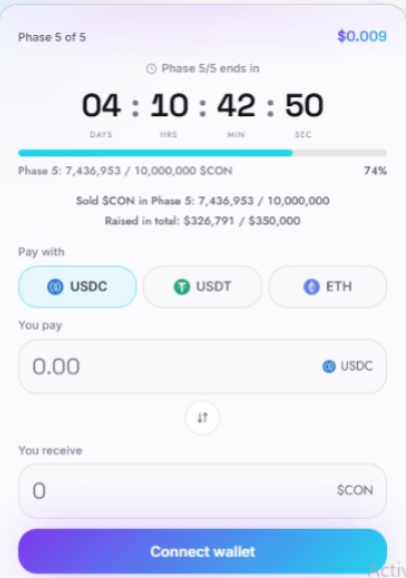
The ConConAI presale has ended after five historical sale phases priced from $0.005 to $0.009. The issuer reports that CON token claiming opened on November 6, 2026, at 22:00 UTC, alongside the launch of an official CON/ETH pool on Uniswap v4. The project no longer sells tokens directly. The former $0.01 launch reference is not a live price or a price guarantee.

Eligible presale participants should use the official CON claim portal with their original purchase wallet and verify their claimable allocation. Ethereum network gas is paid in ETH. Claims, swaps and token prices are different activities: an open claim portal does not guarantee that every wallet is eligible or that a trade will execute at a quoted price.

Why ConConAI Remains Featured After Its Presale

This completed crypto presale remains relevant for research because the project has published its AI commerce use case, token allocations, Ethereum contracts, a SolidProof assessment and public links for its token claim, DEX pool and liquidity lock. Its specialist advisor websites provide evidence of product development, but sustained user activity and paid commercial adoption still require independent verification.

Research tip: Verify the token address and the separate claim-contract address before connecting a wallet. The presale is closed; historical phase prices, a live DEX quote, an eligible claim and a planned CEX listing are not interchangeable.

ConConAI Token Claim: Pros and Cons

✔ Pros ✖ Cons
  • ✓ Defined AI commerce use case and specialist advisor websites
  • ✓ Five sale phases completed, with official claim access open
  • ✓ ERC-20 token and separate claim-contract addresses disclosed
  • ✓ SolidProof assessment published for project contracts, with exact audit scope subject to verification
  • ✓ Both 20M burns, official DEX pool and UNCX lock referenced publicly
  • ✕ Presale is closed; no new direct purchases from the issuer
  • ✕ Token-audit completion and report scope need reconciliation
  • ✕ Trading price, slippage and liquidity can change rapidly; a lock does not remove market risk
  • ✕ Monthly burns and future CEX listings are plans, not completed events
  • ✕ Partner payments, sustained CON demand and business revenue are not independently established
Pro Tip

Do not send funds to any old presale payment address or a social-media claim link. Compare both contract addresses with the official token page . A completed presale, scheduled claim, proposed token burn and planned DEX pool are four different milestones.

Kingz Casino ($KINGZ) – Gaming Powered Ecosystem

Last Updated:
Kingz Casino Presale $KINGZ Casino Token and Staking Platform
Kingz Casino $KINGZ

Kingz Casino (KINGZ) is an Ethereum-based gaming token with NFT benefits and staking rewards. It plans to share 12.5% of casino profits through weekly USDC payouts to eligible stakers.

Token Information

By CoinGabbar Research
Kingz Casino Token Information
Token Name Kingz Casino
Token Symbol $KINGZ
Presale Stage Phase 2
Audit Completed
Presale Price $0.03
Total Supply 1000000000
Start Date Feb 15, 2026
Ethereum Ecosystem Fit Native
Ethereum Integration Strong
Contract Address
0x7016F537CfBC5fC3078f3FeD35d24415889c5EA2

Official Project Screenshot

Kingz Casino official website screenshot

Kingz Casino (KINGZ) Crypto Presale Overview

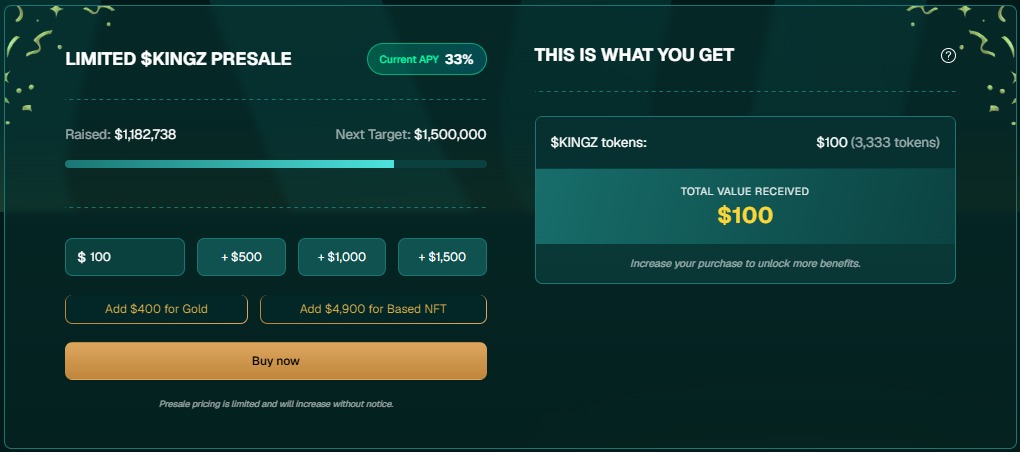
Kingz Casino (KINGZ) is an Ethereum-based crypto casino project combining online gaming, NFT benefits, and token staking. Its ERC-20 KINGZ token has a fixed supply of 1 billion, with 15% allocated to the public presale and 25% reserved for liquidity. The project plans to distribute 12.5% of casino profits to eligible token stakers through weekly USDC rewards. These payments are proposed benefits, not confirmed guaranteed income. The platform also offers NFT membership tiers and advertised casino cashback benefits linked to different purchase packages.

The Kingz Casino presale features purchase tiers ranging from $500 for Gold to $15,000 for Legend, with advertised cashback rates between 4% and 30%. Its earlier 60-day staking campaign, which allocated 9 million KINGZ tokens, is marked as completed. The roadmap includes DEX liquidity, recurring USDC profit distributions, governance features, and a mobile application. SolidProof provides token audit and KYC records, but its assessment identifies an unresolved medium-severity trading restriction concern. The current fundraising total, token generation event date, and liquidity lock status remain unverified in the reviewed information.

Why Kingz Casino Presale Is Featured

KINGZ is included for review because it offers a casino-linked token model with published supply allocations, NFT benefits, and a proposed profit-sharing system. The availability of SolidProof security documentation supports further research, although its reported contract findings, future payout plans, and unverified liquidity require careful assessment.

Pro Tip: Before joining KINGZ, check published casino profit reports rather than relying on projected USDC rewards. The initial staking campaign has ended, while weekly profit-sharing payouts remain a roadmap milestone. Review SolidProof's trading restriction finding and verify token liquidity before purchasing.

Kingz Casino Presale Pros and Cons

✔ Pros ✖ Cons
  • ✓ Published fixed token supply and allocation
  • ✓ SolidProof token audit and KYC records available
  • ✓ Casino platform reported as launched
  • ✓ Defined weekly USDC profit-sharing proposal
  • ✓ NFT membership tiers and cashback benefits disclosed
  • ✕ Medium-severity audit finding remains unresolved
  • ✕ Contract ownership has not been renounced
  • ✕ Weekly USDC rewards are not verified as active
  • ✕ DEX liquidity and token lock status are unverified
  • ✕ Casino revenue and gambling regulations create risks
Pro Tip

Check the actual casino profit reports before valuing KINGZ's weekly reward claims. The early 60-day staking campaign is marked finished, while revenue-sharing payouts are on the roadmap. Also review SolidProof's unresolved transfer restriction finding and the owner's control over trading before purchasing.

Ciforus ($CIFORUS) – Blockchain Powered Ecosystem

Last Updated:
Ciforus presale token sale details and project overview
Ciforus $CIFORUS

CIFORUS is an Ethereum-based utility token presale linked to the live Ciforus privacy app. It offers a fixed token supply, stage-based pricing, public audit reports, and a verified smart contract.

Token Information

By CoinGabbar Research
Ciforus Token Information
Token Name Ciforus
Token Symbol $CIFORUS
Presale Stage Stage 2
Audit Completed
Presale Price $0.035
Total Supply 100000000
Start Date May 13, 2026
Ethereum Ecosystem Fit Native
Ethereum Integration Strong
Contract Address
0x2D125Cba88516832AE1CDc1d39211fC259182c60

Official Project Screenshot

Ciforus official website screenshot

CIFORUS Presale Overview

CIFORUS is an Ethereum-based ERC-20 utility token linked to the live Ciforus privacy platform. The project focuses on secure digital communication, encrypted storage, wallet messaging, private notes, wallet identity, and crypto payment tools. Its token supports planned platform access, subscription discounts, ecosystem rewards, and payments. CIFORUS has a fixed supply of 100 million tokens, with 35% allocated to the presale.

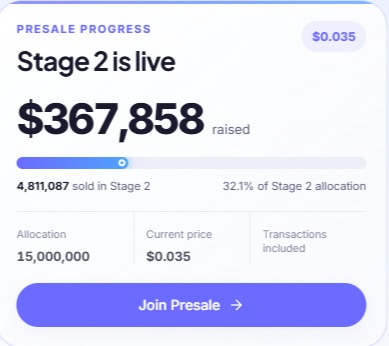
The CIFORUS crypto presale uses three pricing stages: $0.025, $0.035, and $0.05 per token. The project has published tokenomics, a development roadmap, an Ethereum smart contract, and a LexGuard audit report. The Ciforus app is already available, while further token utility and ecosystem features are planned. Users should review the official documents, smart contract, presale conditions, and potential risks before participating.

Why This Presale Is Featured

CIFORUS is included for review because it connects an Ethereum utility token to an existing privacy platform. Its documented tokenomics, public contract information, and audit materials allow users to assess the project beyond presale marketing claims.

CIFORUS Presale Pros and Cons

✔ Pros ✖ Cons
  • ✓ Live privacy application with defined features
  • ✓ ERC-20 token deployed on Ethereum Mainnet
  • ✓ Public LexGuard smart contract audit report
  • ✓ Fixed supply and published token allocation
  • ✓ Defined utility for access, discounts, and rewards
  • ✕ Early-stage token with limited trading history
  • ✕ Future utility depends on platform adoption
  • ✕ Public team transparency needs further review
  • ✕ Post-launch liquidity is not yet established
  • ✕ Token value remains exposed to market risks
Pro Tip

Before joining the CIFORUS presale, verify the Ethereum contract address on Etherscan and review the LexGuard audit report. Check the current sale stage, token claim rules, and official project updates. A public audit does not remove investment or smart contract risks.

Maxi Doge ($MAXI) – MEME Coin Powered Ecosystem

Last Updated:
Maxi Doge Presale MAXI DOGE token chart showing 50-stage price ladder
Maxi Doge $MAXI

Maxi Doge is a meme coin featuring a muscular Doge mascot. It blends gym culture, high-leverage trading memes, and community-driven hype, reflecting the bold spirit of risk-taking crypto traders.

Token Information

By CoinGabbar Research
Maxi Doge Token Information
Token Name Maxi Doge
Token Symbol $MAXI
Presale Stage Final Stage
Audit Completed
Presale Price $0.00028490
Total Supply 150250000000
Start Date Jul 30, 2025
Ethereum Ecosystem Fit Native
Ethereum Integration Strong
Contract Address
0x96fAE80c694748c2fD9AB456CD7023eB41183550

Official Project Screenshot

Maxi Doge official website screenshot

Maxi Doge (MAXI) Crypto Presale Overview

The Maxi Doge presale is an Ethereum-based meme coin offering built around trading culture, community activities and token staking. Its ERC-20 token, MAXI, has a published supply of 150.24 billion tokens. The project plans to use MAXI for staking rewards, trading competitions and community incentives, while future exchange listings and partnerships remain subject to development and market conditions.

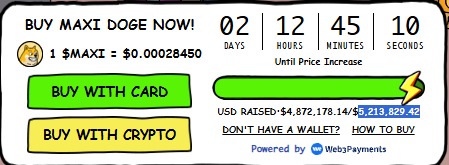
The latest project-reported update for November 2026 quoted a MAXI presale price of $0.00028490, with $4,886,038.86 raised toward a displayed funding target of $5,228,224.53. This represents approximately 93.45% of the stated target. These figures may change as the token sale continues and should not be treated as independently verified live blockchain totals.

The project originally advertised a starting price of $0.00025 per MAXI. Its purchase interface supports cryptocurrency and card payment options, while the token sale operates through staged pricing. A countdown indicates when the next price increase is expected, but it does not confirm the presale closing date or token listing date.

Maxi Doge's published tokenomics allocate 40% of supply to marketing, 25% to the Maxi Fund, 15% to development, 15% to liquidity and 5% to staking. The project also identifies SolidProof and Coinsult as smart-contract audit providers. Buyers should verify the original reports, current contract information and claim conditions before participating.

Despite its community-driven approach, MAXI remains a speculative crypto asset. Staking rewards, planned competitions and future trading access do not guarantee token demand, exchange liquidity or positive investment returns.

Why This Presale Is Featured

Maxi Doge is included for review because it combines a published token allocation model with a staged meme coin presale and a staking-based community reward system. Its November 2026 fundraising update provides information about reported sale progress, while the project roadmap outlines future trading contests, partnerships and exchange ambitions. These details offer a basis for research, although fundraising figures, security claims and future development milestones require independent verification.

The project is designed around speculative trading culture rather than a conventional payment, lending or business-revenue model. Its future token value will depend on market demand, distribution, liquidity and community activity. An advertised staking APY or a rising presale price should not be interpreted as proof of future profitability.

MAXI Presale Pros and Cons

The following comparison highlights published project features alongside the risks that buyers should consider before evaluating the Maxi Doge token sale.

✔ Pros ✖ Cons
  • ✓ Ethereum-based ERC-20 token with published supply details
  • ✓ Defined tokenomics covering marketing, development, liquidity and staking
  • ✓ Project-reported fundraising progress and staged presale pricing
  • ✓ Staking interface and token reward model advertised
  • ✓ SolidProof and Coinsult security assessments reported by the project
  • ✓ Community competition plans and published development roadmap
  • ✕ Public identification and independent verification of the core team remain limited
  • ✕ Large 40% marketing allocation may create distribution and governance concerns
  • ✕ Dynamic staking APY does not guarantee stable rewards or investment profits
  • ✕ Exact TGE, token claim schedule and exchange listing dates remain unconfirmed
  • ✕ Token liquidity and market price after launch are uncertain
  • ✕ Full audit scope and deployed-contract verification require further review
  • ✕ Meme coin demand may depend heavily on promotion and speculative interest
Pro Tip

Before buying MAXI, compare the official Ethereum contract address with the SolidProof audit and check the latest whitepaper. Review the staking APY, claim rules, and token release schedule. Also check the 40% marketing allocation and confirm any exchange listing directly with the exchange. A public audit does not guarantee investment safety or future returns.

Crypto Presales Ethereum Compared

Crypto Presales Ethereum compared
# Project Ticker Stage Current Price Total Supply Audit Ethereum Ecosystem Fit Ethereum Integration Action
1 Apeing presale Apeing $APEING Stage 11 $0.00085 16750000000 Completed Native Strong View Details
2 ConConAI presale ConConAI $CON Presale end $0.008 80000000 Completed Development Strong View Details
3 Kingz Casino presale Kingz Casino $KINGZ Phase 2 $0.03 1000000000 Completed Native Strong View Details
4 Ciforus presale Ciforus $CIFORUS Stage 2 $0.035 100000000 Completed Native Strong View Details
5 Maxi Doge presale Maxi Doge $MAXI Final Stage $0.00028490 150250000000 Completed Native Strong View Details

Ethereum Crypto Presales: Explore Top Ethereum Presale Projects

Ethereum crypto presales can involve tokens issued directly on Ethereum Mainnet, projects built on Ethereum Layer 2 networks, or applications connected to the wider Ethereum ecosystem. These projects may offer early token sales for DeFi services, financial tools, blockchain infrastructure, gaming platforms, and other Web3 applications.

The blockchain connection matters. An Ethereum token presale may use an ERC-20 token on Mainnet, while another project may issue its token on an Ethereum Layer 2. Some sales also accept ETH but deliver tokens on a different network. These arrangements are not the same and may affect wallet setup, transaction fees, and token access.

CoinGabbar compares projects through Ethereum Ecosystem Fit and Ethereum Integration. The first shows the project's relationship with Ethereum. The second explains how the project uses Ethereum technology in its product, token, or infrastructure.

Browse new and upcoming Ethereum crypto presales, check their network details, and review available contract information. For token sales across different blockchains, explore our crypto presale list.

Ethereum Mainnet vs Layer 2 vs EVM-Compatible Presales

Two presales may both describe themselves as Ethereum-related even when their tokens operate on different networks. Understanding the difference can help readers check the correct contract, wallet network, fees, and token distribution process.

Ethereum Mainnet Presales

Ethereum Mainnet is the primary Ethereum blockchain. Projects may deploy ERC-20 tokens and smart contracts directly on Mainnet. Transactions on this network use ETH for gas fees, and their costs can change with network activity.

Ethereum Layer 2 Presales

Ethereum Layer 2 networks process transactions outside Mainnet while using Ethereum for settlement or security under their respective designs. These networks can offer lower transaction costs, but deposits, withdrawals, bridges, and other network features may differ.

A project launching on a Layer 2 should identify the specific network. Readers should verify where its token is issued and whether any movement between Mainnet and the Layer 2 is required.

Ethereum Ecosystem Projects

Some applications connect to Ethereum through smart contracts, liquidity services, wallets, or other integrations without operating entirely on Mainnet. The project should explain which features use Ethereum and whether those connections are already available.

EVM-Compatible Projects

The Ethereum Virtual Machine, or EVM, supports the execution of Ethereum-style smart contracts. Other blockchains can also use EVM technology. Therefore, EVM compatibility alone does not prove that a token is issued on Ethereum or that the project belongs to the Ethereum ecosystem.

An EVM-only project should not be presented as a native Ethereum presale without supporting deployment or integration evidence.

How to Identify the Best Ethereum Crypto Presales?

Identifying Ethereum crypto presales for research starts with confirming where the token and application actually operate. The next step is understanding how the project uses Ethereum and whether its claimed features have been delivered.

Confirm the Token's Deployment Network

Start with the project's official contract information. A token issued on Ethereum Mainnet differs from one deployed on a Layer 2 or an independent EVM-compatible blockchain. Check the network name and contract address before comparing projects.

Check Ethereum Integration

Find out whether Ethereum is central to the application or only a planned addition. A live integration may support payments, smart-contract functions, decentralized applications, or other product features. Planned integrations should be identified separately from working ones.

Review the Smart Contract

When a contract is deployed, inspect its address through the explorer for the correct network. Published source-code verification can make a contract easier to review, but it is not the same as an independent security audit.

Understand the ERC-20 Token Structure

ERC-20 defines common functions for fungible tokens, such as transfers, balances, supply information, and token allowances. Projects may add other functions or controls. Review relevant contract details and tokenomics before drawing conclusions about the token.

Examine the Project's Actual Ethereum Use

Ask why the product uses Ethereum. It may depend on decentralized finance applications, token payments, smart contracts, or another network function. The project should clearly explain how Ethereum helps deliver its service.

Compare Development With Published Plans

Check which Ethereum features are live, under development, or still planned. A deployed token does not prove that every feature described in a project's roadmap is available.

How CoinGabbar Chooses Ethereum Crypto Presales

CoinGabbar examines the relationship between each presale project and Ethereum. The assessment distinguishes where a project operates from how deeply Ethereum technology is integrated into its product.

Ethereum Ecosystem Fit and Ethereum Integration are the two primary evaluation metrics. Additional technical information provides context for the project's network structure, token deployment, and development claims.

Evaluation Metric What CoinGabbar Checks What We Look For
Ethereum Ecosystem Fit Mainnet deployment, Layer 2 network, wider ecosystem connection, or EVM compatibility A clearly established relationship with Ethereum rather than an unsupported blockchain label
Ethereum Integration Native deployment, working integrations, planned features, and actual use of Ethereum technology Evidence explaining how Ethereum supports the project's token, application, or services
Token and Contract Information Token network, contract address, ERC-20 functionality where applicable, and available explorer information Identifiable on-chain information consistent with the project's official disclosures
Smart Contract Controls Available information about administrative permissions, upgradeability, and other contract controls Clear disclosures about important permissions and contract behavior
Layer 2 Relationship Named Layer 2 network, Ethereum settlement relationship, and relevant bridge information Evidence of the stated Ethereum connection and an understandable network arrangement
Development Evidence Published contract deployments, product availability, technical documents, and development updates Information that separates working Ethereum functionality from future plans

Ethereum Ecosystem Fit describes the relationship with the network, using Mainnet, L2, Ecosystem, or EVM where applicable. Ethereum Integration describes whether the relevant connection is Native, Integrated, Planned, or Limited.

An EVM classification alone should not establish eligibility for this Ethereum-focused page. Projects must have a meaningful Ethereum relationship supported by the available evidence. Where important information cannot be confirmed, it should be marked Not Disclosed.

These categories explain a project's technical relationship with Ethereum. They are not security certifications or guarantees of token performance.

How an Ethereum Token Presale Works: From Payment to Claim

Participating in an Ethereum-related token sale may involve several steps, and these steps are not identical for every project. The network used to make a payment may differ from the network where the purchased tokens are eventually distributed.

1. Confirm the Sale Network

Identify the blockchain used by the presale and the network where the token will be issued. Check both details against the project's current official instructions.

2. Review the Payment Transaction

A presale may accept ETH or supported ERC-20 tokens such as stablecoins. Depending on the sale contract, the wallet may need a token allowance before the payment can proceed.

3. Check Gas Fees and Wallet Permissions

Ethereum transactions require gas, while token-based payments may involve a separate approval transaction. The actual cost depends on the network and transaction requirements. Inspect wallet prompts before signing.

4. Understand Token Distribution

Some projects distribute tokens after the sale. Others require a claim transaction at TGE or according to a vesting schedule. Check the project's stated distribution process and whether another network or bridge is involved.

5. Verify the Received Token

After distribution, confirm the token's network and contract address using official sources. A token with the same name or symbol on another network should not automatically be treated as the same asset.

Important Ethereum Presale Checks Before Connecting a Wallet

Ethereum token sales may involve wallet signatures, token approvals, contract interactions, and network switching. These steps deserve careful attention because an incorrect approval or transaction can expose funds to risk.

  • Official Website: Confirm the sale domain through the project's trusted channels before connecting a wallet.
  • Correct Network: Check whether the sale operates on Mainnet, a named Layer 2, or another blockchain.
  • Contract Address: Compare addresses against official documentation and the correct network explorer.
  • Wallet Approval: Review the amount and contract receiving any token-spending allowance.
  • Gas Cost: Check estimated transaction fees before approving a payment or token claim.
  • Token Distribution: Confirm whether purchased tokens arrive automatically or require a later claim.
  • Bridge Requirements: Understand any additional transfers needed between Ethereum Mainnet and another network.

Contract verification and transparent team information are separate research factors. For a wider view of these checks, readers can explore CoinGabbar's crypto presale verification research.

How to Use This Ethereum Crypto Presale List

Start with the comparison table to identify the project's Ethereum Ecosystem Fit. This helps show whether it operates on Mainnet, a Layer 2, or through another meaningful ecosystem connection.

Next, review Ethereum Integration to see whether the project's use of Ethereum is native, already integrated, planned, or limited. Open the project profile to review its stated blockchain, contract information, product, and technical evidence.

These categories are designed for research and comparison. They should not be treated as recommendations to participate in any specific token sale.

Risks and Downsides of Ethereum Crypto Presales

Ethereum provides established infrastructure for tokens and decentralized applications, but crypto presales still carry significant risks. The risks can also differ between Mainnet, Layer 2 networks, and other Ethereum-related systems.

  • Smart Contract Risk: Token and presale contracts may contain vulnerabilities, unexpected functions, or administrative permissions.
  • Network Fee Risk: Ethereum Mainnet gas fees can increase during periods of high demand, raising the cost of payments or claims.
  • Layer 2 Risk: Some networks depend on sequencers, bridges, upgrade mechanisms, or other components that create additional operational risks.
  • Cross-Chain Risk: Moving tokens between networks may involve bridge contracts, delays, or transfer errors.
  • Token Approval Risk: Giving a contract permission to spend tokens can expose assets if the contract or connected service is unsafe.
  • Upgrade and Control Risk: Certain smart contracts may be upgradeable or contain administrative functions that affect how they operate.
  • Liquidity Risk: A token may launch without enough trading liquidity, making it difficult to sell at an expected price.
  • Project Execution Risk: A deployed token does not guarantee that the team will complete its planned product or maintain its services.

Being associated with Ethereum does not guarantee security, project success, an exchange listing, token demand, or investment returns.

Frequently Asked Questions (FAQ)

FAQ Got any doubts? Get In Touch With Us

Ethereum crypto presales are early token sales for projects connected to Ethereum, including projects operating on Ethereum Mainnet or relevant Ethereum ecosystem networks.

CoinGabbar reviews blockchain information, Ethereum ecosystem fit, project integration, smart-contract relevance, and development information to assess whether a project has a meaningful Ethereum connection.

Ethereum ecosystem fit describes how closely a project operates within or integrates with Ethereum. This can include Ethereum Mainnet, Ethereum Layer 2 networks, or other meaningful ecosystem connections.

Smart-contract relevance describes how important Ethereum-based smart contracts are to the project's token, product, or ecosystem. The role can vary between projects.