Legit Crypto Presales 2026: How to Check Audit, KYC & Contract Status
Searching for legit crypto presales usually returns lists that treat a badge as proof. This page shows what can be verified for each listed presale, including audit, smart contract, team, and KYC evidence, and it marks what can’t.
The presales are not ranked, and a “verified” label never means a presale is safe or will succeed.
This page focuses on crypto presales with publicly available evidence supporting their transparency and verification.
Each project is checked for audit information, smart contract verification, and available security details.
Team transparency, KYC information, and other verification signals are reviewed when publicly available.
Missing audits or verification details are clearly identified instead of being treated as proof that a project is safe.
Presale Risk Notice
Crypto presales involve high risks and are not a recommendation to buy, sell, or invest.
CoinGabbar's research is based on publicly available project information and may change as new data becomes available.
Always verify the latest project details, presale terms, and official links on the project's official website before making any decision.
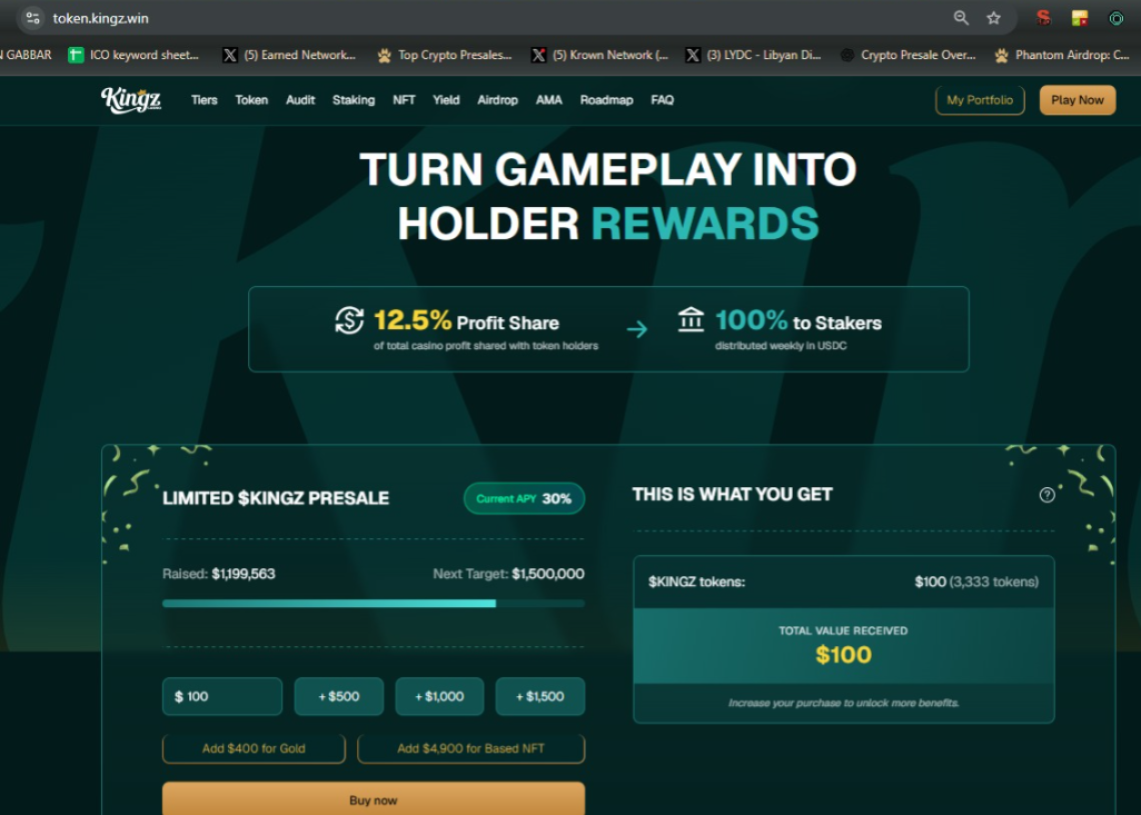
Kingz Casino ($KINGZ) – Gaming Powered Ecosystem
Last Updated:
Kingz Casino$KINGZ
Kingz Casino (KINGZ) is an Ethereum-based gaming token with NFT benefits and staking rewards. It plans to share 12.5% of casino profits through weekly USDC payouts to eligible stakers.
The Kingz Casino presale is an Ethereum-based crypto casino project featuring token staking and NFT membership. Its ERC-20 token has a published supply of 1 billion KINGZ, with 15% allocated to the presale and 25% to liquidity.
The project proposes distributing 12.5% of casino profits through USDC rewards. Actual payouts and liquidity locks remain unverified.
Why This Presale Is Featured
Kingz Casino is featured for conditional review in Legit Crypto Presales based on its published audit, team KYC records and smart contract disclosures.
Category
Evaluation Metric
Assessment
Legit Crypto Presales
Smart Contract Audit
Completed — SolidProof.
Legit Crypto Presales
Team KYC
Available — SolidProof records.
Legit Crypto Presales
Contract Verification
ERC-20 contract disclosed; full matching pending.
Security Assessment
Audit Findings
One unresolved medium-severity trading restriction issue.
Security Assessment
Contract Ownership
Not renounced.
Kingz Casino Presale Pros and Cons
Pros
Cons
Published SolidProof audit.
Available team KYC records.
Published tokenomics.
Defined staking model.
Pending medium-severity finding.
Retained contract ownership.
Unverified liquidity lock.
Unconfirmed USDC payouts.
Editorial Note: Audit and KYC evidence support security research but do not guarantee project legitimacy or investment safety.
Pro Tip
Check the actual casino profit reports before valuing KINGZ's weekly reward claims. The early 60-day staking campaign is marked finished, while revenue-sharing payouts are on the roadmap. Also review SolidProof's unresolved transfer restriction finding and the owner's control over trading before purchasing.
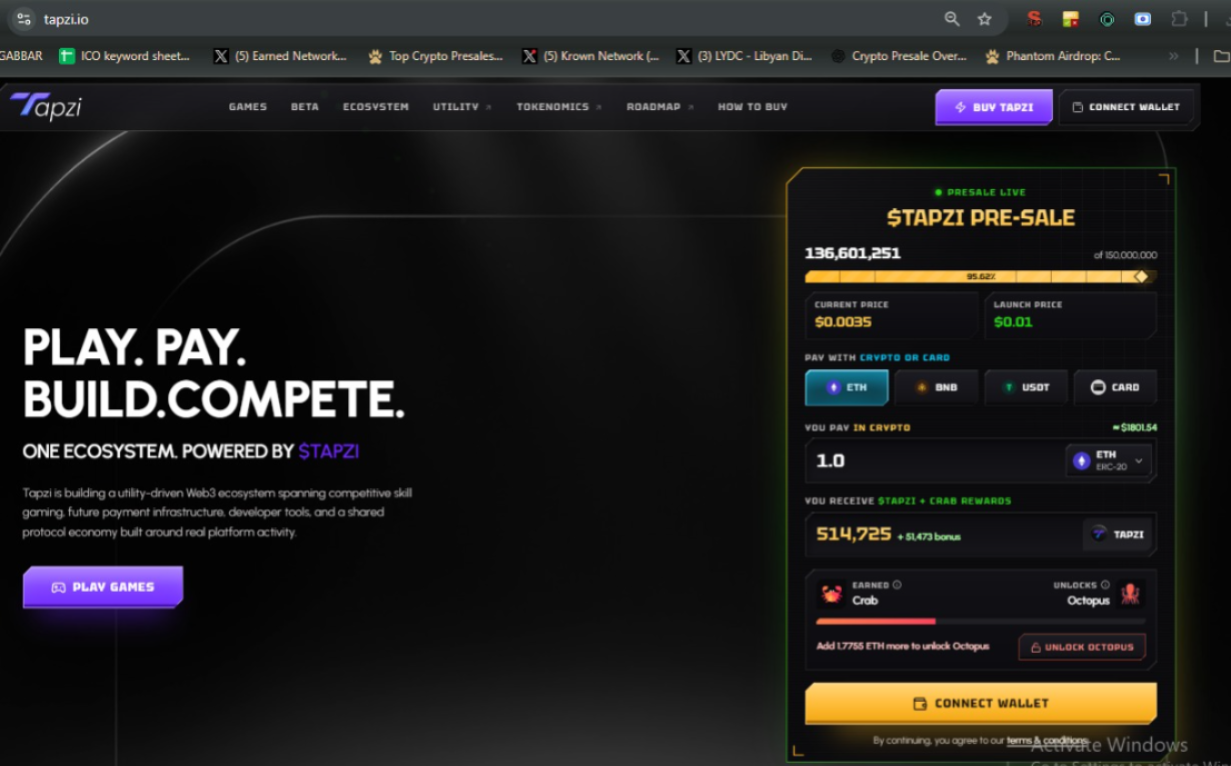
Tapzi ($TAPZI) – Gaming Powered Ecosystem
Last Updated:
Tapzi$TAPZI
Tapzi (TAPZI) is a BNB Chain skill-gaming presale with a $0.0035 advertised price, $17.5M indicative entry valuation and published token unlock and vesting schedules.
Tapzi (TAPZI) is a BNB Smart Chain gaming project developing skill-based games, tournaments and blockchain rewards. Its wider ecosystem includes planned payment tools and developer infrastructure.
Tapzi Presale: Price, Tokenomics and Launch
The Tapzi presale advertises a price of $0.0035 per token. With a fixed supply of 5 billion TAPZI, its indicative Entry Valuation is $17.5 million.
At the planned $0.01 launch price, published token unlocks imply a $14.875 million modeled launch valuation. The project previously reported a $20 million initial market cap. These figures require reconciliation, as unlocked supply may differ from circulating supply.
Why Tapzi Presale Is Featured for Research
Tapzi is shortlisted for its published tokenomics, detailed vesting schedule, reported gaming beta and third-party security assessment. Launch valuation and future liquidity remain key risks.
Metric
What We Searched
What We Found
Valuation
Entry FDV and TGE Market Cap
$17.5M entry FDV and $14.875M modeled launch valuation. The older $20M estimate requires reconciliation.
Token Utility
Gaming and ecosystem use cases
Skill-based games, tournaments and planned developer tools.
Tokenomics
Supply and vesting
5B supply, 20% presale allocation and 25% presale unlock at TGE.
Smart Contract
Audit and team KYC
SolidProof token contract assessment and team KYC listing.
Development
Product and roadmap
Public gaming beta reported. Payment and developer tools remain planned.
Liquidity
Launch liquidity
20% liquidity allocation. Actual deployment remains unconfirmed.
Tapzi Presale Pros and Cons
✓ Pros
✕ Cons
✓ Calculable $17.5M entry FDV
✓ Published TGE unlock schedule
✓ Defined skill-gaming utility
✓ Reported public gaming beta
✓ SolidProof token contract audit
✓ Third-party team KYC listing
✕ Conflicting launch valuations
✕ Inconsistent presale progress
✕ Contract ownership not renounced
✕ 75% of presale tokens unlock later
✕ Unproven sustained player adoption
✕ Unconfirmed listing and liquidity
Pro Tip
Compare Tapzi's $17.5M entry FDV with its published TGE unlock schedule. Explore the gaming beta, check liquidity plans and review the difference between its reported and modeled launch valuations.
Remittix (RTX) – Blockchain Powered Ecosystem
Last Updated:
RemittixRTX
Remittix (RTX) is an Ethereum-based PayFi project focused on cross-border payments and crypto-to-fiat transfers. The final token launch, exchange listing and claim dates remain unconfirmed.
Remittix Presale 2026: RTX Price and PayFi Overview
The Remittix presale is an Ethereum-based crypto project focused on PayFi, cross-border payments and crypto-to-fiat transfers. Its ERC-20 token, RTX, has a published total supply of 1.5 billion tokens. The project ecosystem includes a crypto wallet, payment services, trading features and a proposed Earn program.
As of November 25, 2026, the reported RTX presale price is $0.3500, with a stated launch price of $0.46. The project displays $1,778,888 remaining until launch. The revised launch schedule and exchange trading dates remain unconfirmed.
Why This Presale Is Featured
Remittix is featured for provisional review in Best Crypto Presales to Buy and Legit Crypto Presales based on its calculated valuation metrics, published security assessment and Ethereum token disclosures. Final category approval depends on verification of the supporting financial and security data.
Category
Evaluation Metric
Assessment
Best Crypto Presales to Buy
Entry Valuation
$525 Million FDV — calculated using the $0.35 presale price and 1.5 billion RTX supply.
Best Crypto Presales to Buy
TGE Market Cap
$345 Million (Projected) — based on the stated $0.46 launch price and self-reported circulating supply of 750 million RTX.
Legit Crypto Presales
Smart Contract Audit
Published CertiK token contract assessment.
Legit Crypto Presales
KYC Verification
Official KYC confirmation required.
Legit Crypto Presales
Contract Verification
Ethereum ERC-20 token. Audit and deployed contract addresses require matching.
Project Fundamentals
Token Utility
PayFi, cross-border payments, governance and ecosystem rewards.
Project Fundamentals
Tokenomics
1.5 billion RTX total supply, with an initial FDV of $690 million at the stated launch price.
Project Fundamentals
Development
Wallet development, PayFi testing, fiat currency expansion and a proposed Earn program.
Project Fundamentals
Fundraising Progress
Project dashboard reports $1,778,888 remaining until launch.
Revised launch and listing dates remain uncertain.
Liquidity and token unlock risks remain.
Advertised Earn yields involve financial risks.
Editorial Note: Valuation figures are calculated from published and project-reported data. TGE market cap is a projection, not an observed market value. Category inclusion supports research and comparison and does not guarantee legitimacy, investment safety or future returns.
Pro Tip
Verify the Remittix contract address, CertiK audit scope and current team verification status. Check the latest RTX price, revised launch schedule and token claim terms. Reported fundraising figures do not guarantee liquidity, product adoption or investment safety.
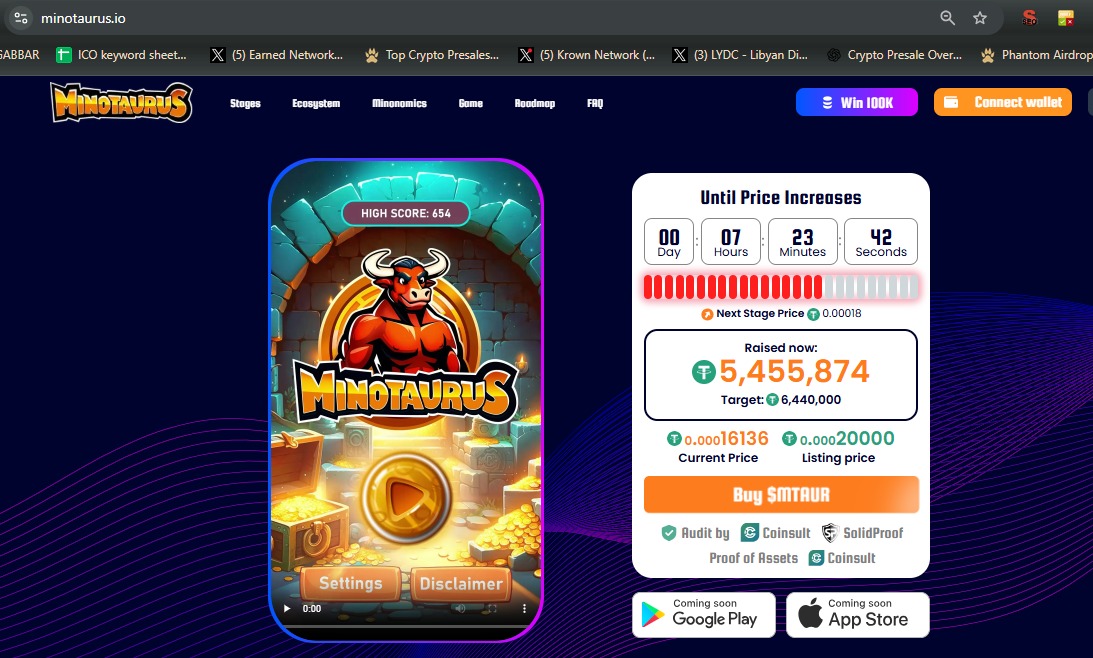
Minotaurus ($MTAUR) – Gaming Powered Ecosystem
Last Updated:
Minotaurus$MTAUR
Minotaurus (MTAUR) is a BNB Chain gaming presale with a $16.136M indicative entry valuation, a project-estimated $5.6M TGE market cap and planned maze-based gameplay.
Minotaurus (MTAUR) is a BNB Smart Chain gaming project developing a maze adventure with creature battles, character upgrades and in-game purchases. Its planned gaming economy uses MTAUR tokens.
Minotaurus Presale: Price, Tokenomics and Launch
Based on the supplied presale price of $0.00016137 and a total supply of 100 billion tokens, Minotaurus has an indicative Entry Valuation of $16.136 million. The project publishes an estimated TGE Market Cap of $5.6 million and an advertised listing price of $0.00020.
The presale accounts for 60% of the total supply. Vesting terms, the final launch date and initial trading liquidity require further clarification.
Why Minotaurus Presale Is Featured
Minotaurus is shortlisted for its published valuation metrics, tokenomics, gaming roadmap and token contract security references. However, game development and launch liquidity remain key risks.
Metric
What We Searched
What We Found
Valuation
Entry FDV and TGE Market Cap
$16.136M indicative entry FDV and $5.6M project-estimated initial market cap.
Token Utility
Gaming applications
Planned character upgrades, in-game items and special features.
Tokenomics
Supply and allocation
100B total supply, 60% presale and 10% liquidity.
Smart Contract
Audit and KYC
SolidProof assessment referenced. Anonymous team.
Vesting
Token unlock conditions
Official sources describe different vesting periods.
Development
Game and listing progress
Game development and DEX listing planned.
Minotaurus Presale Pros and Cons
✔ Pros
✖ Cons
✓Calculable entry valuation
✓Published $5.6M initial market cap estimate
✓Defined gaming token utility
✓Published tokenomics
✓Token contract audit references
✓Published development roadmap
✕Conflicting vesting information
✕High 60% presale token allocation
✕Anonymous project team
✕Finished game launch unconfirmed
✕No fixed TGE or listing date
✕Liquidity lock remains planned
Pro Tip
Compare Minotaurus's $16.136M indicative entry FDV with its project-reported $5.6M initial market cap. Check the current token price, vesting terms, launch supply and planned liquidity before participating.
Last updated: · By CoinGabbar Research · Reviewed by Anisha Dawar
Quick answer: Legit crypto presales are ones whose audit, contract, team and KYC claims can be checked against public evidence. No presale is risk-free, and a badge is not proof. Each listing on this page carries a status of Verified, Partly verified, Unverified or Conflicting. This is research, not a recommendation.
Presale risk notice: Crypto presales involve high risk and nothing on this page is a recommendation to buy, sell or invest. Our review uses public project information, which may change or be incomplete. Always verify the latest terms, contract addresses and official links on each project’s own website.
Are Crypto Presales Risky?
Yes. Crypto presales are high-risk. Buyers send funds before a token trades, often before the product exists, and there is usually no regulator, refund process or investor protection behind the sale.
Funds go first: you commit money before liquidity, a working product or tradable tokens exist.
Contract powers: a token contract can give its owner the power to mint, pause, blacklist or restrict trading.
Liquidity risk: even a genuine project can launch with thin liquidity, or a team can remove it.
Impersonation: fake sites, fake claim pages and lookalike contracts target real projects.
Legal grey areas: rules differ by country, and many presales operate outside securities-style protections.
Regulators and security firms keep warning about this. The SEC’s Investor Alert says fraudsters continue to exploit the popularity of crypto assets to lure retail investors. In an analysis reported in 2025, CertiK found that nearly half of Ethereum token launches promoted in Telegram groups between late 2023 and mid-2024 were rug-pull schemes. In a separate tally reported by Cointelegraph, at least four of 33 Solana presale projects, which together raised about 796,000 SOL, turned out to be rug pulls or scams. These figures are older and come from specific samples, so treat them as context rather than a rate for any one presale.
Verification does not remove this risk. It narrows what you do not know about a specific project.
How We Verify: What Each Signal Proves
We check public evidence across smart contract verification, audit status, team and KYC transparency, and security information. Each signal answers a narrow question.
Signal
What it can show
What it can’t show
How to check
Verified contract source
The published code matches the deployed contract
That the code is safe or fair
Block explorer “Contract” tab shows verified source
Audit report
A named reviewer examined stated code at a point in time
Safety of unaudited code, later changes, or the team’s intent
Open the report; read scope, findings and resolution status
Team KYC
A provider checked the identity of team members
That the team is competent, honest or well funded
Check the provider’s own listing, and that it names the project
Ownership and admin controls
Who can mint, pause, blacklist or change fees
How the owner will behave later
Explorer read and write functions; owner address; proxy status
Liquidity lock
Liquidity tokens cannot be withdrawn for a set period
That the team won’t sell its own tokens
Locker contract page: amount and end date
Holder distribution
How concentrated token ownership is
Intent or coordination
Explorer “Holders” tab, once tokens exist
Matching official links
Site, docs and socials agree on the address
That the site itself is authentic
Compare from the project’s verified channels
Our assessment reflects public information at the time of review. We say “Unverified” where we found no evidence, rather than treating silence as a pass.
How to Verify a Presale Step by Step
Use this checklist for any presale, including the ones listed here.
Start from verified channels. Reach the sale page from the project’s verified social profile or documentation, never from an ad, a DM or a search result alone.
Compare the contract address. Copy it from the sale page and check that it matches at least two official sources. If they differ, treat the project as Conflicting until explained.
Open it on the right explorer. Confirm the network (Ethereum, BNB Chain, Solana and so on) matches what the project states.
Check that the source is verified. An unverified contract hides its code from public review.
Read the admin powers. Look for an owner address, whether ownership is renounced, and any proxy (upgradeable) setup. Look for mint, pause, blacklist and trading-restriction functions.
Open the audit report itself. Note the firm, the date, the exact contracts in scope, the number of findings by severity, and whether each is resolved.
Check team and KYC claims. Find the KYC provider’s own page, and confirm it names this project and not just a similar one.
Look at liquidity and holders once tokens exist. Check the lock amount and end date, and how much supply the largest wallets hold.
Confirm the payment details. Send only the token and network the official sale accepts, to the address shown on the official site. Wrong-network transfers are usually unrecoverable.
Re-check whenever the project changes its contract, announces a new audit, or approaches its token generation event (TGE).
How to Read an Audit Finding
An audit report lists findings by severity and by what happened next. Both matter.
Severity
Typical meaning
Critical or high
Could allow loss of funds or loss of control; should be fixed before launch
Medium
Could cause harmful behavior under certain conditions, such as owner-controlled trading restrictions
Low
Limited impact or best-practice gaps
Informational
Notes and suggestions, not direct risks
Resolution
What it means
Resolved
A fix was made and re-checked by the auditor
Acknowledged
The team is aware but did not change the code
Unresolved
No fix or response is recorded
“Acknowledged” is not the same as fixed. Also check the audit date against contract changes, and confirm the reviewed contract address is the one on sale. For example, a report with one medium finding about owner-controlled trading, marked unresolved, would earn a Partly verified status even though an audit exists.
Team KYC vs Investor KYC, and KYC Token Sale Platforms
Two different things are called “KYC” in crypto presales.
Team KYC means a third-party provider checked the identity of the people behind a project. It is a transparency signal about the team.
Investor KYC means a sale platform verifies the buyers. It screens participants, and is a separate matter from team KYC.
A “KYC” tick on a project-hosted presale normally refers to team KYC, not to buyer screening. A KYC token sale platform is a service that runs the sale itself and verifies participants. Platforms reported in 2026 include:
Platform
KYC and access
Notes (as reported)
CoinList
Full KYC, plus a connected wallet
Eligibility varies by sale; some 2026 sales exclude the U.S., Canada, China and the UK
Legion
KYC and proof of address; allocations use a “Legion Score”
A $100 minimum was reported in recent sales
Sonar by Echo
KYC, wallet screening and jurisdiction rules
Coinbase acquired Echo in October 2025; some sales check US accreditation
Coinbase Token Sales
Verified Coinbase account
Reported activity varies; confirm current availability
Exchange launchpads (for example Binance Launchpad, KuCoin Spotlight, Bybit Launchpad)
Exchange KYC or sale-specific compliance steps
Rules differ by sale and region
Platform KYC can filter out some fraud and sanctions risk. It does not guarantee a project’s quality or returns. Platform availability, fees and regional rules change, so check each platform’s current terms before you rely on them.
Red Flags That Override a “Verified” Badge
Treat these as warning signs even when a listing looks well documented:
Guaranteed or “risk-free” returns
Countdown timers and limited-allocation pressure
Unsolicited messages or calls promoting a sale
Fees or “taxes” demanded before you can withdraw
A contract address that differs between the site, documentation and socials
An audit logo with no link to the actual report
Referral bonuses for recruiting other buyers
“SEC-compliant” or “regulated” claims with no proof
A sale link that reached you only through a DM or an ad
A “legit” status is a snapshot, not a permanent label. Nothing carries over from one year to the next, so a presale described as a 2027 opportunity needs its own evidence. Re-verify at each of these points:
When the contract, audit or ownership changes
When the sale ends and the TGE date is confirmed
When the claim page opens, since fake claim pages commonly appear around launches
When the token lists and liquidity is created
Check that the claim contract matches the sale contract, and that vesting and lock terms can be read on-chain, not only on a webpage.
Risks and Limits of Verification
Verification and transparency signals improve the information you have, but they cannot remove the risks of crypto presales.
Audit limitations: an audit covers only the code, scope and time the auditor reviewed.
Contract risk: a verified contract can still contain functions users do not expect.
KYC limitations: KYC confirms an identity-check process. It does not guarantee success or performance.
Team risk: a publicly identified team can still fail to deliver.
Liquidity risk: security checks do not ensure enough trading liquidity after launch.
Information risk: claims, addresses and reports can change or become outdated.
Regulatory risk: rules and restrictions differ by country and can change.
A presale described as legit, verified, trusted, safe or secure on this page is not guaranteed to be safe, successful, profitable or free from risk.
Glossary
Smart contract verification: A status showing that a block explorer has published source code matching a contract address.
Audit scope: The specific code, contracts or systems an audit reviewed.
Finding severity: The auditor’s rating of a finding, from critical to informational.
Acknowledged finding: An issue the team has seen but not fixed.
Team KYC: An identity check on the team, carried out by a third-party provider.
Investor KYC: Identity checks on buyers by a sale platform.
Ownership renounced: The owner has given up the contract’s admin controls.
Proxy (upgradeable) contract: A contract whose logic can be changed after deployment.
Mint function: A function that can create new tokens and so change supply.
Blacklist or trading restriction: A function that can block certain addresses or limit transfers.
Honeypot: A token that can be bought but not sold.
Liquidity lock: A time-lock on liquidity tokens so they cannot be withdrawn early.
Token generation event (TGE): When a project’s token is created or released under its launch plan.
Conclusion
The most useful question about a presale is not whether it is called legit, but what you can actually verify. Check the contract, read the audit scope, separate team KYC from buyer KYC, and treat a conflicting address as a stop sign. Re-verify at each stage, and use any status on this page as a starting point for your own research.
Always verify details on each project’s official website before acting.
Disclaimer: This content is for informational purposes only and is not financial, investment or legal advice. Crypto presales are high-risk, and you can lose all of your funds. Verify project information, contract addresses and local regulations before acting.
Legit crypto presales are projects that provide stronger publicly available evidence around areas such as audits, smart contract verification, team transparency, and KYC information. These signals do not remove investment risk.
CoinGabbar reviews available audit information, smart contract verification, security details, team transparency, and KYC evidence. The assessment is based on publicly available information at the time of review.
No. An audit can provide information about a project's reviewed code or security process, but it does not guarantee that a project is safe, successful, or free from future risks.
Check the contract address against the project's official website and verify the contract on the relevant blockchain explorer when verification data is available. Avoid relying only on an address shared through unofficial channels.