ApeChain Chainlink CCIP: LayerZero Exit What APE Holders Need to Know

ApeChain’s Chainlink CCIP Move: What Changes for APE and USDC?
In the ApeChain Chainlink CCIP, the team says it is working with Chainlink to strengthen its infrastructure for the future.
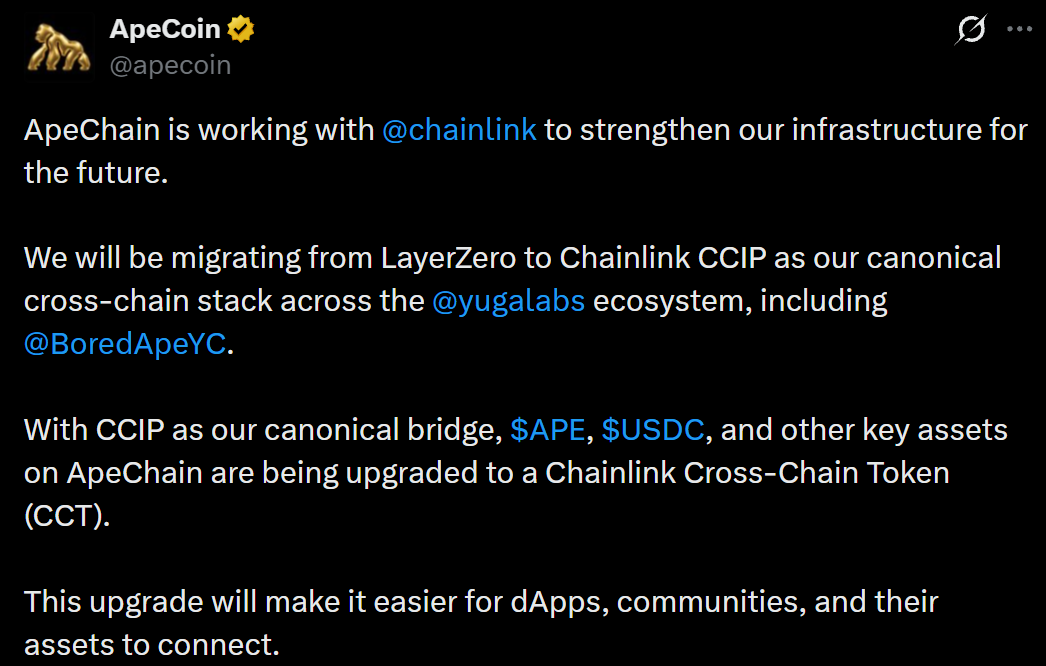
Source: ApeCoin post
It will migrate from LayerZero to CCIP as its canonical cross-chain stack, and “canonical” simply means the main, official one.
The same post says that APE, USDC, and other key assets on ApeChain are being upgraded to a Chainlink Cross-Chain Token, or CCT.
According to the post, this will make it easier for apps, communities, and their assets to connect.
The network’s post adds that ApeChain is deprecating its legacy cross-chain solution, meaning the old one is being retired.
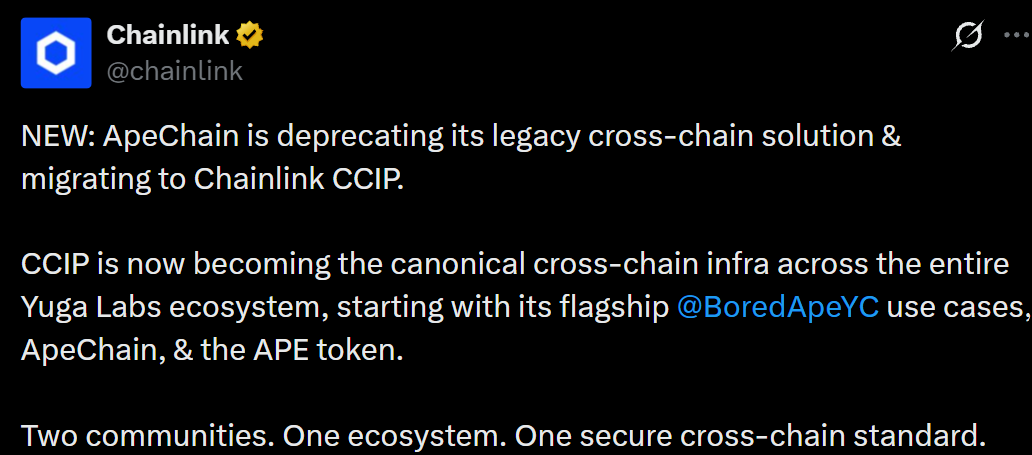
It says the new standard will cover the entire Yuga Labs ecosystem, starting with Bored Ape use cases, the chain itself, and the APE token. Its closing line calls it “one secure cross-chain standard.”
What Is Changing and What Is Not Stated
The table below separates what the posts confirm from what they leave out:
| Topic | What the posts say |
| Old system | LayerZero, described as the legacy solution |
| New system | Chainlink CCIP as the main cross-chain standard |
| Scope | Yuga Labs ecosystem, including Bored Ape Yacht Club |
| Upgraded assets | APE, USDC, and other key assets |
| Migration date | Not stated |
| Steps for holders | Not stated |
In short, the announcement explains the direction, but it gives no timeline. It also does not say whether holders must swap or move anything or what will happen to older versions.
Until more details arrive, nobody should assume extra steps.
What a Cross-Chain Token Is
The oracle network’s official documentation defines a Cross-Chain Token as an existing coin that has been registered and set up for transfers between blockchains through CCIP.
The docs say this approach was designed to solve two problems: liquidity splitting across many networks and the need for developers to have more control.
Think of it this way. When one coin exists in several different versions on different networks, trading depth gets divided.
A single standard is meant to keep one coin moving smoothly instead.
Each setup has three parts on every supported network:
| Part | Plain-English role |
| Token | The coin itself |
| Token pool | A contract that handles locking, burning, releasing, or creating coins on that network |
| Admin registry | A directory that links each coin to its owner and its active pool |
The docs add that a transfer uses two separately set-up pools, one on each side, and the pools do not move coins directly between networks.
How the ApeChain Chainlink CCIP Setup Controls Risk
The documentation lists several built-in safety tools. First, developers keep ownership and control of their contracts, pools and settings by default.
Second, the docs say the pool contracts are standardized and audited. Third, there are rate limits, which the docs explain with a bucket example.
The bucket’s size sets the largest single transfer, and a refill speed sets how fast the bucket fills again.
After a big transfer, the next one must wait, so splitting an amount into many quick transfers does not bypass the cap. This buys time to spot and respond to a problem.
Two details matter here:
-
Limits can be set separately for each route between two networks, on both the sending and receiving sides
-
If a limit is not turned on, transfers are unlimited, so the docs strongly recommend setting one
The docs also include a clear disclaimer: Chainlink does not hold or transfer any assets, and how an app behaves depends on the choices made by developers, issuers and verifiers.
That means the final safety of this upgrade will depend on how the ApeChain team configures it.
What Holders and Builders Should Watch
Because the posts leave key details open, here are the points to follow:
-
The official migration date and any steps for APE and USDC holders
-
Whether the settings, such as transfer limits, are made public
-
Which other assets count as “other key assets”
-
How apps on the network will connect to the new system
Meanwhile, a few habits are sensible. Use only the project’s official accounts and websites for instructions, ignore direct messages about “migration help,” and never share a recovery phrase.
For anyone tracking the ApeChain Chainlink CCIP rollout, official updates are the only reliable source.
Conclusion
The announcement signals a clear shift: one main cross-chain system for the whole Yuga Labs ecosystem, with APE and USDC moving to the new coin standard. Still, no date, holder steps or settings have been shared.
The ApeChain Chainlink CCIP change is promising on paper, but its real value will depend on how it is rolled out and configured.
Disclaimer
This article is for educational and informational purposes only and is not financial or investment advice. Crypto assets are high risk, their prices can be very volatile, and you can lose some or all of your money. Always do your own research and consider speaking with a licensed financial advisor before making investment decisions.






