Avalanche DEX Volume Surges 31%, but Pharaoh Controls 70%


Avalanche DEX Volume Jumps 31%, but Pharaoh Dominates 70% of Trading
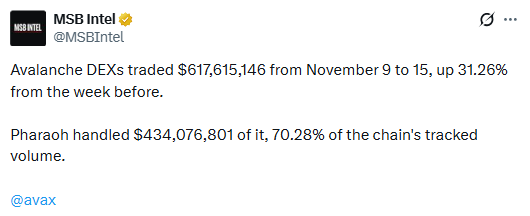
Avalanche DEXs recorded $617,615,146 in trading volume from November 9 to 15, up 31.26% from the week before, per a data post from MSB Intel. Pharaoh handled $434,076,801 of it, or 70.28%. This Avalanche DEX volume report asks what the rise shows and what it cannot.
Volume counts dollars traded. It does not count users.
What the November 9 to 15 Data Shows
Metric | Figure | Basis |
DEX volume, Nov 9 to 15 | $617,615,146 | Data post |
Change on prior week | +31.26% | Data post |
Pharaoh volume | $434,076,801, 70.28% | Data post |
All other DEXs | $183,538,345 | Arithmetic |
Implied prior week | About $470.5 million | Arithmetic |
The rise equals about $147 million more than the prior week. The source does not say how much of it came from Pharaoh. The shares check out: $434,076,801 divided by $617,615,146 is 70.28%.
The figure was not reproduced independently. DefiLlama's Avalanche page, as of November 17, shows a rolling seven-day DEX volume of $559.03 million with a weekly change near 6%. Calendar-week and rolling windows differ, so the numbers are not directly comparable.
Pharaoh's dominance is not new. A rolling 30-day snapshot on October 17 put it at 74.9%, or $3.135 billion of $4.184 billion.
Why Is Pharaoh's TVL Falling While Its Volume Stays High?
DefiLlama shows Pharaoh Exchange's total value locked at $33.87 million on November 17. That is down 16.41% over seven days and 23.65% over 30 days.
Pharaoh runs several pools, including V3 and DLMM versions, so protocol-level figures can differ by listing. Against $434.1 million of weekly volume, TVL turns over about 12.8 times a week. This is arithmetic, not a forecast.
Concentrated liquidity lets a small pool support large trading. High turnover can mean efficient use of capital. It can also mean a few wallets trading repeatedly. The data here cannot say which.
Avalanche DEX Volume: Does It Prove Organic Demand?
Not necessarily. Bitquery traced every swap from September 27 to October 4. Two clusters of bot wallets, each funded by one address, made 65% of Avalanche DEX dollars. Wallets that did not trade like bots made 8%.
Their trades tracked Binance's AVAX price, consistent with cross-venue arbitrage. The operators are unknown. These were real trades, not proof of wrongdoing or of human users. That study is historical. No wallet-level breakdown for November 9 to 15 was found.
For Avalanche DEX volume, useful checks include:
Pharaoh's daily volume and TVL across November 9 to 15
Unique wallets and the share of the top wallets
Volume at other DEXs, such as LFJ and Uniswap
Incentive programs or automated trading
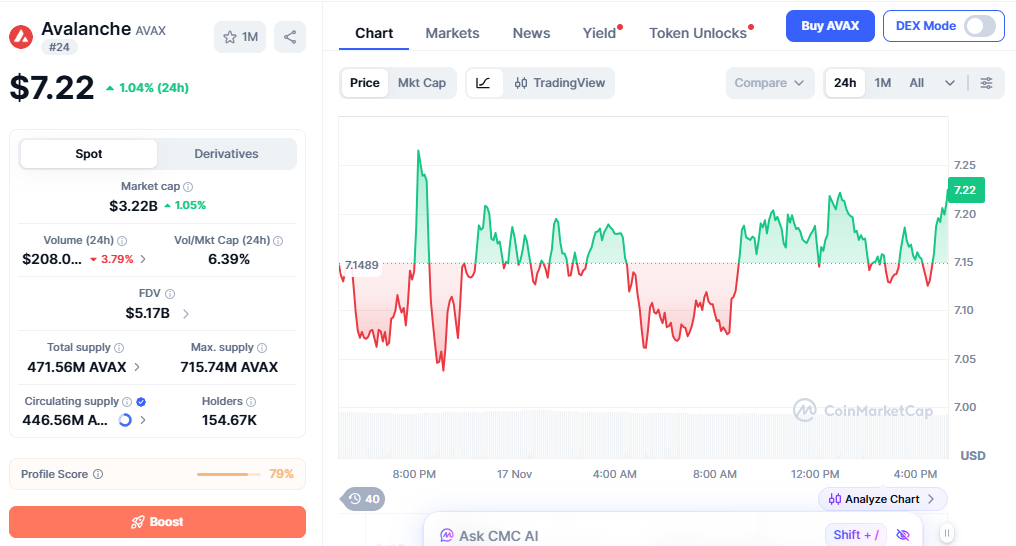
AVAX traded at $7.22 on November 17, up 1.04% in 24 hours, with a $3.22 billion market cap. That is about 15% below the $8.53 seen on November 4. It is context only. No link to DEX volume is established.
The Bottom Line
This Avalanche DEX volume rise is real in dollars but concentrated in one exchange. Treat it as activity, not proof of new users, until wallet-level data shows who traded.
YMYL Disclaimer: This article is for informational purposes only and is not financial or trading advice. It uses source screenshots, DefiLlama data and a Bitquery study reviewed as of November 17, 2026. Weekly volume figures were not independently verified, and source periods may differ. Turnover is an arithmetic estimate, not a forecast. No wrongdoing is alleged or implied. Crypto assets carry a risk of total loss. Verify current details through official sources before making decisions.






