Best Crypto SIP Apps: Does a $1 Fee Quietly Eat 10% of a Small Buy?


How Do You Pick the Best Crypto SIP Apps for Your Country?
The best crypto SIP apps share three traits.
They’re legal where you live, they show every cost before you confirm, and they let you stop at any time. Most buyers don’t lose money on the coin first. They lose it on fees they never read.
That sounds basic. Yet one flat dollar charge can swallow a tenth of a small buy, and a plan can still lose money in a long slide.
What Should a Crypto SIP App Pass Before You Start?
SIP means systematic investment plan. You pick a coin, an amount, and a day, and the app buys on schedule. Other apps call it a recurring buy, auto-invest, or dollar-cost averaging (DCA).
A fixed amount buys more coins when the price drops and fewer when it climbs. What changes by country is whether the app may serve you at all.
• A license that covers your country
• Fees shown before you confirm
• A stated minimum buy
• Pause and cancel rules in plain words
• Two-factor login and exportable records
An app that fails the first two checks isn’t worth the other four.
Is Crypto Legal in Your Country Before You Start a SIP?
CoinGecko’s research on crypto legality counts 119 countries and four British Overseas Territories where crypto is legal. Twenty of those have bank bans. Only 62 have comprehensive regulations.
Legal status | Countries | Share of 166 analyzed |
Legal | 119 | 71.7% |
Neutral | 25 | 15.1% |
Illegal | 22 | 13.3% |
Source: CoinGabbar calculation using CoinGecko research counts, checked 16 November 2026. Shares are rounded.
The counts rest on 2023 assessments, though CoinGecko updated the page in April 2026. Rules move, so your national regulator has the final word. A plan that pulls from a bank account can also fail at the funding step.
How Do You Pick the Best Crypto SIP Apps for Your Country?
No one app fits every country, so a scorecard beats a fixed ranking. CoinGabbar rates five criteria from 0 to 5. Each score is multiplied by its weight and divided by 5.
Criterion | Weight | Example score | Points |
Fee clarity | 30 | 4 | 24 |
License and country eligibility | 25 | 5 | 25 |
Control (pause, cancel, withdraw) | 20 | 3 | 12 |
Security basics | 15 | 4 | 12 |
Record export | 10 | 2 | 4 |
Total | 100 |
| 77 |
Source: CoinGabbar scoring method. Scores describe a hypothetical app, not any provider.
Fees get the top weight because a SIP repeats the same cost on every buy. A license comes second. An unlicensed provider can leave you with little recourse.
Adjust the weights to fit you. Beginners should lean on fee clarity, weekly buyers feel flat fees most, and tax-focused buyers should raise record export.
How Much Does a $1 Flat Fee Cost on a Small Crypto Buy?
Many apps quote a trading fee and tuck the spread into the price. The spread is the gap between the market price and the quoted price. Take $50 bought every week for a year: 52 buys, $2,600 in total.
Fee level | Cost per $50 buy | Cost over 52 buys | Net invested |
0.5% | $0.25 | $13.00 | $2,587.00 |
1.5% | $0.75 | $39.00 | $2,561.00 |
Flat $1 (2%) | $1.00 | $52.00 | $2,548.00 |
3% | $1.50 | $78.00 | $2,522.00 |
Source: CoinGabbar calculation. Fee levels are examples, not quotes. Checked 16 November 2026.
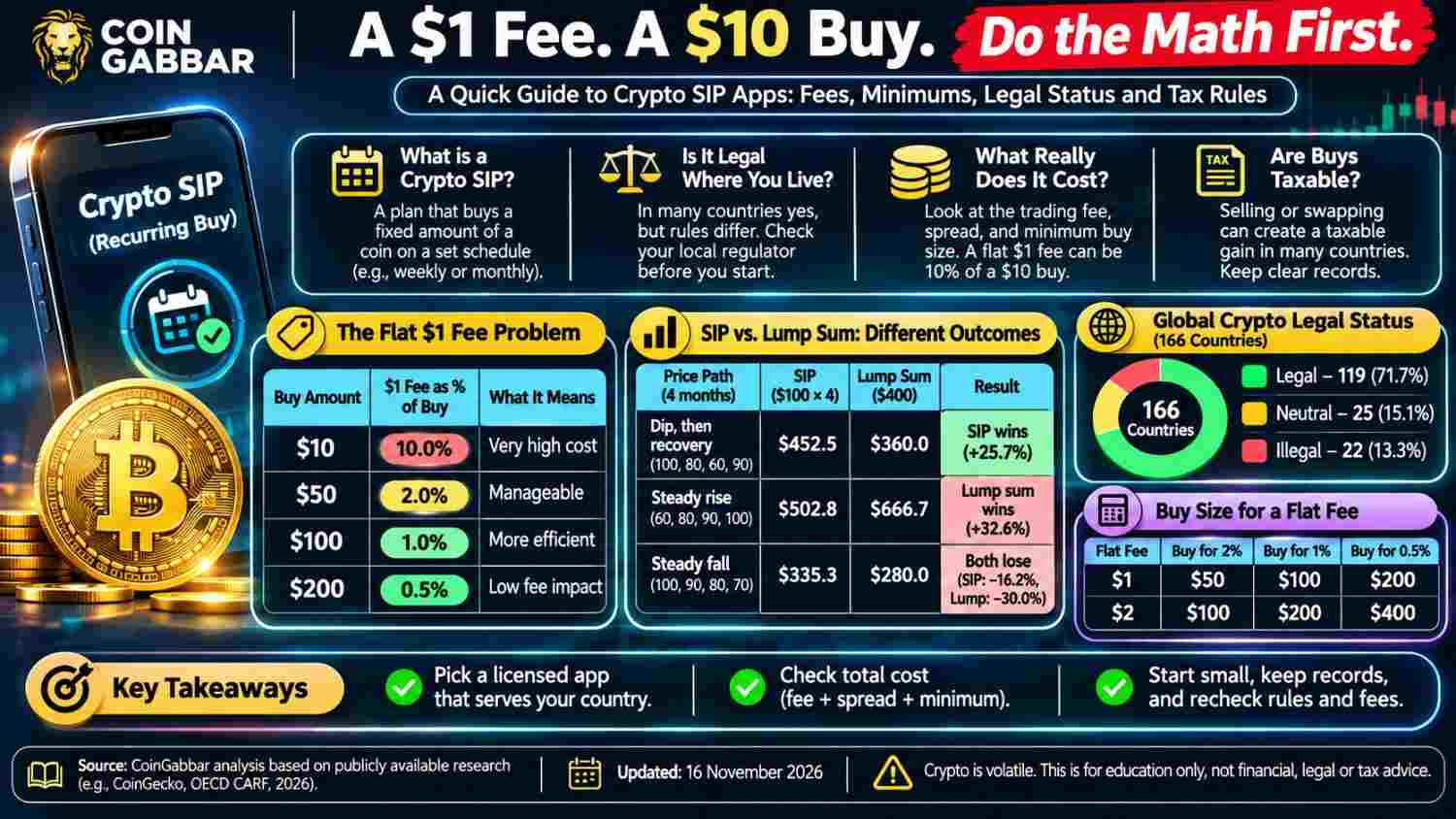
A flat $1 charge is 2% of a $50 buy but 10% of a $10 buy. Moving the same $2,600 to monthly buys cuts the flat-fee bill from $52 to $12.
What Buy Size Keeps a Flat Fee Under 1% or 2%?
Divide the flat fee by the share you can accept. If your buy sits below that line, buy less often.
Flat fee | Buy needed for 2%. | Buy needed for 1%. | Buy needed for 0.5%. |
$1 | $50 | $100 | $200 |
$2 | $100 | $200 | $400 |
Source: CoinGabbar calculation, fee divided by target share. Checked 16 November 2026.
Example: a $2 flat fee needs a $200 buy to stay at 1%.
Is a Crypto SIP Better Than Lump Sum Investing?
It depends on the price path. CoinGabbar ran $400 through both methods over four months, using made-up prices.
Price path | Prices over 4 months | SIP of $100 x 4 | Lump sum of $400 |
Dip, then partial recovery | 100, 80, 60, 90 | $452.5 | $360.0 |
Steady rise | 60, 80, 90, 100 | $502.8 | $666.7 |
Steady fall | 100, 90, 80, 70 | $335.3 | $280.0 |
Source: CoinGabbar illustration with made-up prices, not a forecast.
The SIP won after a dip. The lump sum won in a steady climb. In a steady fall, both lost value. The SIP was down 16.2% against 30.0% for the lump sum, but a smaller loss is still a loss.
Coin choice matters too. Our guide to the best crypto to DCA covers it.
How Are Crypto SIP Purchases Taxed Around the World?
No single rate applies. In many countries, selling or swapping crypto can create a taxable gain. Each recurring buy can count as its own purchase with its own cost.
Here’s a hypothetical. Twelve monthly buys of $100 cost $1,200. The holding sells for $1,500. The gain is $300, and an example 20% rate gives $60 of tax.
Reporting is catching up too. The OECD Crypto-Asset Reporting Framework is a standard for tax authorities to share crypto data. One industry tracker counted 76 committed jurisdictions in June 2026. Save the date, amount, price, and fee of every buy.
What Risks Can a Crypto SIP App Never Remove for Buyers?
A SIP doesn’t remove price risk. Fixed buys can still lose value through a long decline.
Provider risk sits outside the plan too. Exchanges fail, custody goes wrong, and fake apps copy real ones. A license doesn’t prove an exchange is safe or solvent.
Rules can shift, and an app can leave a market.
What Do Key Terms in a Crypto SIP Plan Mean for Buyers?
KYC: the identity check an exchange requires.
Tax lot: a single purchase tracked with its own date and cost.
Spread: the gap between the market price and the quoted price.
What Should You Do Before Funding a Crypto SIP App?
Check legal status first. Then read the fee page and the order preview.
Start small, and keep records from the first buy. When you compare the best crypto SIP apps, use the same order each time. Our guide to choosing a crypto exchange helps screen providers.
Recheck the fee page whenever the app updates its terms.
Expert Opinion: Does a SIP Remove Crash Risk?
CoinGabbar analysis suggests a SIP reduces timing risk but not crash risk. The basis is the three-path test above, where the SIP still lost value in a steady fall.
Low fees and a pause option matter more than a long coin list. That’s what separates the best crypto SIP apps from a feature list. This analysis considers fee drag, price paths, legal status, and tax treatment. It is not a forecast.
Disclaimer: This article is for information only and is not financial, legal, or tax advice. Returns are never guaranteed or promised. Cryptocurrencies are volatile, regulations may change, and the terms of use of the app differ in each country, so all money invested can be lost. Talk to a professional before investing.