Binance Alpha Listing: A Guide to 24-Hour Launch Readiness

A Binance Alpha listing gives a project about 24 hours in front of Binance Wallet users, and most of what decides how those hours go is prepared weeks earlier. Before the showcase, a project needs settled tokenomics, a liquidity plan sized for the Quick Buy wave, inventory in place, consistent pricing on every venue it trades on, and a plan for the days after the window closes.
At EchoTrade, we have supported more than 40 launches on Binance Alpha. The projects that come out of the showcase with an orderly market almost always did the same five things before the countdown started. The ones that struggled usually treated Alpha as a marketing event and left liquidity for the last week.
What is Binance Alpha, from a project's point of view?
Binance describes Alpha as a section of Binance Wallet that showcases early-stage projects, working as a pre-listing selection pool. Tokens are selected based on market signals and community interest, go live when a countdown reaches zero, and are usually featured for around 24 hours. Users buy through Quick Buy, a one-tap flow inside the wallet, and since March 2025 the same tokens can also be traded from the main Binance app through Alpha 2.0.
For a founder, that means three things. Demand arrives fast and all at once. It arrives from users who can buy with very little friction. And Binance is clear that being featured does not guarantee a later exchange listing, so the showcase has to be worth it on its own terms.
Why do the first 24 hours matter so much?
Because the chart from those hours becomes the token's reference point. Early buyers, later buyers, partners and exchanges all look back at it.
The pattern we see most often in the first hours is a wave of Quick Buy orders, a peak, and then a quick drop in activity. If the market behind the token was sized for that wave, the token trades in an orderly way through it. If not, the first larger sell orders meet very little on the other side, and the chart shows a sharp spike followed by a long slide. Both projects had the same attention. Only the preparation was different.
What should be ready four weeks before the showcase?
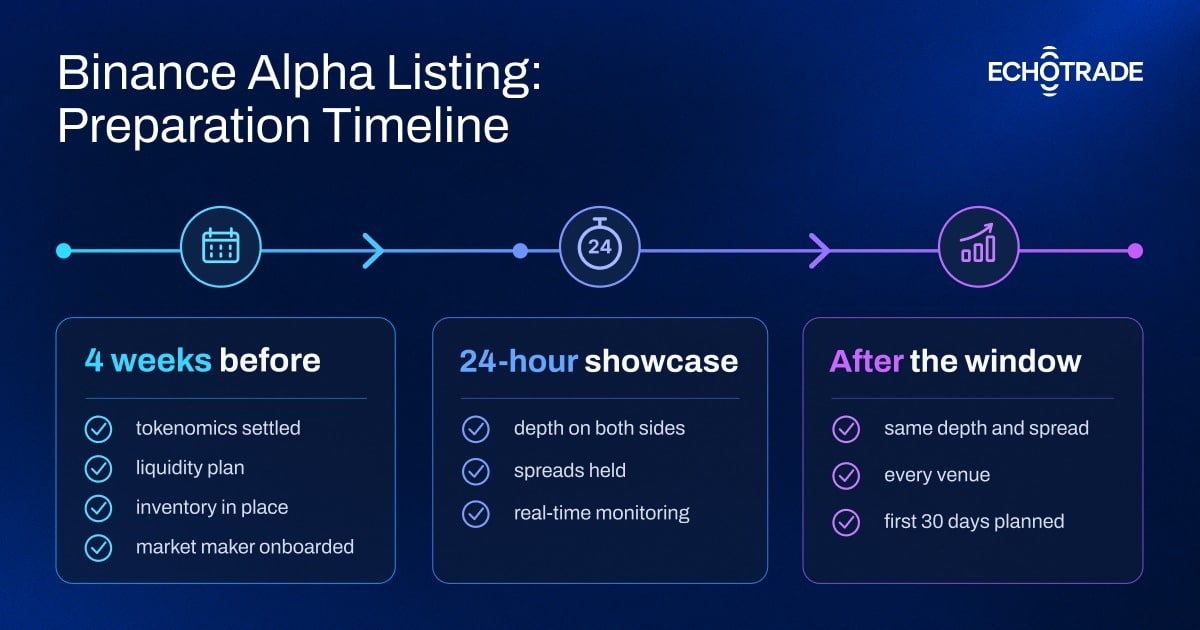
Tokenomics settled. Circulating supply at the showcase, any unlocks in the first weeks, and how airdrops or Alpha Box distributions will reach the market. Supply decided after the date is confirmed is supply nobody has planned for.
A liquidity plan for the window. How much depth the token needs to absorb the expected demand, and in which pools and venues. It comes from the size of your community, the size of the distribution and the expected Alpha traffic.
Inventory in place. The tokens and stablecoins that will support the market need to be ready and positioned before the countdown, not moved during it.
One price everywhere. If the token already trades elsewhere, the price on every venue has to stay consistent with the Alpha price. Gaps between venues get closed by arbitrage, at the project's expense.
A market maker onboarded. Onboarding takes time: connections, inventory planning, and agreed targets for depth and spread. Across our Alpha launches, four weeks is a comfortable lead time and one week is a rushed one.
Preparing a Binance Alpha launch? EchoTrade runs liquidity for Alpha showcases end to end: the depth plan for the window, inventory positioning, quoting through the 24 hours and consistent markets after it.
More than 40 Binance Alpha launches and 2,000 token launches in general completed.
Check the details on the website: echo-trade.io
What happens during the showcase?
The work is mostly invisible when it goes well. Depth is kept close to the price on both sides so that buy and sell orders can both be filled without large gaps. Spreads are held through the busiest hours. Activity is watched in real time, because the demand curve on Alpha moves faster than on a typical listing.
What happens after the 24 hours?
This is the part most projects plan least. Alpha demand fades once the token leaves the featured spot, but the token keeps trading, both in Binance Wallet and through Alpha 2.0. A token that was only supported for the showcase is often left with a wide spread and little depth by day two.
The fix is simple to describe: keep the same depth, spread and uptime commitments running after the window, on every venue where the token trades. Plan the first weeks after Alpha with the same care as the 24 hours, including any unlocks or distributions that land in that period.
Listing on a tier-1 exchange as well? EchoTrade quotes across 90+ centralized and decentralized exchanges, with 20+ traders and 2,000+ launches completed.
If you are still comparing providers, this overview of the top crypto market makers covers pricing models, exchange coverage and custody.
What mistakes do we see most often?
-
Treating Alpha as a marketing event only. Attention without depth produces the spike-and-slide chart.
-
Last-minute liquidity. Inventory moved or market maker hired in the final week.
-
Unplanned supply. Airdrop or Alpha Box tokens reaching the market with no plan for absorbing them.
-
Price gaps between venues. One price on Alpha, another elsewhere.
-
Nothing planned for day two. All the preparation ends when the featured window does.
A pre-showcase checklist
-
Circulating supply and first-month unlocks final and public.
-
Distribution plan (airdrops, Alpha Box) known to the liquidity team.
-
Depth target for the window agreed, with inventory in place.
-
Market maker onboarded at least four weeks out.
-
Pricing aligned on every venue where the token trades.
-
Announcement schedule matched to the countdown.
-
A plan for the first 30 days after the showcase.
About EchoTrade
EchoTrade is a crypto market making firm working with token projects across 90+ centralized and decentralized exchanges. Founded in 2023, it has supported more than 2,000 token launches, including more than 40 on Binance Alpha, and is an official liquidity partner of MEXC. It works on a monthly retainer, and projects keep custody of their tokens. Founders planning a Binance Alpha showcase or an exchange listing can contact the team through the EchoTrade website.
This article is for information only and is not investment advice. Binance Alpha selection and any Binance listing are decided by Binance.