Binance Hack Sparks Trump Response and CFTC Warning: What Change Next?


CFTC Chairman on $6.3B Binance Hack: Offshore Exchanges Lack Safeguard
The Binance hack, reported at about $6.3 billion, has put crypto security back on lawmakers' radar. On October 30, 2026, President Donald Trump said he was looking into the incident.
CFTC Chairman Michael Selig said it shows why crypto markets need clear rules. The key question is whether the Binance hack will push U.S. lawmakers to tighten oversight of crypto exchanges.
At a Glance: Key Facts About the Binance Hack
-
Reported value: About $6.3 billion in affected assets.
-
Trump’s response: He said he was looking into the matter and that Binance has pledged to return customer funds.
-
CFTC view: Selig said offshore exchanges lack U.S. market safeguards.
-
Attribution: TRM Labs and other firms link the attack to TraderTraitor, a North Korea-linked group.
-
Policy push: Calls are growing for crypto legislation and stronger customer asset protection.
How the Binance Hack Happened?
Binance co-CEO Richard Teng said a compromised laptop belonging to a DevOps engineer caused the attack in part. A DevOps engineer manages the systems that run and update a company’s software.
According to Binance Exchange, the laptop gave the attacker access to a service container, which is an isolated environment where an application runs. The attacker then used it to submit unauthorized withdrawals.
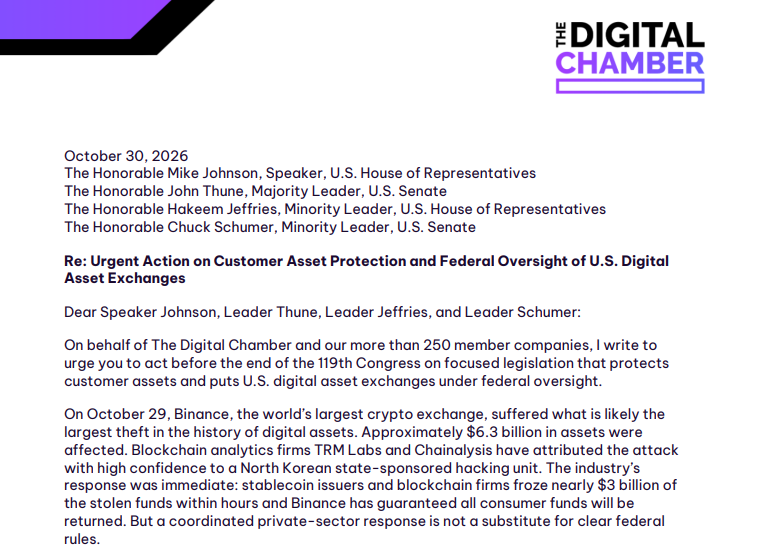
Analytics firms TRM Labs and Chainalysis attribute the attack to North Korean state-linked hackers. This is an attribution by private firms, not a court finding. The Digital Chamber says stablecoin issuers and blockchain firms froze nearly $3 billion of the stolen funds within hours. The final amount lost or recovered has not been confirmed.
Source: The Digital Chamber
Trump Responds to the Binance Hack
At a Friday press conference, Trump said Binance told officials it is making sure customers get their money back. He also voiced a broader worry about digital assets. He compared them to signing a paper check, saying that with a hack the money is gone and the people behind it are different. He had always felt crypto was “a little bit dangerous.”
These are public remarks. They are not the findings of a confirmed government investigation.
CFTC Chairman Warns About Offshore Exchanges
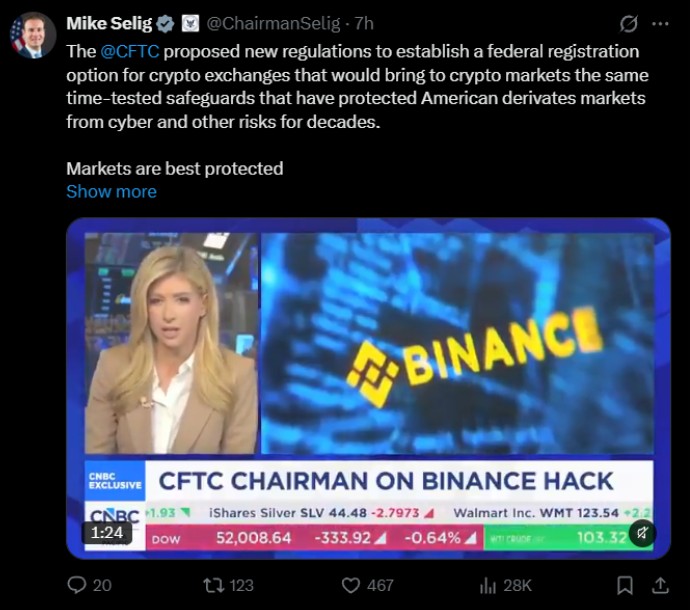
Selig told CNBC that Binance is not federally regulated by his agency. He called the Binance hack proof of the point behind the CFTC’s October 5 proposal. That proposal covers leveraged and margined retail crypto trading and creates a registration category for exchanges that offer those products.
Selig said offshore exchanges do not have the same safeguards as U.S. financial markets. The limits are real, though. U.S. rules mainly reach platforms that serve American customers, so an offshore exchange sits largely outside direct federal supervision.
Source: Mike Selig X Post
CLARITY Act Debate Intensifies
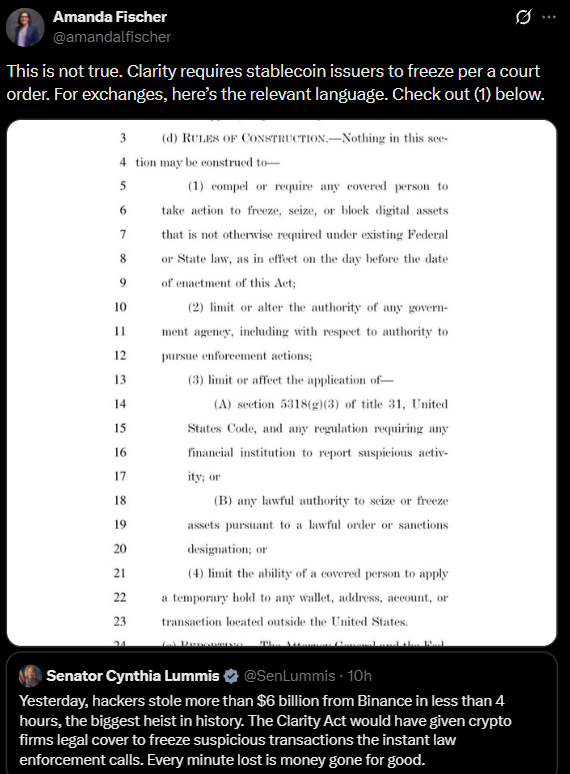
Senator Cynthia Lummis said the CLARITY Act would have given crypto firms legal cover to freeze suspicious transactions as soon as law enforcement calls. She argued that every lost minute can mean money gone for good.
Amanda Fischer of Better Markets disagreed. She said the bill would have required stablecoin issuers to freeze assets only under a court order. Patrick Wilson of the Solana Policy Institute countered that a section of the bill protects issuers from private lawsuits over voluntary, temporary holds, with no court order needed.
The reading of the bill remains disputed. No one can say the CLARITY Act would have stopped the Binance hack. The bill passed the House but is stalled in the Senate amid concerns about Trump’s crypto wealth.
Source: Senator Cynthia Lummis
Digital Chamber Urges Congress to Act
Cody Carbone, CEO of The Digital Chamber, sent a letter to congressional leaders on October 30. He asked Congress to pass a focused bill before the 119th Congress ends. His main requests are:
-
Give the CFTC registration, examination, and enforcement power over U.S. spot digital asset exchanges.
-
Require exchanges to keep customer assets separate from company assets and protected in bankruptcy.
-
Set baseline security rules, including multi-party approval for moving funds, tight control of privileged access, real-time monitoring, and prompt incident reporting.
Carbone noted that regulators can only act after the damage is done. He pointed to the Senate Agriculture Committee’s Digital Commodity Intermediaries Act as a base for a smaller bill.
North Korea-Linked Crypto Hacks Raise Security Concerns
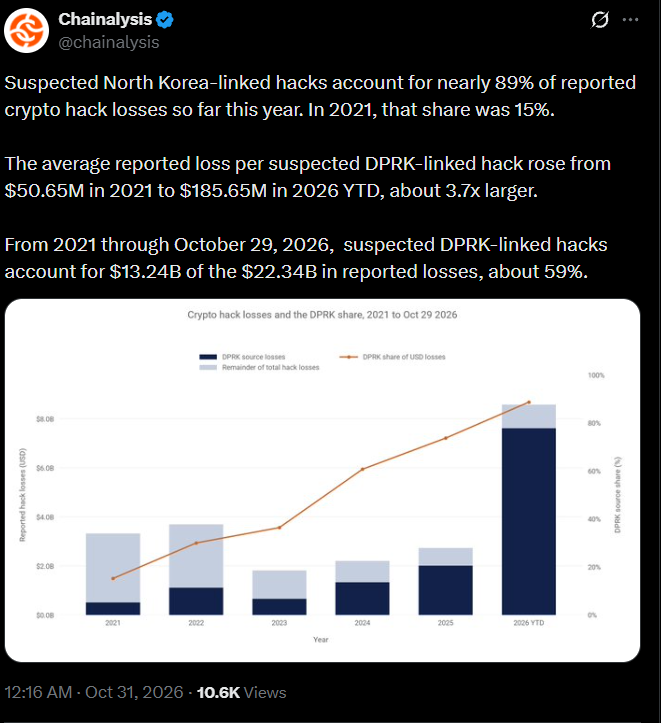
Chainalysis says suspected North Korea-linked attacks made up nearly 89% of reported crypto hacking losses in 2026 through October 29. That share was 15% in 2021. The average loss per attack rose from $50.65 million to $185.65 million, about 3.7 times higher.
Source: Chainalysis
From 2021 through October 29, 2026, reported hacking losses total $22.34 billion. Suspected North Korea-linked attacks account for $13.24 billion, or about 59%. Rep. William Timmons called the Binance hack a national security threat, saying rogue states should not use digital assets to fund weapons programs. These are allegations and analytics estimates, not court rulings.
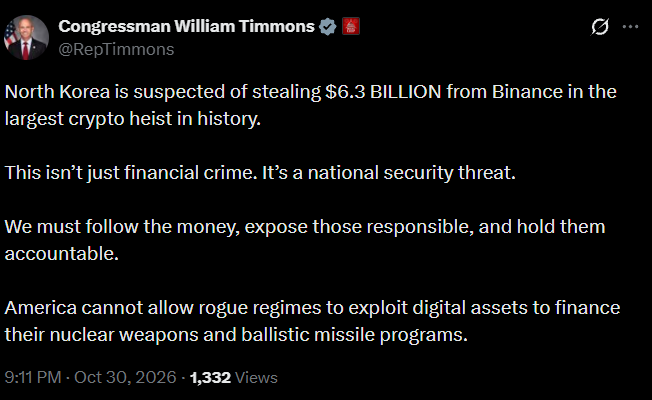
Source: Congressman William Timmons
Binance Hack Timeline
-
October 5, 2026: The CFTC proposes a framework for leveraged and margined retail crypto trading and exchange registration.
-
October 29, 2026: Binance reportedly suffers an attack involving about $6.3 billion.
-
October 30, 2026: Trump comments, and Selig highlights regulatory gaps.
-
October 30, 2026: The Digital Chamber urges Congress to act.
-
October 31, 2026: Coverage continues to focus on the debate.
This timeline uses dates from the supplied reports. It does not mean any proposed rule has become law.
Conclusion: What the Binance Hack Means for Crypto Regulation
Trump said he is looking into the matter, the CFTC says offshore exchanges lack safeguards, and industry groups want Congress to move quickly. The Binance hack has sharpened the debate over exchange oversight, cybersecurity, and customer fund protection. Its lasting impact will depend on what lawmakers decide and on the details of any final rules.
YMYL Disclaimer: This article is for informational and educational purposes only and does not constitute financial, investment, or legal advice. The reported losses, hacking attribution, and proposed regulatory measures should be independently verified using reliable, up-to-date sources. Cryptocurrency investments and trading involve significant risks.






