Binance Hacker Moves 74,881 ETH in One Hour: What Happens Next


Key Takeaways
-
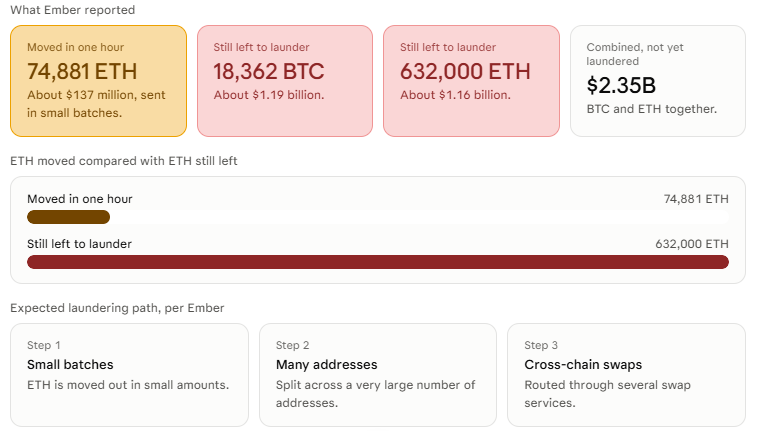
On-chain analyst Ember says addresses tied to the Binance hacker moved 74,881 ETH, worth about $137 million, in small batches over one hour.
-
Ember says about 18,362 BTC and 632,000 ETH, worth roughly $2.35 billion together, have not been laundered yet.
-
Ember expects the moved Ether to be split across many addresses and routed through cross-chain swap services.
-
These are an analyst’s estimates, and they do not prove that any funds have been cashed out.
The Binance hacker has started moving Ether again, with analyst Ember reporting that 74,881 Ether, worth about $137 million, left the attacker’s wallets in small batches over a single hour, which suggests a plan to launder the coins.
Binance Hacker Moves 74,881 ETH: What Ember Reported
In an X update , Ember said the attacker had already disposed of most of the scam tokens and then began moving the Ether it still held in small batches over the past hour.
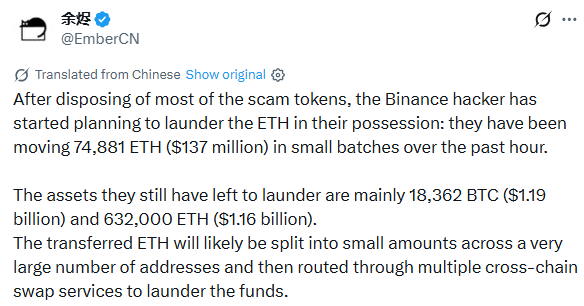
On-chain analyst values the moved ETH at $137 million and says the assets still left to launder are mainly 18,362 BTC, worth $1.19 billion, and 632,000 ETH, worth $1.16 billion.
How Crypto Laundering Usually Works After a Hack
On-chain analyst expects the moved Ether to be split into small amounts across a very large number of addresses and then routed through several cross-chain swap services, which is a common way to makestolen funds harder to follow.
A cross-chain swap lets someone trade coins from one blockchain for coins on another without a regular exchange account, so the trail gets spread across many networks and many wallets. This is Ember’s expectation and not a confirmed outcome.
What Binance Has Said About the Hack
According to Binance’s X posts from the time of the incident, its team was running security checks and said user funds remained safe.
Readers can visit the Arkham Intelligence entity page for the “Binance Hacker."
What Happens Next After the Binance Hacker Moves ETH
Watchers will now look at whether the small batches reach swap services and whether the much larger BTC and ETH balances begin to move too, since those hold most of the remaining value.
Exchanges and wallet teams often flag addresses linked to a hack so that deposits from them can be reviewed, which can make it harder for the attacker to turn stolen coins into cash.
Crypto Terms in Simple Words
-
On-chain analyst: a person who tracks public blockchain data to follow where funds move.
-
Address: a wallet identifier on a blockchain where coins can be held.
-
Laundering: moving stolen funds through many steps so their source is harder to trace.
-
Cross-chain swap: exchanging coins from one blockchain for coins on another.
Safety Tips for Crypto Users
Large hacks often bring phishing messages and fake recovery offers, so only use links posted on official exchange accounts and never share your seed phrase with anyone.
The Bottom Line
The Binance hacker has begun moving Ether in small batches, and Ember says billions in BTC and ETH are still untouched, so the next transfers will show how the laundering plan unfolds.
YMYL Disclaimer: This article is for information only and is not financial or investment advice. Crypto assets are volatile and carry a risk of loss. Check official sources before you act.






