

Crypto news from developer Abubakar Sadiq Ismail shows how Bitcoin Core rebroadcast privacy can fail: a wallet that re-sends a stuck payment shows a watcher, which machine tracking an address. Ismail, a contributor who posts as ismaelsadeeq, published the findings on Delving Bitcoin on Nov. 25, 2026.
His Delving post calls this a long-known leak, not a new bug. What he adds is a measured test of Bitcoin Core rebroadcast privacy. On a test network, it linked a planted payment to the right node in all 30 attempts.
The research describes network exposure through address-to-IP linking. It does not describe access to keys or funds.
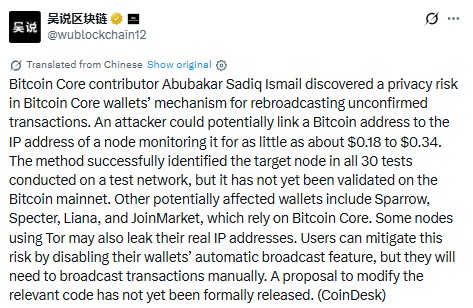
Wu Blockchain also shared the findings on X.
A self-hosted wallet re-announces unconfirmed transactions it holds, sent or received, after roughly 12 to 36 hours. This helps stuck payments spread. It also leaves a signal an attacker can read.
The attack has three steps, according to the post:
The attacker sends a tiny "dust" payment, the smallest output the network relays, to a known address. A very low fee keeps it unconfirmed.
The attacker connects a fresh peer to each candidate and waits.
When the timer ends, the machine tracking that address announces the payment again, and the fresh peer sees it.
Watch-only wallets, which track addresses without holding keys, give off the same signal. The node found may not belong to whoever controls the funds, the post notes.
Ismail ran six rounds with five target wallets each on regtest, a private test network. The spy linked the planted payment to the correct node 30 out of 30 times.
That is not a mainnet measurement of Bitcoin Core rebroadcast privacy. An attacker would also need listening nodes, links to candidate nodes, and time.
Output type | Cost per planted payment | USD at about $59,000 per BTC (Nov. 25, 2026) |
P2WPKH | 309 sat | $0.18 |
P2TR | 346 sat | $0.20 |
P2PKH | 569 sat | $0.34 |
The author calls these rough estimates, covering the dust output and relay fee.
Once a source is known, a fresh transaction's spread pointed to a likely direct peer about 90% of the time in simulated networks. Those runs assumed an ideal observer, so it is not a real-world rate.
Any tool that loads addresses into the node wallet inherits the behavior, per the post.
Group | Software named in the post |
Built-in wallets | Core itself, Knots |
Desktop wallets that use it | Sparrow (Core mode only), Specter Desktop, Liana, Caravan |
Other RPC-based wallets | Fully Noded, Gordian, Lily Wallet (v1.0.7) |
Services, bridges, and Lightning | JoinMarket and Jam, Electrum Personal Server, bwt, Eclair |
Operators who keep the default setting and use clearnet face the most direct exposure.
Option | Benefit | Trade-off | Status on Nov. 27, 2026 |
-walletbroadcast=0 | Removes the resend signal | Stops all wallet relay; sends need sendrawtransaction | Available now |
-onlynet=onion or i2p | Hides the clearnet IP | Still links the address to the onion or I2P identity. | Available now |
Pull request 36482 | Resends only newly added transactions. | Does not close every leak | Open |
Pull requests 36398 and 36481 | Wallet-originated resends only; manual resend | Needs manual action | Open |
Pull request 36482, opened by developer achow101 on Oct. 8, 2026, would rebroadcast only transactions newly added to the mempool.
Developer mzumsande replied that this alone does not stop the worst case. A passive operator can still be dusted over old transactions. He backs opt-in resends of received payments, plus manual resends. Ismail said resending should be opt-in too.
Tor alone does not close the gap. A node mixing Tor or I2P with clearnet peers still leaks its clearnet IP. The -privatebroadcast option covers only the first announcement.
For most readers the risk is tracing, not theft. An attacker needs a target address, a few dollars, connected nodes, and time. Addresses tied to a real identity are the likeliest targets. That is an editorial reading, not a finding of the post.
Setting -walletbroadcast=0 shifts the work to the user, because your own sends will not go out unless you broadcast them by hand. Check official documentation first.
Bitcoin Optech's transaction origin privacy page lists resending among the known ways a watcher can trace a payment to an IP address.
Until a fix is merged and released, the Bitcoin Core rebroadcast privacy trade-off sits with each operator: accept the exposure, change the setting, or go onion-only. Readers can follow the latest crypto news for the next update.
Disclaimer: This article is for information only and is not financial, legal, or security advice. Review node settings against official node documentation before changing them.
Frequently Asked Questions (FAQ)




Owned by:-
DCG Tech FZCO, UAE
Delivery Partner:-
Gabbar MediaTech Pvt Ltd.
Copyright © 2026 Coin Gabbar. All Rights Reserved


