

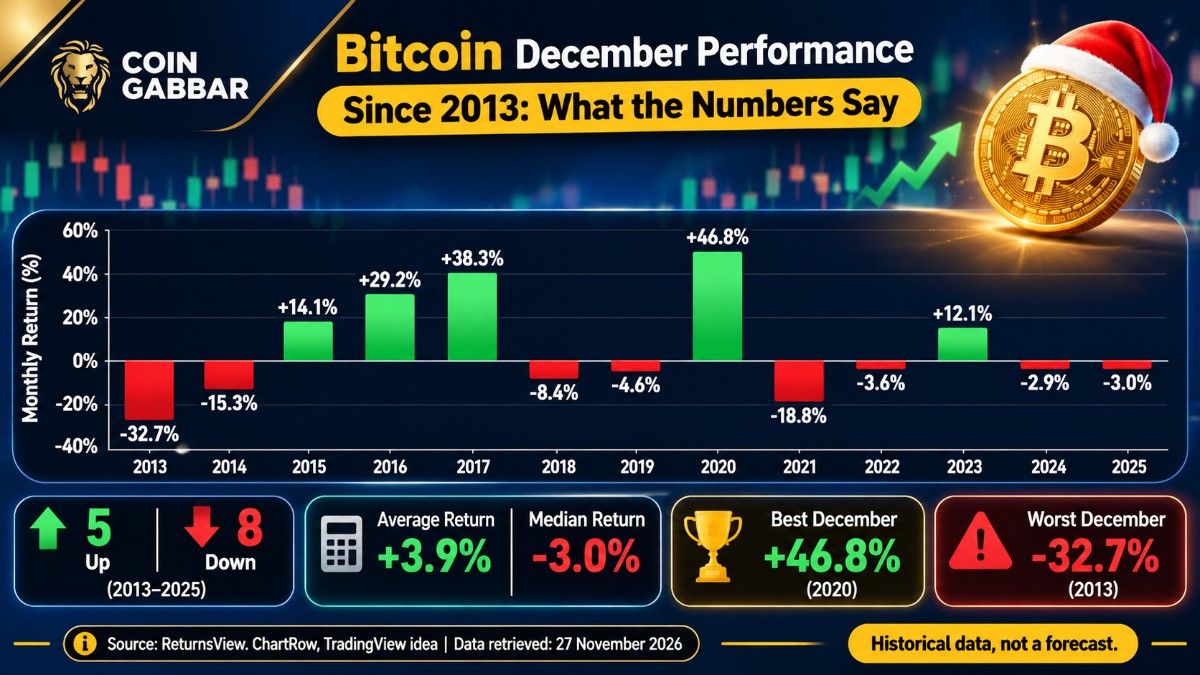
Bitcoin's December performance is mixed, not a sure rally. Across 13 months, from 2013 to 2025, Bitcoin ended 5 higher and 8 lower. The average was +3.9%, but the median was -3.0%. Two huge years, 2017 and 2020, lift the average, so the typical month looks weaker. This guide uses data pages and official calendars, each with a date. Data was retrieved on 27 November 2026 at 14:40 IST (09:10 UTC). It is not a forecast. New to the market? Read our guide to crypto wallets first.
Here is a snapshot of Bitcoin's December performance. Each row shows its own date.
Measure | Reading | As of | Source |
December's up or down, 2013 to 2025 | 5 up, 8 down | Page updated 27 Nov 2026, 02:32 UTC. | |
Average December | +3.9% | Same | My arithmetic |
Median December | -3.0% | Same | My arithmetic |
Best December | +46.8%, in 2020 | Same | ReturnsView |
Worst December | -32.7%, in 2013 | Same | ReturnsView |
November 2026 so far | -21.9% | 26 Nov 2026 close | ReturnsView |
Bitcoin close | $60,557 | 26 Nov 2026 | |
Fear and Greed Index | 11, Extreme Fear | No date shown, retrieved 27 Nov |
Methodology note: a monthly return is the change between month-end closes. ReturnsView data starts on 17 July 2010. The mean and median are my arithmetic on its 13 December figures. Other sites use other price feeds, so numbers can differ by a point or two.
Two data pages and one chart idea cover the same decades. Look at how close they are.
Year | ReturnsView | ChartRow | TradingView idea |
2013 | -32.7% | -34.6% | About -25% |
2014 | -15.3% | Not shown | About -15% |
2015 | +14.1% | Not shown | About +19% |
2016 | +29.2% | +30.8% | About +30% |
2017 | +38.3% | +39.3% | About +30% |
2018 | -8.4% | -5.1% | About -5% |
2019 | -4.6% | -5.2% | About -4% |
2020 | +46.8% | +47.0% | About +48% |
2021 | -18.8% | -18.8% | About -19% |
2022 | -3.6% | -3.6% | About -3% |
2023 | +12.1% | +12.2% | About +6% |
2024 | -2.9% | -2.8% | Not covered |
2025 | -3.0% | -3.0% | Not covered |
Source notes: Chart Row uses the market close of 26 November 2026 and Twelve Data prices. It lists 2013 only as its worst December. The TradingView idea was published on 18 December 2024. Its prices are approximate. It cannot cover 2024 or 2025.
The mean is +3.9%. The median is -3.0%. Why the gap? Five gains, led by 2017 and 2020, pull the average up. Eight Decembers fell, and most fell only a few points. The median shows typical Bitcoin December performance better.
Look at recent years. Since 2021, four of five Decembers have fallen, and the mean was -3.2%. The only gain was +12.1% in 2023. The last two winters, 2024 and 2025, both finished near -3%.
Here is a simple example. This is an illustration, not a forecast. A $1,000 holding with the median December of -3.0% ends near $970. The same holding with 2020's +46.8% ends near $1,468. Same month, very different results.
A word on the "Santa rally". It is a stock market idea. Wikipedia defines it as a rise in the last five trading days of December and the first two of January. Yale Hirsch first recorded it in 1972. Crypto trades daily, so that window does not map to Bitcoin's December performance.
Not every page agrees. Three examples:
Averages: A TradingView idea by FieryTrading, dated 27 December 2022, cites a 7.34% average over 12 years and about 75% green. It does not say which 12 years, so I cannot reconcile it with the table above.
Method: What IfIHodl shows a 2025 open of $86,302.37 and a close of $87,519.13, a gain of 1.4%. Month-end to month-end data shows -3.0%. The open-to-close method skips the first day's move.
Price feeds: ReturnsView and ChartRow differ by up to 3.3 points in 2018, a gap caused by different data feeds.
So always state the method. A claim about Bitcoin's December performance means little without it. Ask which prices, which days, and which dates sit behind it.
December has not started yet, so 2026 Bitcoin December performance is unknown. Its return will use the 30 November close as the base. Here is what happened, with dates.
Date | What happened? | Source |
28 October 2026 | Bitcoin closed at $81,325. | Coinlore |
20 November 2026 | Bitcoin closed at $58,870. | Coinlore |
26 November 2026 | Bitcoin closed at $60,557, and November stood at -21.9%. | Coinlore, ReturnsView |
27 November 2026 | Today. Fear and Greed shows 11 | Alternative.me |
30 November 2026 | Month-end close sets December's base. | Calendar |
8 to 9 December 2026 | Fed meeting with projections | |
10 December 2026 | November CPI, 8:30 a.m. ET | BLS |
31 December 2026 | December month-end close | Calendar |
26 to 27 January 2027 | First Fed meeting of 2027, tentative | Fed calendar |
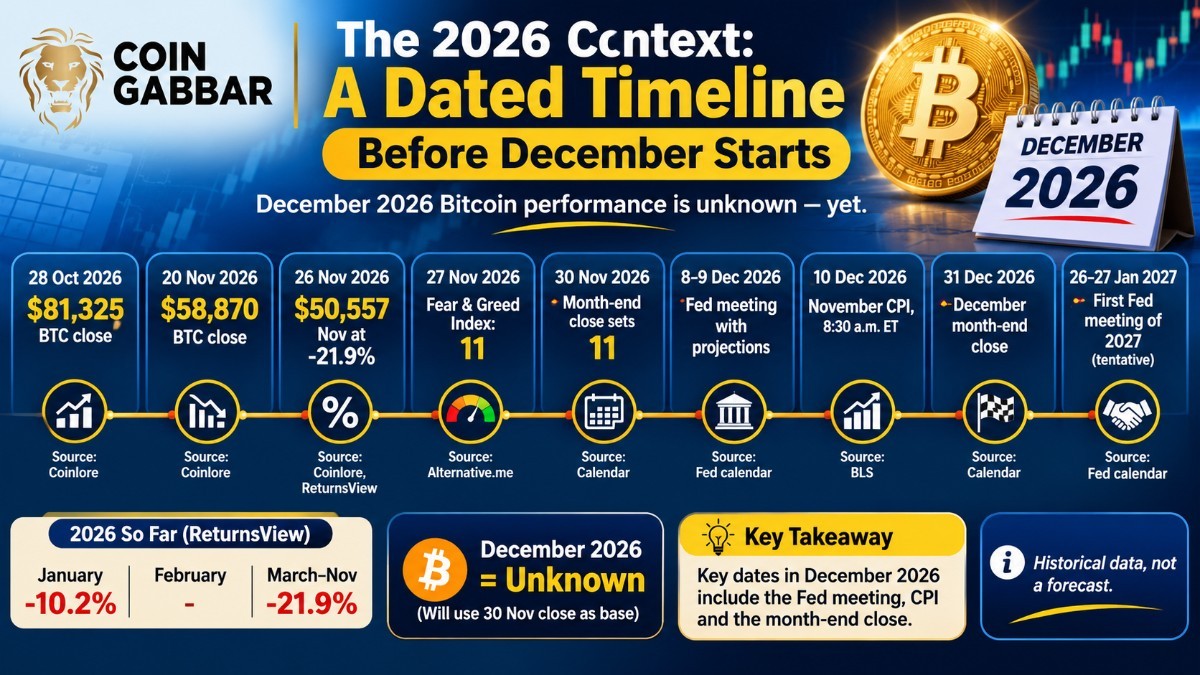
ReturnsView also lists 2026 months so far. January was -10.2%, February -14.9%, June -20.4%, August +24.9%, and October -7.3%. It was a year of big swings. A large drop in November does not change what December history shows.
Expert view: market analysts often say seasonal patterns, such as Bitcoin's December performance, are weak guides in crypto. In that view, big news and market cash flow matter more than the calendar month.
Use this list when you read any claim about Bitcoin's December performance. It is general, not personal advice:
Sample size: Thirteen Decembers is a small sample.
Method: Check whether returns use month-end closes or open-to-close.
Date: Look for a date on every figure.
Median: Do not rely on the average alone.
Counter-case: 2020 gained 46.8%, but 2021 lost 18.8%.
Platforms: Review exchange security features before you use one.
Identity checks: Our crypto KYC guide explains them.
Scams: Holiday "giveaways" are often fake.
If you move coins, follow the transfer with a Bitcoin block explorer. Our stablecoin explainer covers cash-like tokens.
Bitcoin's December performance since 2013 is split: 5 up, 8 down, with a +3.9% average and a -3.0% median. History describes the past and does not set the odds. Check dated sources, keep records, and never invest more than you can afford to lose.
Disclaimer: This article is for education and information only. It is not financial or investment advice and makes no price prediction. Crypto is volatile, and you can lose money. Data changes, so verify everything on official pages before you act.
Frequently Asked Questions (FAQ)




Owned by:-
DCG Tech FZCO, UAE
Delivery Partner:-
Gabbar MediaTech Pvt Ltd.
Copyright © 2026 Coin Gabbar. All Rights Reserved