Bitcoin Mining Demand Response: Can Miners Help Stabilize the Grid?


How Does Bitcoin Mining Demand Response Work in Practice?
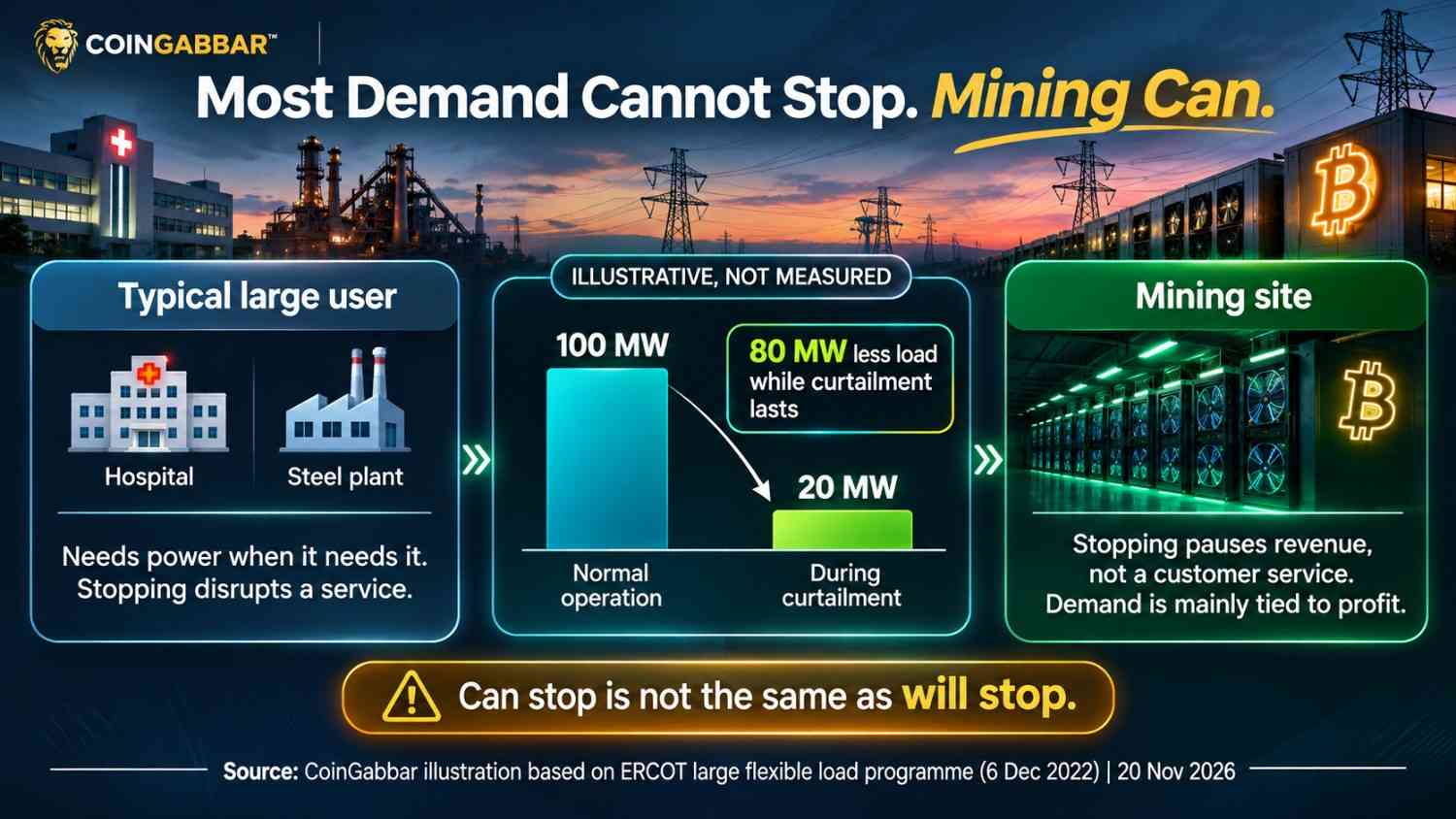
Most big power users cannot simply stop when the grid is stressed. A hospital cannot pause. A steel plant struggles to. A mining site can. That odd trait is why Bitcoin mining demand response is getting attention from system planners. But a machine that can switch off is not the same as a grid resource that will.
Miners can cut load, and Texas has built programs around that. But research shows the benefit depends on size, place, price and Bitcoin profit.
A miner that can stop may still choose to keep running. Flexible hardware does not ensure flexible behavior.
Why Is Bitcoin Mining Load Different From Other Demand?
Because it can stop without ending a customer service. A mining machine runs hash calculations to compete for block rewards. Switch it off and revenue pauses. No patient or shopper is affected.
A factory or hospital often cannot do this. Miner demand is mainly tied to profit, so it can run in bursts.
That is the idea behind controllable demand. The catch is the word “can”.
How Does Bitcoin Mining Demand Response Help a Strained Grid?
By lowering demand when supply is tight. Demand response means a customer cuts use after a price or grid signal. A flexible load is one whose demand can be adjusted without serious harm.
Picture a 100 MW site cutting to 20 MW. The grid sees 80 MW less load while it lasts. This example is illustrative, not measured.
Grids need this when renewable output swings fast, a change called ramping, or when peaks strain supply. Mining itself is covered in how does Bitcoin mining work guide.
What Has ERCOT Done With Large Flexible Loads Like Miners?
It built programs for them. On 6 December 2022, ERCOT announced a voluntary curtailment program for large flexible customers and named bitcoin miners as an example. See the ERCOT announcement.
A September 2025 ERCOT briefing says crypto miners were the largest provider type in its emergency response service, with over half of resources. The service awarded 2,088 MW in one period. That shows participation. It does not prove the grid became more reliable.
The same slide says these loads are typically price sensitive, and Texas Senate Bill 6 bars them from a separate 24-hour notice program.
What Did One High-Price Day Show About Miner Behavior?
They followed price. An ERCOT slide for a September 6 high-price day shows large flexible load falling from roughly 1,850 MW to under 100 MW through the afternoon. Curtailment began around 11:30 am, as prices neared breakeven.
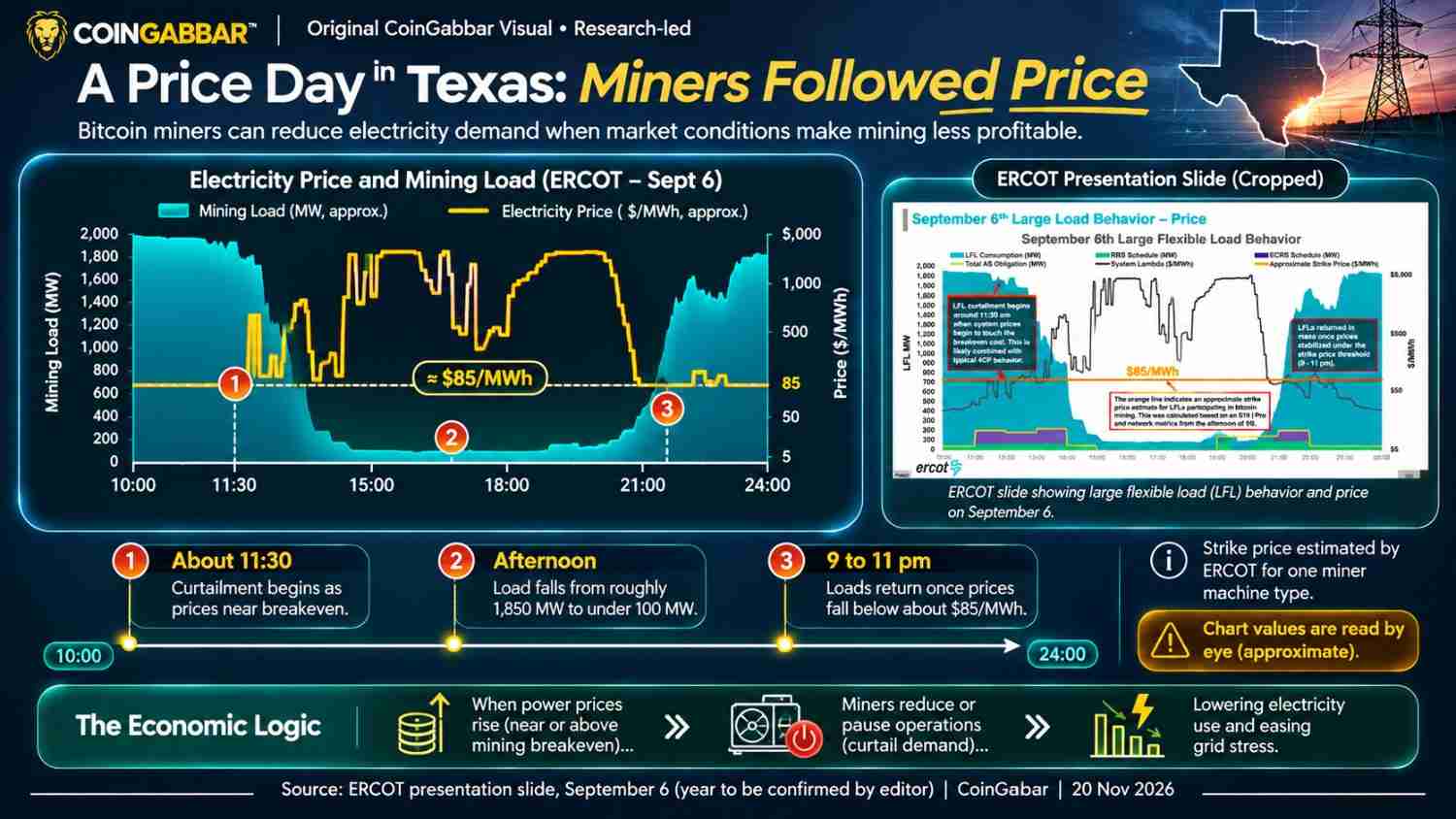
Loads returned in mass between 9 and 11 pm, once prices fell below an approximate strike price of $85/MWh. A strike price is the power price above which a miner stops. Electricity is a major cost, as mining PC build costs guide shows.
Reading a chart by eye is approximate. The slide shows a response to price, not altruism. A Riot Platforms filing describes the same logic.
What Do Models Say About Miner Load and Power Prices?
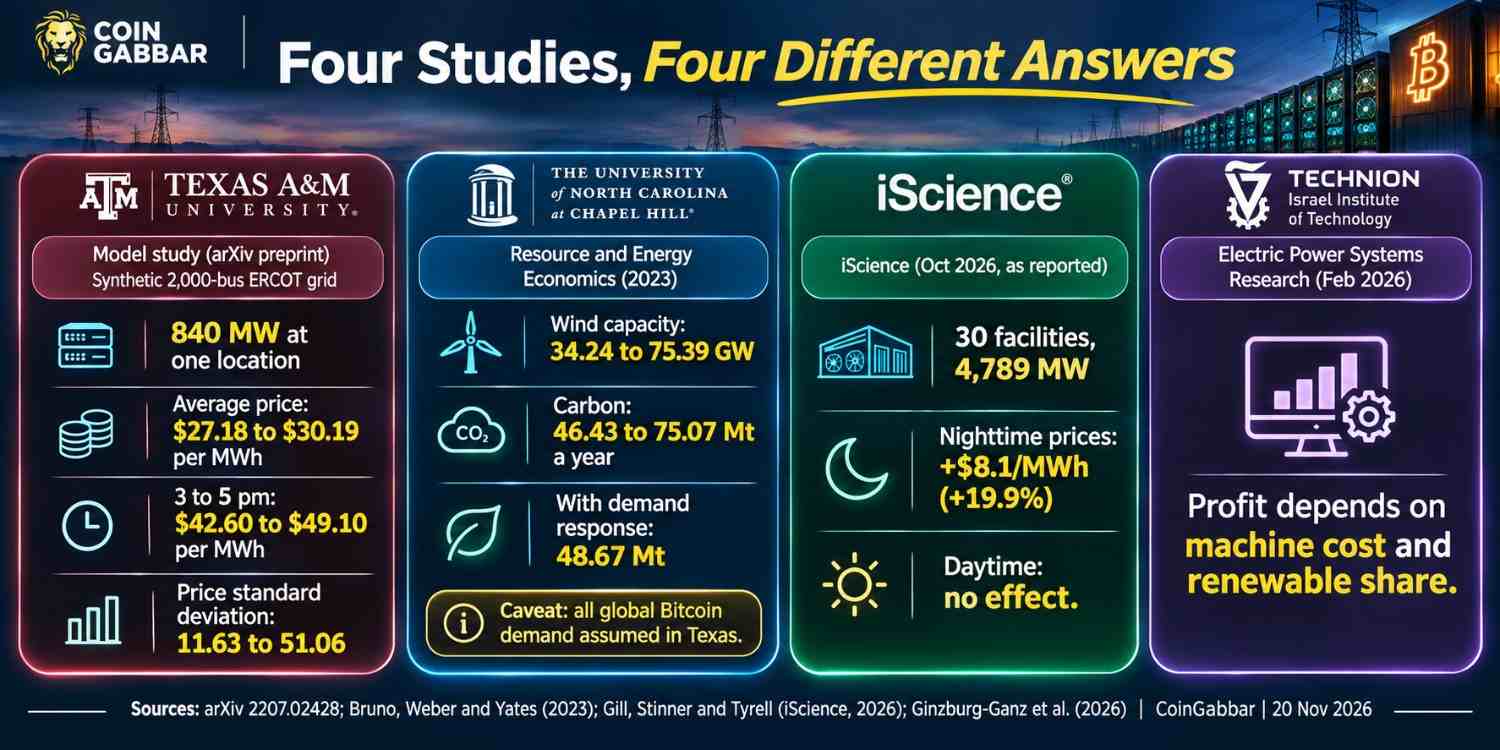
They say it depends on size and place. Texas A&M researchers modelled a synthetic 2,000-bus ERCOT grid. Adding 840 MW at one location raised the average price from $27.18 to $30.19 per MWh, and from $42.60 to $49.10 between 3 and 5 pm.
Price swings widened too, with standard deviation rising from 11.63 to 51.06. Demand response earned more at that location than at another.
A Technion-led study tested miners as ramping support using California and Israeli grid data. It found profit depends on machine cost and renewable share.
Can Bitcoin Mining Support Renewables Without More Emissions?
Only with demand response, in one model. A University of North Carolina study of the Texas market found Bitcoin demand could lift wind capacity from 34.24 to 75.39 GW. Carbon rose from 46.43 to 75.07 million tons a year. Read the journal paper.
When miners cut use during shortfalls, emissions fell to 48.67 million tons, close to baseline.
The authors assume all global Bitcoin demand sits in Texas, so treat the result as a model, not a forecast.
Did Miners Raise Local Power Prices in Texas?
In one study, at night. Researchers studying 30 Texas facilities with 4,789 MW of capacity estimate nighttime prices rose $8.1 per MWh, or 19.9%, after miners arrived. Daytime prices showed no effect.
Negative-price hours were unchanged, so the rise is not from soaking up surplus power. The authors call it a lower bound.
These figures are as reported, and we have not read the full paper.
Why Might Miners Not Switch Off When the Grid Needs Them?
Because profit can override price. A June 2026 arXiv paper on the Texas market finds mining load falls as wholesale prices and peak-demand charges rise. Higher hashprice weakens that response.
Hashprice is expected mining revenue per unit of computing power, as our hashprice squeeze explained guide covers. Machines also have different breakeven points.
The author warns that treating such loads as stable demand-response resources may overstate their flexibility.
What Would Have to Be True for Miners to Help the Grid?
CoinGabbar tests four conditions. Control: can load drop fast and reliably? Economics: do incentives hold when hashprice rises? Usefulness: does it help where and when the grid is short? Environment: does it avoid adding emissions?
The evidence so far supports control and shows mixed results on the other three. Some firms are also moving toward AI data centers, as our mining AI pivot report notes. How that changes flexibility is open.
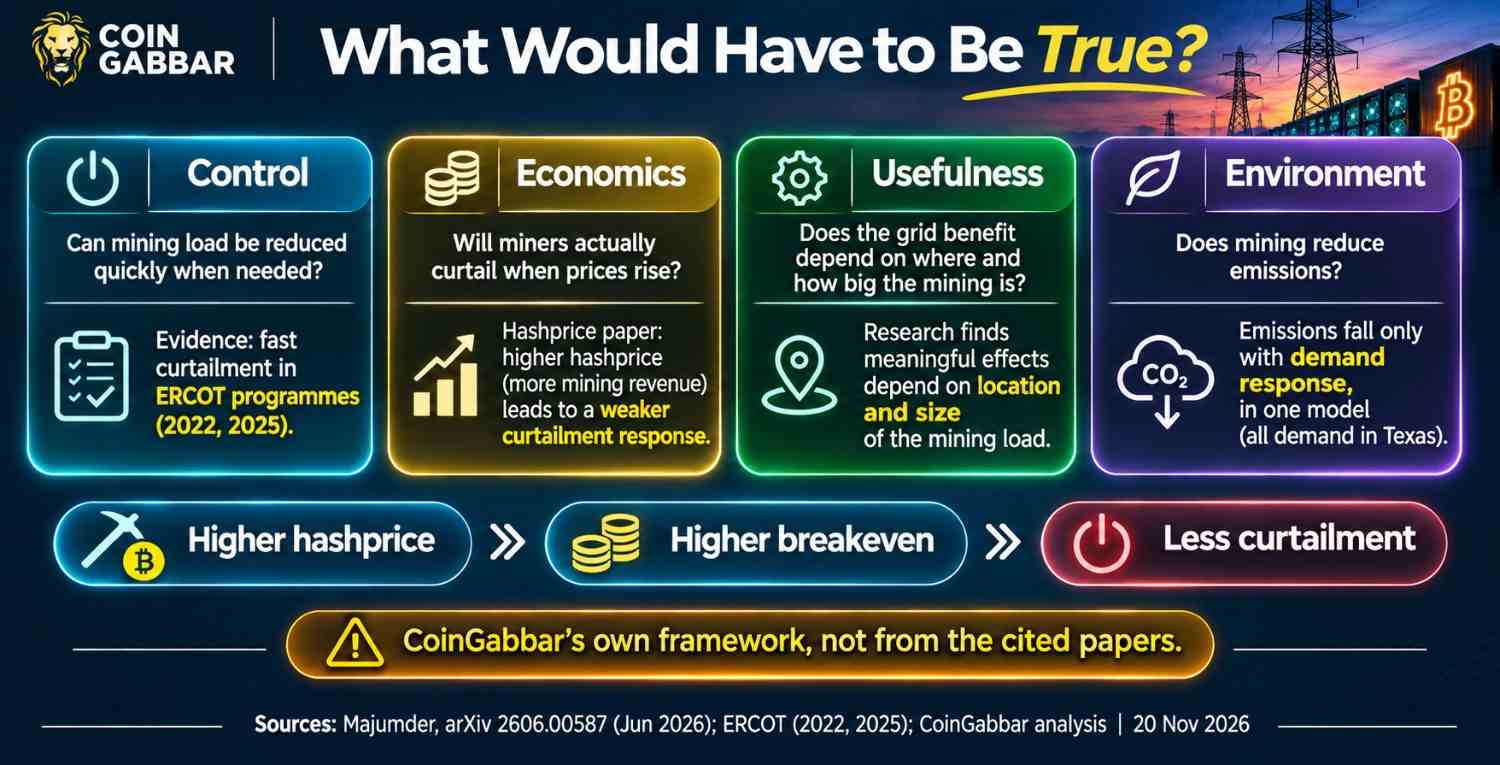
This framework is our own analysis. It is not from the cited papers.
Expert Opinion: Are Bitcoin Miners Real Grid Infrastructure?
CoinGabbar analysis suggests Bitcoin mining demand response is a real but conditional grid tool.
This view rests on the ERCOT programs, the five studies above and the price-response slide.
It works when payments, location and rules line up, and weakens when hashprice rises.