Bithumb Event Rewards Taxable: Seoul Court Splits $16.4M Tax Case

Bithumb Event Rewards Are Taxable, Seoul Court Rulein a Mixed Verdict
A Seoul court has delivered a mixed verdict in a tax fight between a crypto exchange and Korea's tax authority.
Bithumb event rewards, the crypto handed to traders during promotions, were ruled taxable, yet the court also cancelled a large part of the bill.
What the Seoul Administrative Court Decided
On November 13, the Seoul Administrative Court ruled partly in favour of the exchange in a case against the head of the Yeoksam Tax Office.
The ruling is covered in a Korean-language report. As a result, an assessment of about 21.8 billion won (roughly $16.4 million) was cancelled.
The main findings were:
-
Rewards that exchanges give users for promotions, based on trading volume and transaction amounts, are "other income" and are taxable under the law. This holds even though income tax on crypto transactions remains suspended.
-
The tax authority's assessment on the promotion payouts was upheld.
-
The related assessment for about 3.177 billion won paid to nonresident users in 2018 was overturned.
-
The exchange's weighted-average method for calculating the acquisition cost of crypto assets was accepted. Part of the related corporate income tax assessment was overturned.
How the Dispute Began
Korea's tax authority audited the exchange from January to April 2023. That June, it imposed about 37.9 billion won in other income-tax, corporate tax and other levies, as the English report details.
The central claim was that about 36.16 billion won in crypto assets and other rewards, handed out through 146 promotions between 2019 and 2021, was taxable income.
The authority assessed the exchange because it had failed to withhold and remit tax on those payouts. Withholding simply means a payer deducts tax before paying and passes it on to the state.
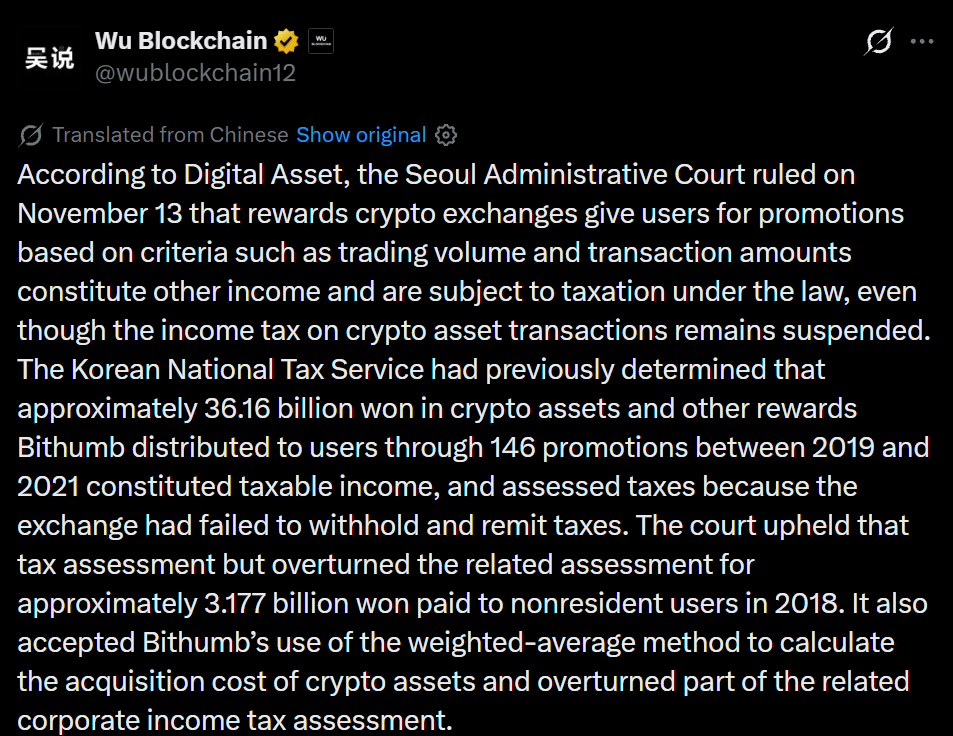
Source: Wu Blockchain Post
Two other issues were involved. The authority said the 2018 nonresident payouts were also taxable in Korea.
It also said the exchange had understated inventory assets by about 10.5 billion won by using the weighted-average method instead of first-in, first-out.
The exchange first went to the Tax Tribunal. In March 2025 the tribunal accepted that trading fee refunds were not other income, and the tax authority cut about 5.1 billion won.
The exchange then sued over the rest.
| Issue | Tax authority's position | Court's ruling |
| Promotion payouts, 2019–2021 (146 promotions) | Taxable other income; tax should have been withheld | Upheld |
| Payouts to nonresident users, 2018 (about 3.177 billion won) | Korean income subject to withholding | Overturned |
| Cost calculation method | First-in, first-out required | Weighted-average accepted; part of corporate tax assessment overturned |
Why Bithumb Event Rewards Count as Taxable
The exchange ran 146 promotions between 2019 and 2021. It gave crypto to members who ranked among the top traders by volume or who reached set transaction amounts.
The exchange argued these were closer to gifts or fee discounts, which would make them a sales discount.
The court disagreed. It treated the payouts as equal to prizes or bounties that users earn by meeting conditions the exchange sets.
In plain terms, Bithumb event rewards looked more like a contest prize than a discount.
The court also drew a clear line. The pause on tax is limited to income from trading and lending crypto. It does not stop tax on crypto that counts as other income in its own right.
Why the Court Sided With the Exchange on Other Points
The 2018 nonresident payouts. The court noted that crypto transaction data is stored across a global blockchain network, not on a central server in Korea.
Korean law lists taxable income by statute, so crypto cannot be treated as a domestic asset just because it was traded on a Korean exchange. A 2020 amendment did create a basis to tax nonresidents' crypto income.
The court saw it as a new tax duty, not a clarification, and it took effect after 2018. About 635 million won of tax on those payouts was therefore cancelled.
The cost method. The court said no clear tax rule or accounting standard covered crypto valuation at the time.
It also found the exchange's crypto had been earned as fees for matching trades between members, not held for sale, so it did not count as inventory under corporate tax law.
It added that Korea's accounting standards body replied to the exchange in March 2018 that management could set its own policy where standards were unclear. Official crypto accounting guidelines only arrived in December 2023.
What the Ruling Means for Exchanges and Users
-
Promotions with conditions carry tax risk. Payouts tied to trading volume or amounts can be treated as other income, and the payer's withholding duty becomes the issue.
-
The paused crypto tax is a separate matter. The 2020 rules on taxing crypto transfers and lending have had their start date delayed three times, now to January 2027. The government has recently been pursuing a further delay to 2029.
-
Open question. The reports do not say whether either side will appeal.
Conclusion
The verdict cuts both ways. The exchange won on the 2018 nonresident payouts and on its cost method, with about 21.8 billion won cancelled.
But the court firmly backed the tax on Bithumb event rewards, ruling that prize-like payouts for meeting conditions are taxable income.
Exchanges planning promotions should note that this line is now clear, and this article is not tax or legal advice.
Disclaimer
This article is for educational and informational purposes only and is not financial or investment advice. Crypto assets are high risk, their prices can be very volatile, and you can lose some or all of your money. Always do your own research and consider speaking with a licensed financial advisor before making investment decisions.






