Blockchain Internet Outage: Online Network, Unreachable Users


What Is a Blockchain Internet Outage, and Why Does It Matter?
A blockchain internet outage does not stop the chain, but it can stop the people who need to reach it. The protocol stays healthy while users inside a shutdown lose their view of it. This guide separates network health from user access, using 2026 shutdown data, cable repairs, hash rate records, and satellite limits.
What a Blockchain Internet Outage Really Breaks
Bitcoin kept adding blocks while Iran spent 87 days far below normal traffic.
The chain and each user's route to it can fail on their own.
A region with 10% of the hash rate would need about 10 hours for six confirmations.
Satellites restore receiving. They cannot send a payment back.
What Is a Blockchain Internet Outage, and Why Does It Matter?
A blockchain internet outage is any event that cuts nodes, miners, or users off from the wider peer-to-peer network. A government order, a broken cable, a failed hosting firm, or a regional power loss can cause one.
Protocol health asks whether miners elsewhere still make valid blocks about every ten minutes. User access asks whether a person can still see a balance and send a payment. One can pass while the other fails.
Does Bitcoin Keep Running When Whole Countries Go Offline?
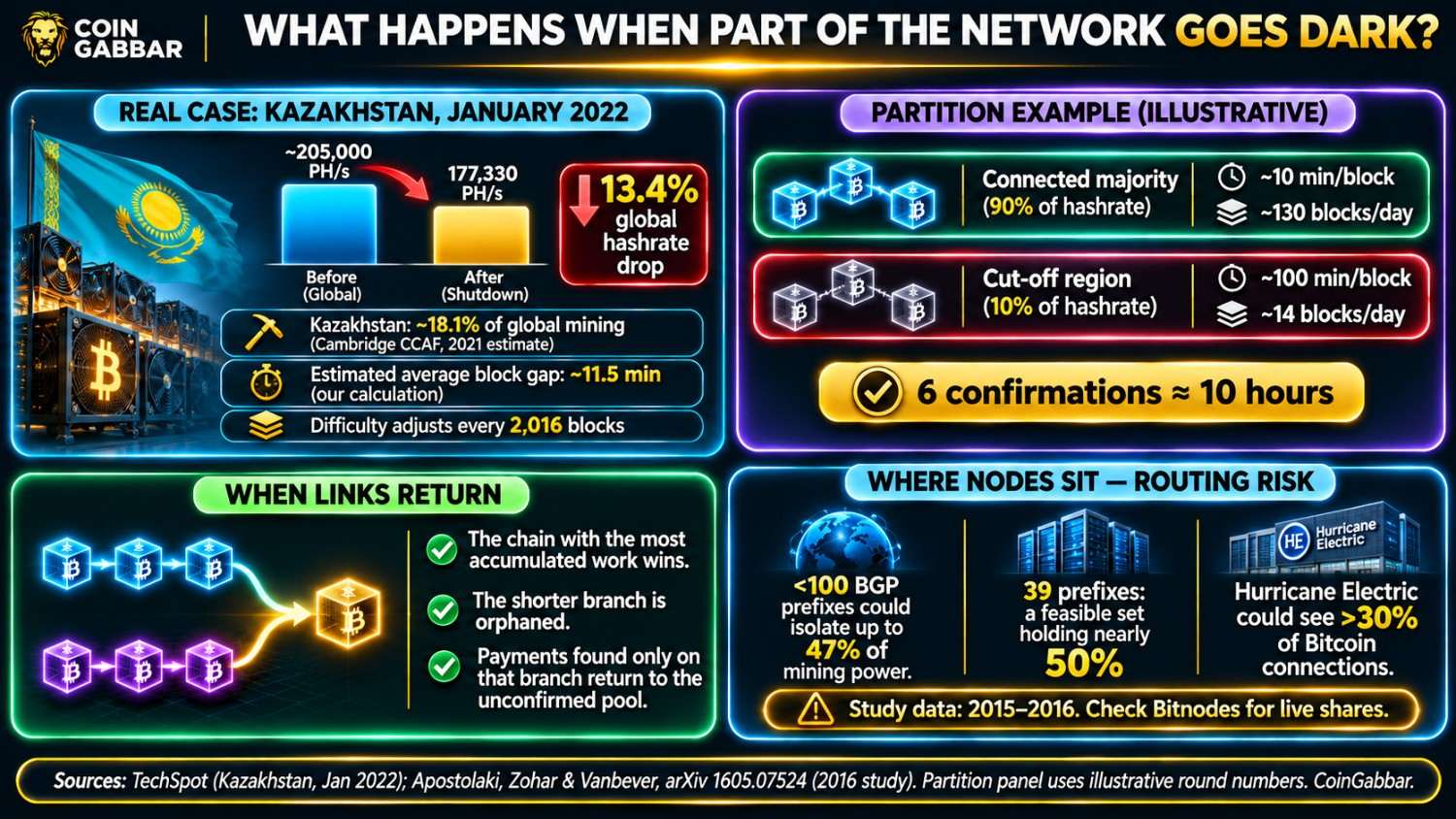
Yes. The clearest test came in January 2022, when Kazakhstan switched off its internet amid protests. It held about 18% of Bitcoin mining, according to a report on the Kazakhstan hash rate drop.
Hash rate is the computing power that secures the chain, and these Bitcoin hash rate basics explain it. The same report shows it fell roughly 13%, from about 205,000 to 177,330 PH/s.
A simple calculation shows the effect. A 13% drop stretches block gaps to about 11.5 minutes until difficulty resets every 2,016 blocks. That blockchain internet outage slowed the chain a little. It never stopped it.
Why Do Decentralized Networks Still Depend on Cables?
A blockchain internet outage can start far out at sea. An ITU briefing on cable resilience says submarine cables carry about 99% of the world's internet traffic. It cites over 170 cable repairs worldwide in 2025, almost four a week.
Tonga shows how long one break can last. A volcano damaged its only cable on 15 January 2022. Cloudflare's Tonga report says full access took 38 days to return. The 827 km link to Fiji had no backup, and a repair ship needed 20 days to replace a 92 km section.
How Often Do Governments Cut Access for Their Users?
More often each year. The Access Now Keep It On report, published 31 March 2026, it counted 313 shutdowns in 52 countries during 2025. That is up from 304 in 2024 and 289 in 2023. Another 75 shutdowns in 33 countries ran into 2026.
Iran gives two recent cases. A March 2026 preprint from the University of Napoli Federico II dates the first shutdown from 8 to 18 January 2026. About 98.14% of Iranian IPv4 space stayed routed, so routing data looked normal while users were blocked.
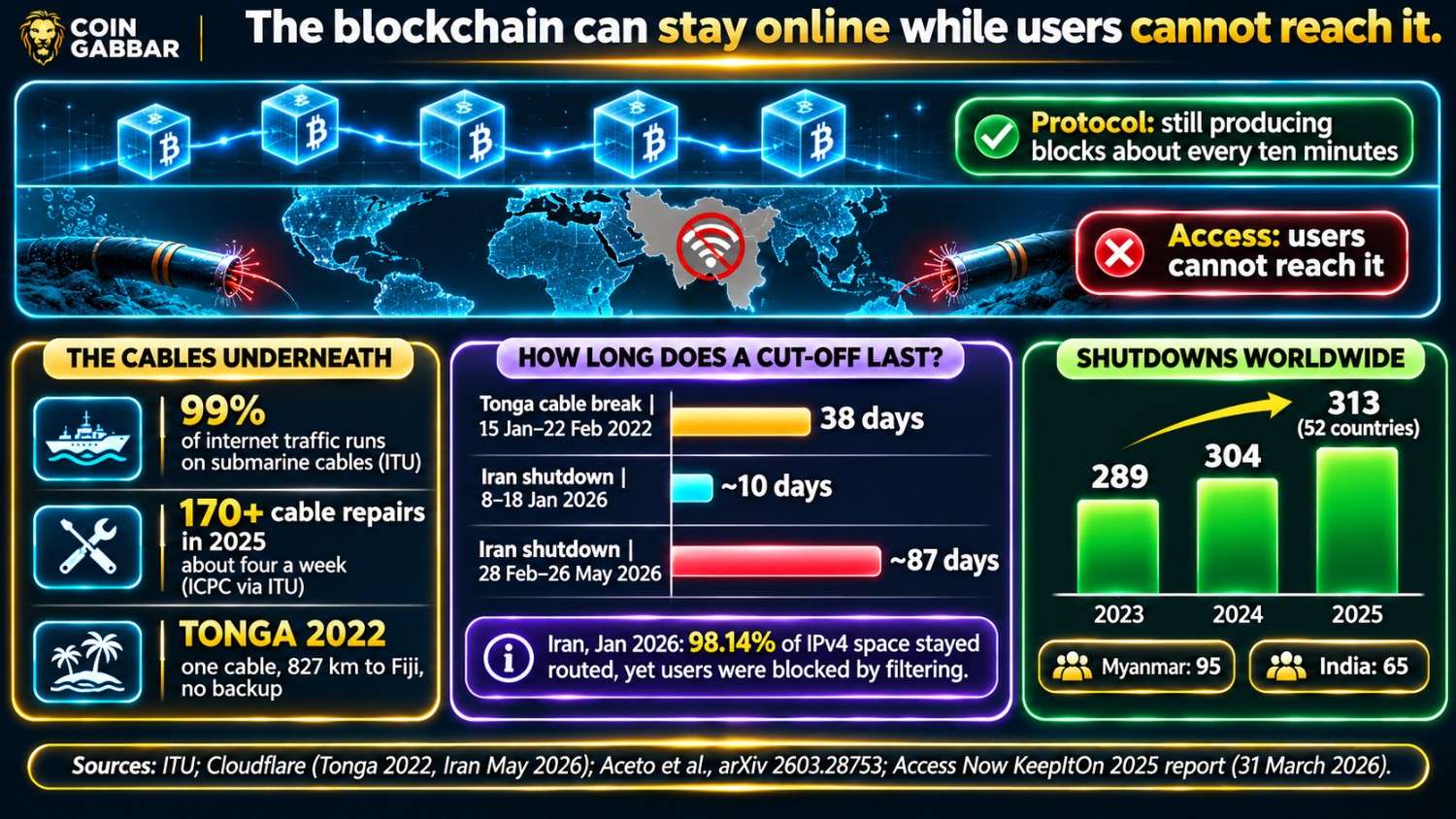
The second began on 28 February 2026. Cloudflare Radar data showed traffic well under 1% of earlier levels until partial relief on 26 May. That is 87 days.
Can a Chain Split During a Blockchain Internet Outage?
Yes, for a while. A network partition happens when groups of nodes cannot reach each other. Each group builds on the blocks it can see.
Take round numbers. A region with 10% of the hash rate is cut off. Its miners would find a block about every 100 minutes. The connected majority slows to about 11 minutes until mining difficulty adjusts.
On the cut-off side, six confirmations would take about ten hours. When links return, nodes keep the chain with the most work. The short branch is orphaned, and payments found only there return to the unconfirmed pool.
Are Bitcoin Nodes Too Concentrated on a Few Networks?
Where nodes sit matters as much as how many exist. The routing study Hijacking Bitcoin found that hijacking fewer than 100 BGP prefixes could isolate up to 47% of mining power. BGP tells networks how to reach each other. One provider, Hurricane Electric, could intercept more than 30% of Bitcoin connections.
The data dates from 2015 and 2016, so it warns about a type of risk. It is not a live measurement. The Bitnodes tracker shows the current split, and a full node setup guide shows how home operators add variety.
Can Satellites and Mesh Radios Keep Bitcoin Reachable?
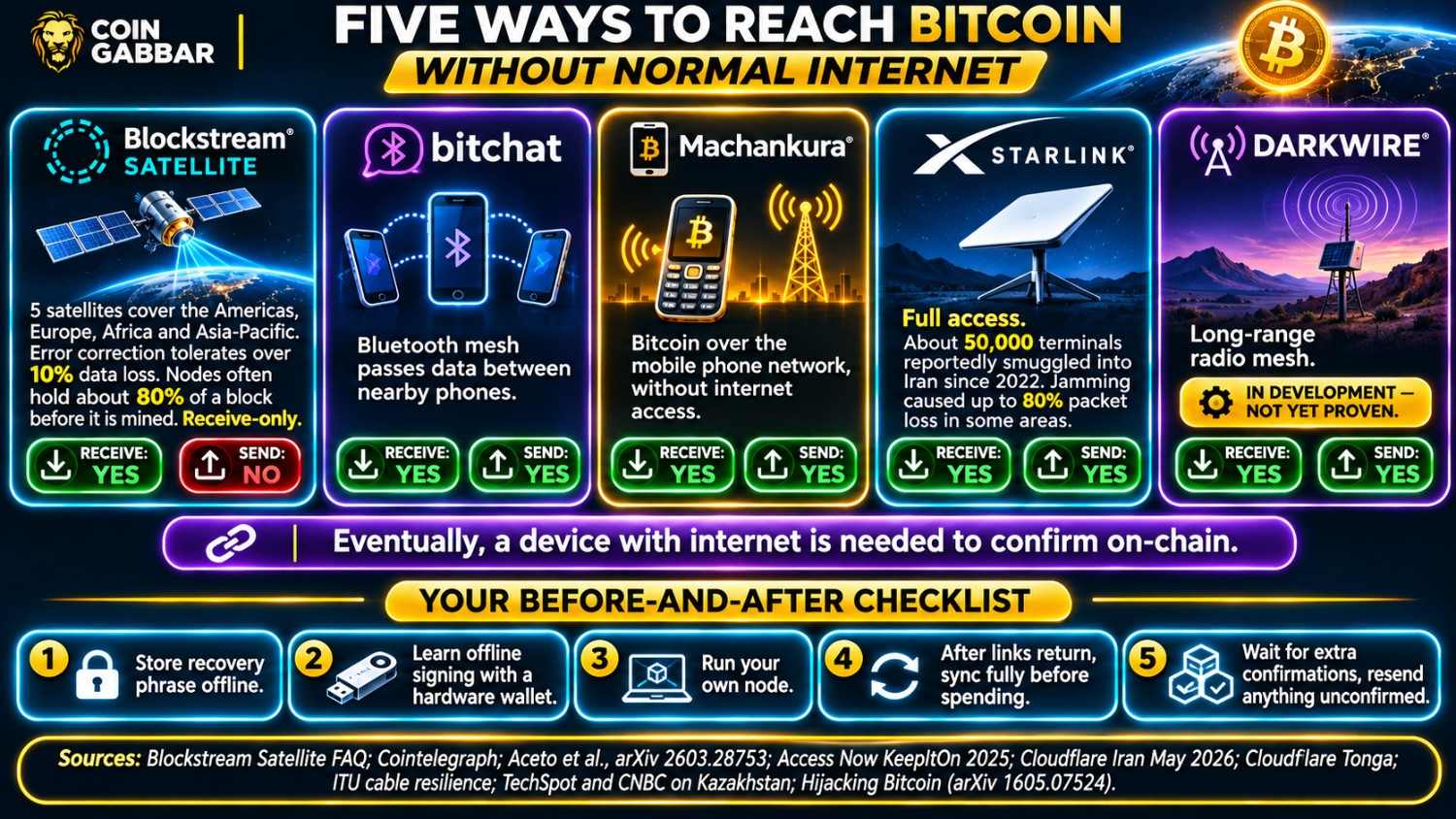
Partly. During a blockchain internet outage, each tool covers a different half of the problem. The Blockstream Satellite FAQ says five satellites span the Americas, Europe, Africa, and Asia-Pacific. Reception is receive-only, so sending a payment needs another channel.
A report on offline crypto options in Iran lists several. Bitchat passes data over a Bluetooth mesh between phones. Machankura moves Bitcoin over the mobile phone network. Darkwire, a radio mesh, is still in development.
Starlink is fuller but riskier. The Napoli authors note about 50,000 terminals were reportedly smuggled into Iran since 2022, and jamming caused up to 80% packet loss in some areas. A Lightning Network payments guide covers a payment layer some tools use.
What Should Users Do Before a Blockchain Internet Outage?
These are general steps, not advice.
Store the recovery phrase offline, so a lost phone never means lost coins.
Learn offline signing, as this hardware wallet guide shows, and keep a second connection from another provider.
Run a personal node if possible, so the wallet checks facts instead of trusting one server.
After an outage, let the wallet finish syncing, then confirm earlier payments still show as confirmed.
Wait for extra confirmations on payments received during a shutdown.
Which Network Resilience Terms Matter, in Plain Words?
Node: a computer that checks and passes along Bitcoin blocks.
Orphaned block: a valid block that lost to a heavier chain.
BGP: the system that tells networks how to reach each other.
Confirmation: one block built on top of a payment's block.
Network partition: a split in which nodes cannot reach each other.
What Is the Bottom Line on a Blockchain Internet Outage?
A blockchain internet outage tests access, not consensus. The chain slowed in Kazakhstan and kept going, while users in Iran lost access for 87 days. Resilience starts with a reader's own keys, backups, and second connection.
Expert Opinion: Is Bitcoin Still Decentralized Offline?
CoinGabbar applies a three-layer check to outage stories: consensus, routing and last mile. Consensus held in Kazakhstan, where a roughly 13% hash rate drop only stretched block times. Iran showed that a country can be filtered out for 87 days while its routes look normal, and a blockchain internet outage exposes that gap.
This is an editorial reading, not a forecast. The research reviewed has no measured Bitcoin payment volume for the Iranian shutdowns, so claims about market effects remain unproven. This page will be updated if Access Now or Cloudflare Radar publish new data.
Disclaimer: This article is for information only and is not financial, legal, or tax advice. Crypto assets are volatile, and holders can lose some or all of their money. Shutdown rules and limits on satellite equipment differ by country, and past events do not guarantee future outcomes. Readers should consult a qualified adviser before making decisions about their funds.