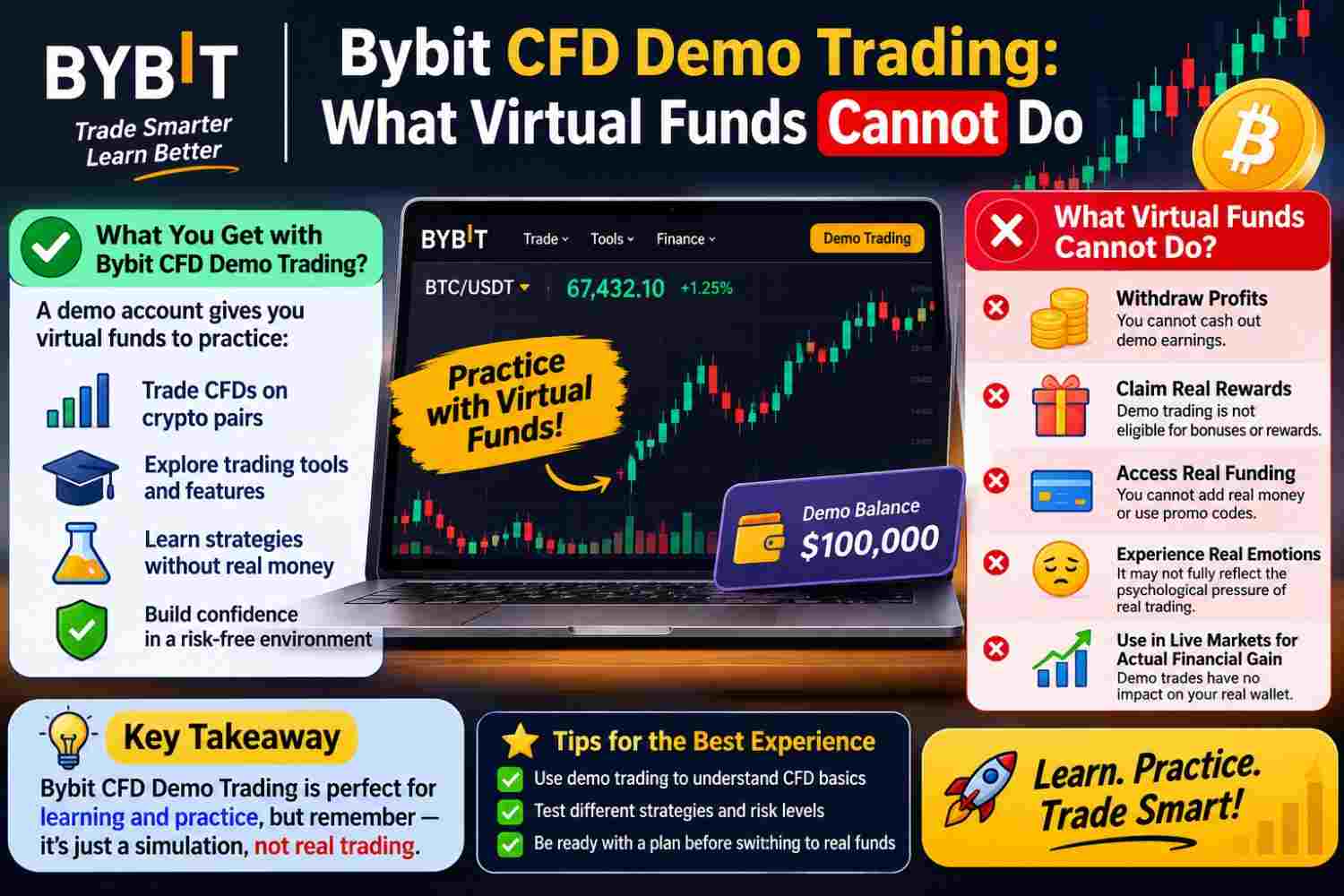
Bybit CFD Demo Trading: What Virtual Funds Cannot Do

Why Is Bybit CFD Demo Trading Getting So Much Attention?
Bybit CFD Demo Trading lets people practice CFD trades with fake money before any real cash is at risk, and that’s why more readers have been searching for it since Bybit changed the name of its TradFi product to CFD in July 2026.
CFD, short for contract for difference, is a deal that pays or charges the change in price of something like gold, a stock index, or a currency pair, and the trader never owns the asset.
Mode sounds harmless, and mostly it is, but results in practice and results with real money can be far apart. This guide covers what the feature is, how it works, how to check it, and where fake funds stop helping.
What Is Bybit CFD Demo Trading and How Does It Work?
Demo trading on Bybit is a practice mode that uses fake money and live market prices, so traders can test ideas without risking real cash. Bybit offers it in two forms, and they’re easy to mix up.
The first is Demo Trading inside the Unified Trading Account, which the Bybit help center describes as a practice mode for Spot and Derivatives. The second is the MT5 demo account, which runs on the MetaTrader 5 platform behind Bybit’s CFD product.
How It Works
Unified Trading Account demo:
Bybit sets it up on its own for every user.
No ID check is needed.
It starts with 50,000 USDT, 50,000 USDC, 1 BTC, and 1 ETH of practice money.
MT5 demo account:
It uses a separate server called Bybit-Demo, according to Bybit’s own guide.
It pulls live market prices with small built-in changes.
Leverage and margin rules stay close to the live account.
Only a verified main account holder can open an MT5 account.
The demo funding menu gives a choice of 500, 1,000, 5,000, or 10,000 USDT.
Which Features Matter Most Before Going Live?
Bybit CFD Demo Trading comes with most of the tools found on a live MT5 terminal, such as chart indicators, charts with different time frames, many order types, and Expert Advisors, which are small programs that place trades by set rules.
Bybit’s official CFD page lists more than 400 markets across forex, metals, indices, stocks, and commodities, with leverage up to 500x tied to forex pairs. CFD accounts close positions automatically, which is called liquidation, once the margin level falls to 50%.
Bybit says the CFD product is powered by Infra Capital, which is Mauritius FSC licensed, and its announcements say people living in the European Economic Area, among other regions, can’t use it.
How to Verify a Demo Account Step by Step
Five quick checks help tell a real demo account from a live one.
Open demo mode from the official Bybit website or app, then find the bright Demo Trading label at the top of the page.
On MT5, make sure the server field says Bybit-Demo and the account ID matches the MT5 Demo ID shown under the demo tab.
Make sure the balance is made of practice funds, since demo assets have no real value and aren’t deposits.
Read the CFD page for the product name, the Infra Capital license note, and the list of restricted regions before assuming access.
Compare the steps in the app with the help center page, which was last updated on October 30, 2026, because menus often change after a rename.
What Causes the Gap Between Demo and Live Results?
The Bybit help center says orders filled in demo mode never enter the real order book, so a big order that would move the price in a market leaves no mark in practice.
Fills in a practice feed therefore tend to seem cleaner than real ones, and the built-in price changes in the MT5 demo mean results never match live trading exactly.
Slippage, which is the gap between the price expected and the price actually received, can grow when the market moves fast. Emotion matters too, because Bybit’s own MT5 guide admits that demo trading can’t fully copy the feelings of live trading.
Free refills add one more problem, since more funds can be requested whenever equity drops below 10,000 USDT.
What Are the Main Risks of Relying on Bybit CFD Demo Trading?
CFDs are complex products, and Bybit’s own CFD page warns about leverage, price swings, and liquidity.
With 500x leverage, a price move of just 0.2% can wipe out a whole position.
A winning demo record says little about future live results.
Strategies tested without slippage or fear often act differently once real money is on the line.
Which Related Bybit Topics Deserve Research Next?
Readers weighing the platform can continue with a Bybit review to compare fees, safety, and product range, or with Bybit vs. Binance coverage to compare the two exchanges.
Bybit open interest data shows how many derivative contracts are still open, which helps measure market activity but doesn’t predict direction. Crypto copy trading, which Bybit’s help center lists in Classic, TradFi, and Pro versions, lets followers mirror master traders and brings its own risks.
Bybit restricted counterparty discussions belong on the same reading list when access is in doubt, while Bybit listing news, Bybit AI trading tools such as the TradeGPT bot, and Bybit banking services like Bybit Card and Bybit Pay sit outside CFD practice.
What Does the Data Say About Bybit CFD Demo Trading?
The strongest point is access. Demo mode costs nothing, needs no ID check or deposit for the standard version, and uses live market data closely enough to teach how the platform, order types, and margin work.
The main worry is how useful the lessons are on profit, because practice fills, built-in price changes, and refillable balances all make results seem better than they’d be live.
Still unclear is how closely the CFD practice setup follows live spreads in volatile sessions, since Bybit’s published material gives no figures on that.
Readers should check current fees, margin rules, where the product is offered, and the license holder on official pages before opening a live account.
Bybit CFD Demo Trading works best as practice for learning the platform and, worst of all, proof that a strategy will make money.
Conclusion
This practice mode is a free and handy way to learn the platform, the order tools, and the margin rules behind leveraged smart contracts.
Its biggest limits are practice fills, free refills, and the lack of real pressure on the trader. The checks above deserve a read before any live decision.
Disclaimer
This article is for informational purposes only and isn’t financial advice. CFDs and crypto are high-risk products, leverage can magnify losses, and demo results don’t guarantee live performance. Readers should research independently and consult a licensed advisor before trading.