Cardano news today: ADA crash deepens despite development push


If you’re checking Cardano news today, the short version is this: ADA is down, oil is up, and the Cardano treasury is about to vote on buying copper. Three stories collided on the same day, and none of them happened in isolation.
ADA is trading at $0.212, down 2.2% on the day. It touched a weekly low today after sliding from $0.217 to $0.207 within hours. Zoom out to seven days and the drop reads worse: 5.9% for the week. Market cap sits at $7.931B, with $235.05M changing hands in the last 24 hours.
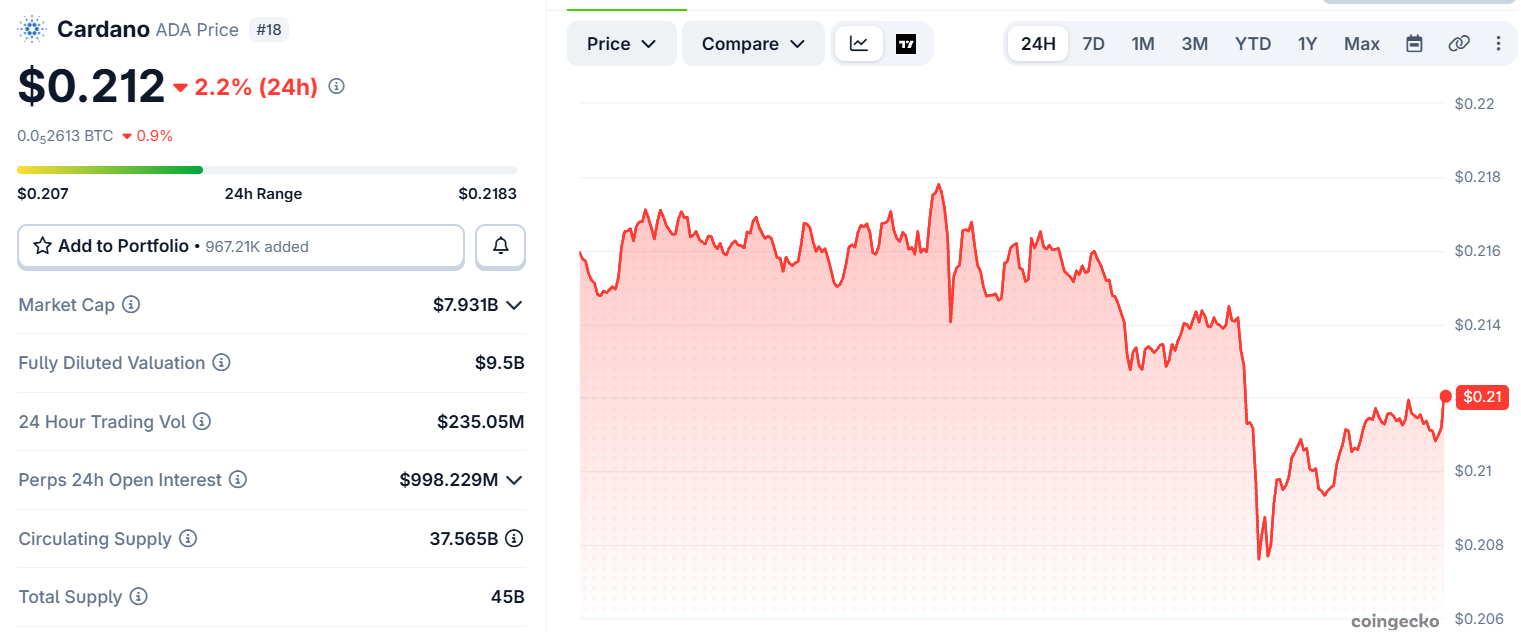
Source: Coingecko Data
That’s the backdrop for everything else in Cardano news today.
Three Key Takeaways
- ADA price crash today: Down 2.2% to $0.212, with a 5.9% weekly drop and a fresh weekly low.
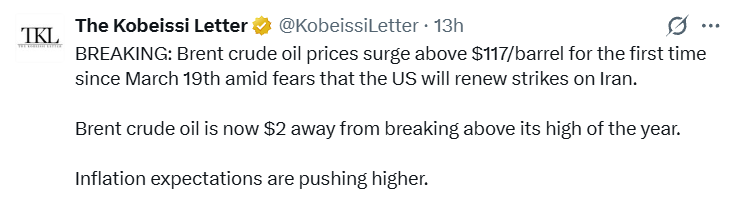
- The real trigger isn’t crypto: Brent crude jumped above $117 a barrel on Iran strike fears, per the Kobeissi Letter, pulling risk assets like ADA down with it.
- Cardano is still building: Leios, Hydra, Plutus and a new tool called Hades all moved forward this week, and a $5M copper reserve vote closes November 15.
Why Is ADA Price Down Today? Blame The Oil Market First
Here’s the part most people miss when they ask why is ADA price down today. It didn’t start with crypto. It started with oil.
According to a post from the Kobeissi Letter on X, Brent crude surged past $117 a barrel for the first time since March 19, driven by fear that the US will renew strikes on Iran. The post notes Brent is now just $2 away from breaking its high for the year, and inflation expectations are climbing again.
Source: X Post
Trading Economics data backs this up with harder numbers. At the time of writing, crude oil sat at $103.270, up 3.82% intraday. Brent oil itself traded at $116.72, up 3.14% in a single day.
Why does an oil spike hit ADA? When oil jumps on war fear, inflation expectations rise with it. Traders read that as a signal that interest rates could stay higher for longer. Higher rate expectations push money out of volatile assets, and ADA, as a smaller cap token, gets hit harder than large caps.
That’s the chain reaction behind Cardano news today and the price crash.
ADA Price Snapshot
| Metric | Value |
|---|---|
| ADA price today | $0.212 |
| 24-hour change | -2.2% |
| Weekly change | -5.9% |
| Market cap | $7.931B |
| 24-hour volume | $235.05M |
| Intraday range | $0.207 - $0.217 |
Cardano News Today: Development Report Explained
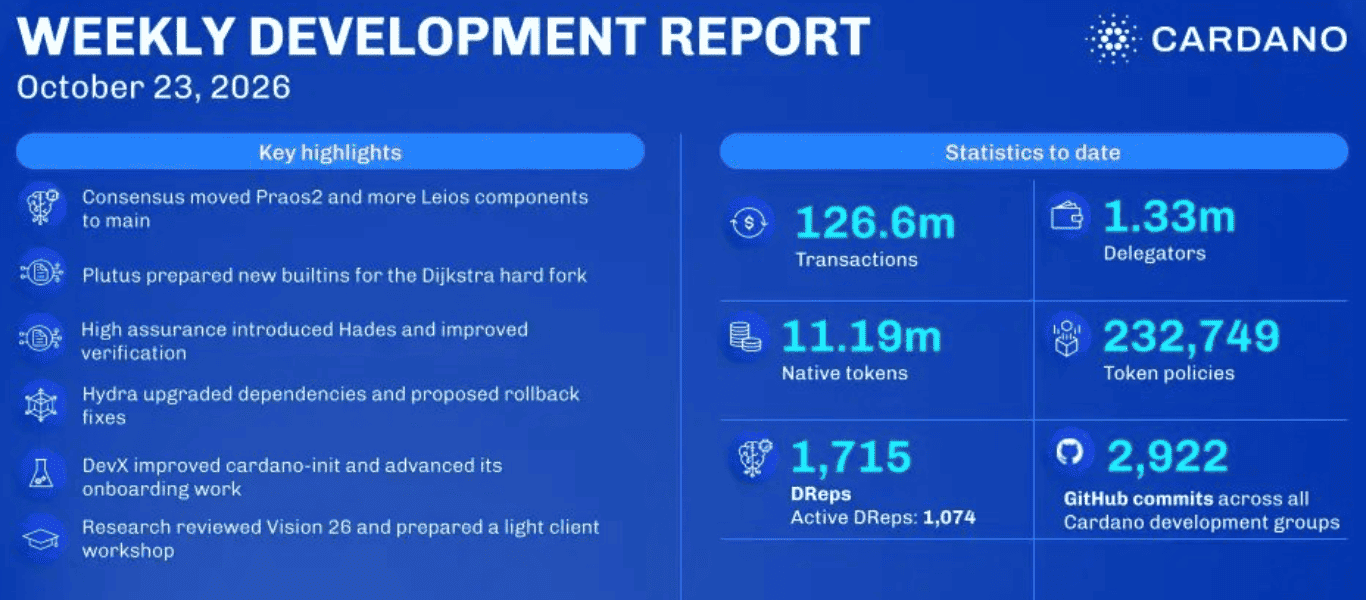
While the price fell, the Cardanians account on X shared a weekly Cardano development report, and it shows real work shipped across five teams.
Source: X Post
On consensus development, Praos2 (Praos combined with the Leios overlay) merged into main, along with LeiosNotify clients and LeiosFetch servers. Selecting and fetching Endorser Blocks is next on the list. The team also tightened checks on peer announcements and certificates, and the prototype network now needs a restart from genesis, not Cardano mainnet, to pick up the new Leios header format from Dijkstra onward. A maintenance release, ouroboros-consensus 5.1.0.1, shipped alongside a tracing fix that stops Dijkstra validation failures from crashing the tracing thread.
On scaling, Hydra upgraded its dependencies to cardano-node 11.1.3 and cardano-api 11.7.0.0, while Plutus moved to version 1.68, producing smaller compiled scripts. Rollback recovery, snapshot handling and even experimental Windows support (hydra-node only, untested for live connectivity) are open as proposals, not finished releases yet.
On developer experience, cardano-init 0.3.0 launched October 12 with short flags and project scaffolding. The Beginner and Intermediate onboarding path entered staging review, though advanced lessons are still under review. A community pledge reached 36 signatories, and a bounty-program guide remains a draft.
On smart contracts, Plutus enabled multiIndexArray and four new Value builtins for Dijkstra, usable only after the hard fork activates. And in high assurance, the team introduced Hades, a new container environment for building and verifying smart contracts, alongside performance fixes merged into the Z3 solver that powers Blaster.
The research team also hosted a Cardano R&D session covering Q3 progress on Vision 26, and registration is now open for a light client architecture workshop next week.
Cardano Copper Reserve Proposal: What’s Actually On The Table
This is the headline that caught traders off guard. Toto Finance published a breakdown of its Cardano copper reserve proposal on X, asking the Cardano treasury to fund a copper reserve with 22M ADA, worth roughly $5 million.
The plan: buy real copper, store it in a COMEX-approved warehouse, and issue one CuTT token for every pound held. Toto Finance would hold the metal for up to two years before selling, with leftover proceeds returning to the treasury. About two-thirds of the funds go toward physical copper, the rest covers operations, storage, insurance and audits. This single proposal would use more than half of the treasury’s remaining withdrawal allowance.
The math matters here. Under Toto Finance’s own assumptions, copper needs to rise from $6.73 to about $10.06 per pound just to recover the full withdrawal, assuming ADA’s price stays flat. Toto Finance also keeps commercial rights to its separate tokenized copper business. There’s no guarantee the treasury gets its money back. ADA Voting closes November 15.
Separately, Charles Hoskinson weighed in on where Cardano fits long term, saying crypto and AI “have a natural connection,” arguing that pairing AI with smart contracts creates systems that are abstract and multi-chain by design.
What Next For Cardano?
Nothing here resolves instantly. The oil-driven pressure on ADA depends on whether Iran tensions ease or escalate. The development work depends on the Dijkstra hard fork actually activating before any of the new builtins go live. And the copper reserve proposal depends entirely on the treasury vote closing November 15.
For now, Cardano news today is a story of a token under macro pressure while its engineering roadmap keeps moving regardless of price.
Expert Opinion: The pattern seen in Cardano news today lines up with how mid-cap tokens typically behave during macro stress. ADA’s drop tracks a broader risk-off move triggered by oil and inflation fears rather than anything specific to Cardano’s own technology. Development output, including the Leios and Hydra progress, does not usually move price in the short term, but it does shape whether a network can scale once broader market conditions stabilize.
The copper reserve proposal introduces a different kind of risk, tied to treasury governance and commodity pricing rather than blockchain performance, and its outcome on November 15 will say more about Cardano’s treasury strategy than about ADA’s price direction.
YMYL Disclaimer: This content is for informational purposes only and does not constitute financial, investment or trading advice. Cryptocurrency prices are volatile and can change rapidly. Figures cited reflect the time of writing and may have changed since publication. Always do your own research and consult a licensed financial advisor before making investment decisions.









