Cardano News Today: ADA Crash Hard Despite Brale and Validator Update


Cardano is having a rough morning. You'd think two solid pieces of network news would hold the price steady, but that's not how today is playing out. ADA is sliding along with the rest of the market, and the reasons go well beyond Cardano itself.
This is your complete Cardano news today breakdown of the price action, the two big updates that dropped today, the real reason behind the crash, and what's lined up next for the network.
Key Takeaways
ADA trades at $0.1428 today, down 2.8%, with a market cap of $5.368B and $193.96M in 24-hour volume, per CoinGecko data.
Cardano went live on Brale today, letting businesses issue their own USD stablecoin on the network, while Token Terminal data shows Cardano's validator count grew 14.9% in a year, the fastest among top proof-of-stake networks.
The crash isn't really about Cardano. A reported hack of the CIA and ODNI, plus today's US PCE inflation and GDP data, are dragging the entire market down with it.
ADA Price Today: Just How Bad Is the Drop?
Cardano price today sits at $0.1428. That's a 2.8% drop for the day. In the last 24 hours alone, the coin swung from $0.1496 down to $0.1418 before settling where it is now. Zoom out to a week, and it's worse: ADA is down more than 6.7% over seven days.
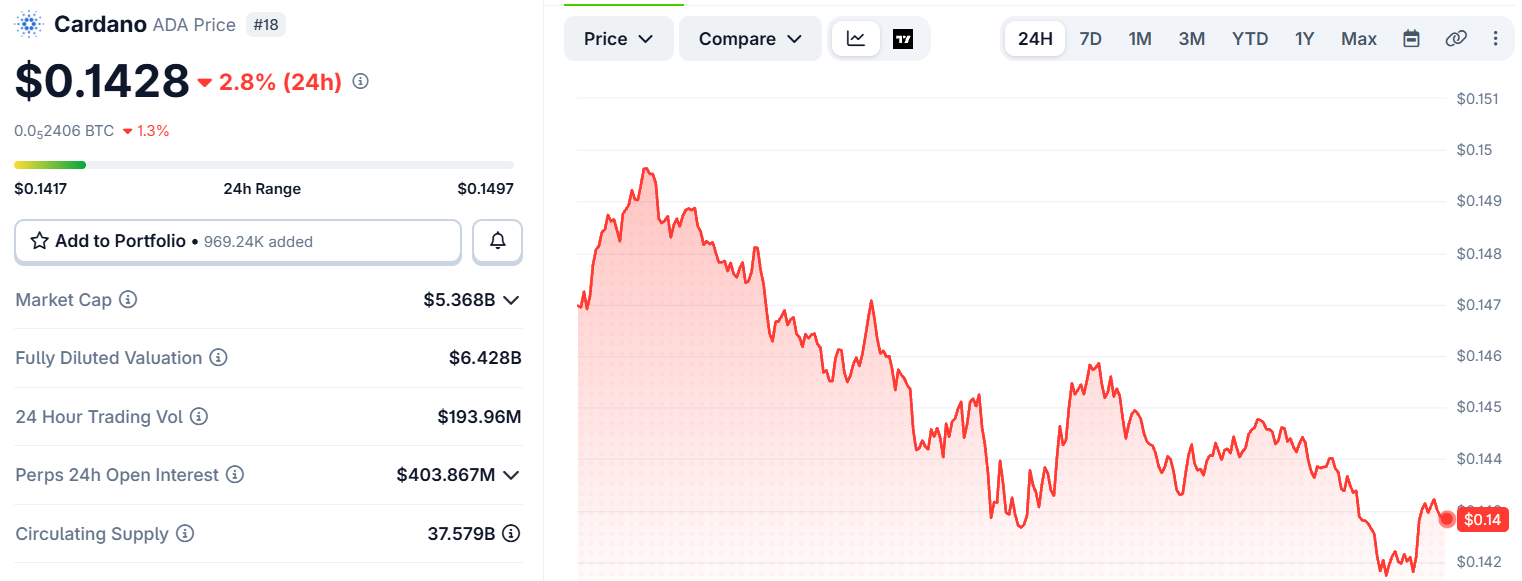
Source: CoinGecko Data | November 25, 2026 | Time: 9:30 AM
Metric | Figure |
ADA Price | $0.1428 |
24-Hour Change | -2.8% |
Market Cap | $5.368B |
24-Hour Volume | $193.96M |
24-Hour Range | $0.1418 - $0.1496 |
7-Day Change | -6.7% |
Cardano News Today: Cardano Goes Live on Brale, What Does It Mean?
This is the first big piece of Cardano news today. According to a Cardano Foundation post on X, Cardano is now live on Brale. In plain terms, this means businesses can now issue their own regulated, dollar-backed stablecoin directly on Cardano.
They can also use existing stablecoins on the network for settlement, payouts, and treasury work, and move them across 30 different chains.
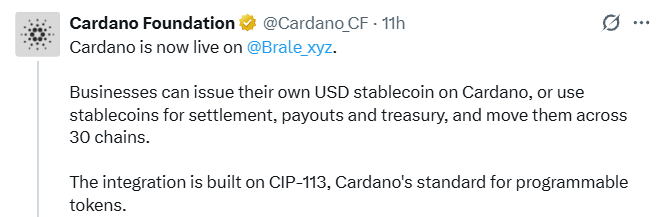
Source: X Post
The integration runs on CIP-113, which is Cardano's standard for programmable tokens, tokens that can carry built-in rules for how they move and who can use them. This isn't a new idea coming out of nowhere either. Brale and the Cardano Foundation had already announced a partnership to bring stablecoin issuance to Cardano, and this launch is that plan going live. Any team already using Brale can simply add Cardano without building a fresh integration from scratch.
Cardano Leads in Validator Growth, Why Does It Matter?
The second piece of good news comes from Token Terminal data, which shows Cardano led every major proof-of-stake network in validator growth over the past year. A validator, in simple terms, is a computer that helps confirm transactions and keep the network secure.
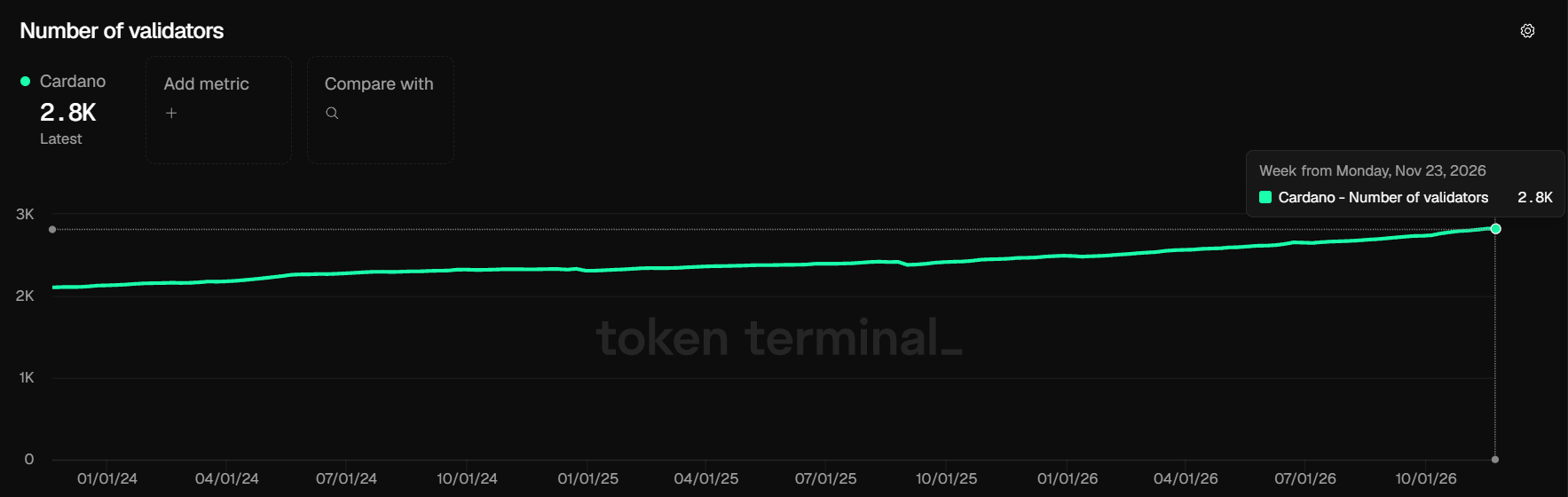
Source: Official Site | November 25, 2026 | Time: 9:30 AM
Cardano's validator count climbed 14.9% over the year to reach 2,823, the highest growth rate among the top 10 proof-of-stake networks. More validators spread out across more people generally means a more decentralized, harder-to-manipulate network.
On top of that, Cardano now has $3.2B staked, which works out to 47.5% of its fully diluted valuation, a sign that a large chunk of ADA token holders are choosing to lock up their coins rather than sell. That growth is a key thread in today's Cardano news story, even with the price sliding.
So Why Is Cardano Crashing Today?
Here's the part that confuses people. Two solid updates dropped, yet ADA is still down. Why? Because this isn't a Cardano problem, it's a market problem, and most of today's Cardano news today coverage across the wider market says the same thing.
According to a post from The Kobeissi Letter on X, the CIA and the Office of the Director of National Intelligence have reportedly been hacked.
Exposing unclassified intelligence information, according to the New York Times. This follows earlier reported breaches at the FBI and the USDA, along with several outages across US government systems. News like this rattles investors across every risk asset, and crypto gets hit especially hard because it trades around the clock.
On top of that, two major economic reports are landing today. The October US PCE inflation data releases Wednesday, November 25, 2026 at 8:30 am ET. One market commentator expects the headline rate to climb from 3.6% to 3.8%.
US GDP data is also scheduled for release today. Higher-than-expected inflation tends to cool off risk appetite fast, and that pressure is clearly showing up in ADA's chart alongside the rest of the market.
What's Next for Cardano?
Looking ahead, there's a concrete date to watch. According to a post from Cardanians on X, Ouroboros Leios is now targeting January 2027 for the Dijkstra hard fork. Leios is Cardano's project to make the network process transactions faster and handle more of them at once.
The full build is being folded into Node 11.3.0, which will become Node 12.0.0 once testing and benchmarking wrap up. Carlos Lopez de Lara, the Leios Product Manager, shared this update directly on X.
Expert Opinion: Cardano news today notes that today's drop lines up with broader risk-off conditions rather than anything specific to the network. The Brale stablecoin launch and the validator growth data both point to steady building happening under the surface, even while the price chart looks ugly. Whether ADA holds current levels may depend more on how the PCE inflation print lands than on anything Cardano itself does this week.
Conclusion
Cardano news today shows a network that isn't really the problem. Between a reported government hack and fresh inflation data, the market dragged ADA down despite real progress on stablecoins and network growth.
January 2027's Dijkstra hard fork is the next big date to watch.
Disclaimer: This content is for informational purposes only and does not constitute financial, investment, or trading advice. Cryptocurrency prices are volatile and can result in significant losses. Always do your own research and consult a licensed financial advisor before making investment decisions.


Frequently Asked Questions (FAQ)




