CARV Tokenomics: Gaming Data Utility, Supply, and Unlock Risks

What Is CARV, and How Does Its Token Fit the Gaming Data Model
CARV Tokenomics is back in crypto news today for a simple reason. The token has fallen far from its 2024 high, and more tokens unlock every month.
As per the public market data, on November 10, 2026, CARV is valued at approximately $0.0276 with a market capitalization of $20.3 million. This huge difference between the historical price and the current price has resulted in several readers looking for an explanation for CARV tokenomics.
This guide covers what the project does, how CARV token utility works, how the CARV token distribution is split, and where the unlock risks sit.
What Is CARV, and What Does It Do?
CARV is a blockchain project that builds identity and data tools for gaming and AI. Its CARV ID puts a player’s game accounts and activity into one profile, using a standard called ERC-7231.
The project says users keep control of that data and can earn from it. Official CARV documentation also describes an SVM Chain and a framework that checks data.
Key Features of the CARV Gaming Ecosystem
The CARV gaming ecosystem has a few main parts, based on the project’s roadmap:
CARV ID: one portable identity, which the roadmap links to 2.8M NFT holders.
CARV Play: a game portal and mobile app that the project says has 1.2M+ players across 450+ games.
Banana: a Telegram mini-game that the roadmap credits with 8M+ players.
How Does CARV Work?
CARV works in layers. The SVM Chain runs transactions fast, much like Solana, and then settles them on Ethereum.
A framework called D.A.T.A. checks data using secure hardware and digital proofs, and the project’s public profile says more than 60,000 verifier nodes help confirm it. Data owners, providers, and consumers earn rewards along the way.
What Is CARV Token Utility?
CARV token utility covers a few jobs, based on the official token utility page. The token is used for voting and for gas fees on the SVM Chain. It also pairs with AI agent tokens in trading pools, and it pays for premium features like game items and gated data.
Holders can stake CARV to get veCARV at a 1:1 rate. That version can’t be moved, and it brings voting rights and node rewards. Getting CARV back takes time. Waiting 15 days returns 25%, 90 days returns 60%, and 150 days returns 100%, plus a 1 CARV fee per request. Anything left over goes to the treasury.
How Is CARV Tokenomics Structured Today?
CARV Tokenomics begins with 1B total tokens, released over four years after launch. The official distribution and vesting page shows the split below.
Allocation | Share | Purpose |
Nodes and Community | 50% | Rewards for contributors |
Founding Team and Advisors | 19.459% | Core contributors |
Early Investors | 9.246% | Seed and strategic backers |
Private Fundraising | 8.295% | Series A and later investors |
Ecosystem and Treasury | 9% | Treasury holdings |
Liquidity | 4% | Market liquidity |
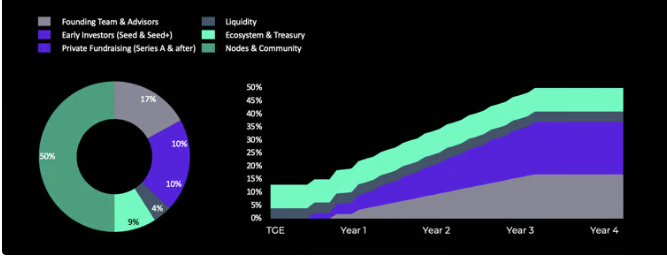
Half of all tokens sit with nodes and the community, so the CARV token vesting schedule shows small releases to those wallets each month. The founding team and advisors hold the next biggest share.
Early and private investors hold about 17.5% together. An older chart shows different numbers (17%, 10%, and 10%), so the current docs are the safer guide.
What Does the CARV Roadmap Say?
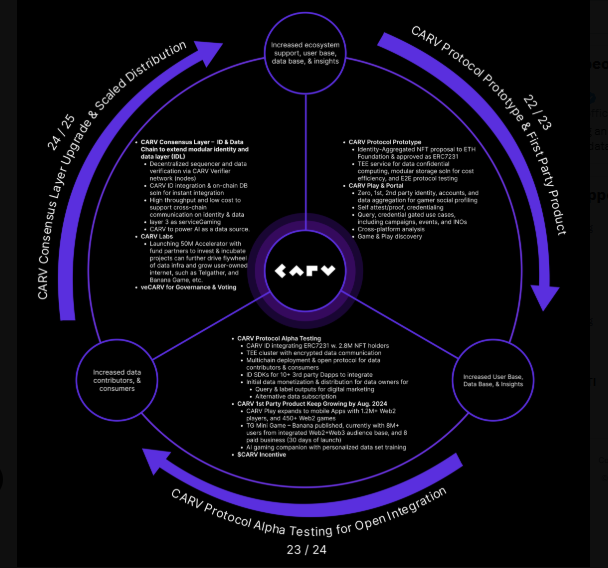
The roadmap splits CARV’s plan into three phases. It comes from older 2024 material, though, so progress should be checked against current updates.
Phase 1: build the protocol prototype and a first game product. The ERC-7231 idea won approval from the Ethereum Foundation, and CARV Play with its portal was the first product.
Phase 2: alpha testing for open use. It covered a multichain launch, tools for 10+ outside apps, and rewards for sharing data.
Phase 3: a consensus layer for identity and data, a 50M accelerator called CARV Labs, and veCARV voting.
Since then, the project has moved toward an SVM chain and AI agents, so the plan has changed from the original chart.
How Does the CARV Token Unlock Schedule Affect Supply?
The CARV token unlock schedule matters because the circulating supply of CARV, now about 736.75M out of 1B, keeps growing.
According to Unlock tracker information, the next token release will take place on December 9, 2026, with a total amount of 9.75M tokens valued at around $269K, accounting for roughly 1.26% of the total circulating supply. The next release will have a smaller volume of 4.40M tokens on January 9, 2027.
However, not all unlocks are equally significant. On October 10, tracker data showed a 38.78M release, or 5.01% of circulating supply, that went to the team, early investors, and private investors. Those groups are the most likely to sell, so insider unlocks get more attention than community rewards.
Fully diluted valuation (FDV) is $27.56M. That number assumes all 1B tokens exist today, so it isn’t the same as market cap. Price sits about 98% under the 2024 high of $1.40.
What Are the Main Risks Behind CARV Tokenomics?
Supply pressure comes first. Even small monthly unlocks add tokens, while daily trading volume stays near $1.65M, so a big insider release could meet weak demand.
Next is the gap between claims and real use. A project post says CARV reached 2.5M users and $6M in combined revenue in 2024, but that number isn’t an independent audit, so current activity needs checking.
Last is the VECARV exit. Holders who want full value must wait 150 days, and every request costs a 1 CARV fee.
What Does the Data Say About CARV Tokenomics?
The four-year distribution schedule of the CARV tokenomics is the strongest point of the model that allows spreading the supply into time rather than throwing it out into the market all at once.
The most disturbing factor is the unlocking from the insiders' side, given the low trading activity. It is still uncertain how much demand can be created by the gaming ecosystem and CARV token since prices rely on usage and not distribution charts.
The circulating supply, as well as the volume unlocked, has to be checked regularly through the official resources like documents, blockchain explorers, and monitoring systems because release dates may change from time to time.
Final Thoughts on the CARV Project
CARV builds identity and data tools for gaming and AI, and its token pays for gas, voting, staking, and premium features.
The supply plan is clear on paper, with 1B tokens over four years and half set aside for nodes and the community. Demand is the open question, since unlocks continue while price stays far below its high.
Readers following CARV Tokenomics in crypto news today should check fresh unlock data and the CARV documentation first.
Disclaimer
This article is for information only and isn’t financial advice. Crypto is volatile and high risk, so readers should research on their own and talk to a licensed advisor before any decision.
















