Casino Bankroll Management Budgets Limits and Risks

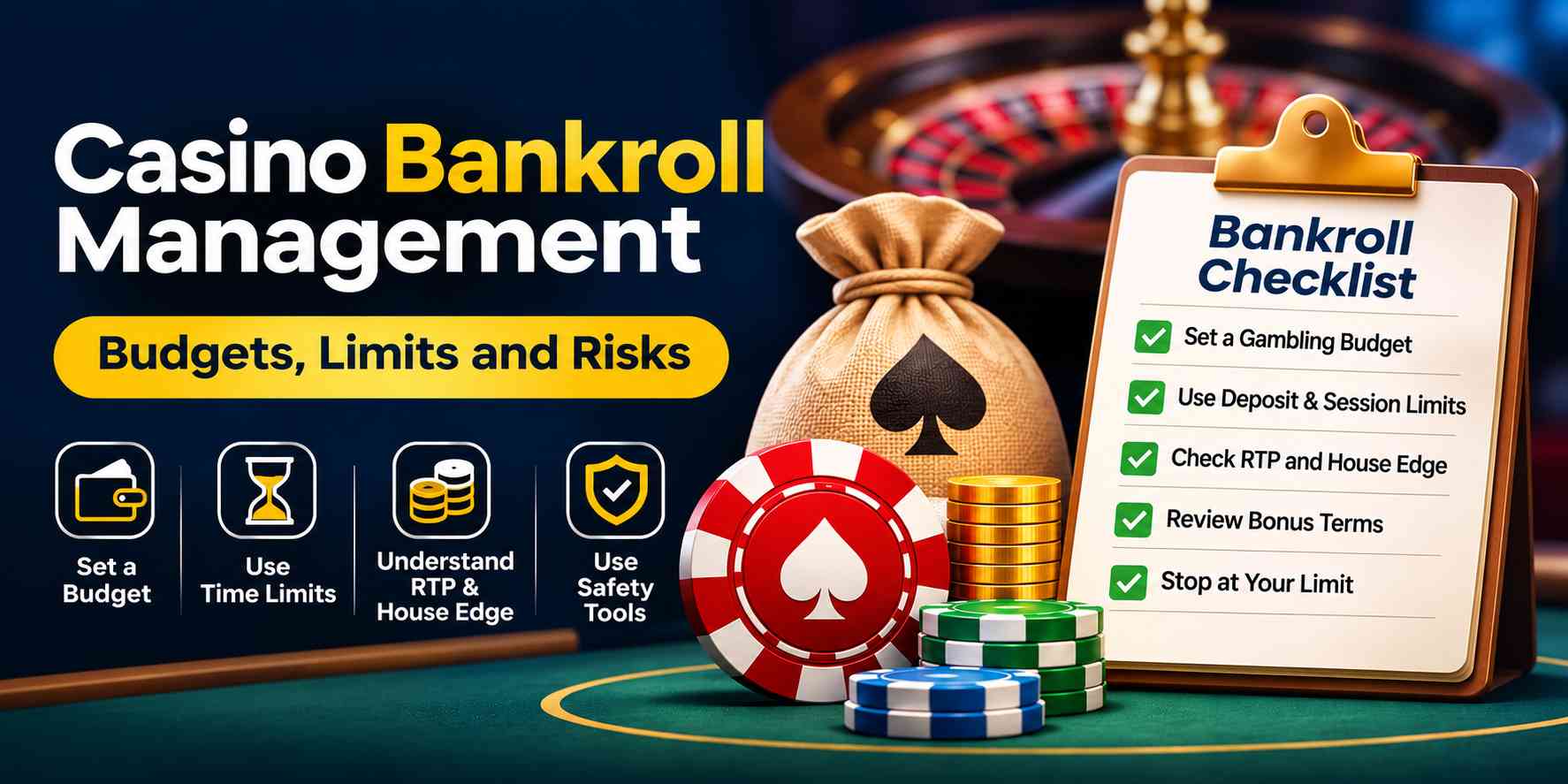
A gambling budget can be lost quickly, even when someone intends to play for only a short time. Increasing bets to recover losses can deepen those losses. Setting limits before play may help control spending, but cannot make gambling safe or guarantee how long money will last.
Bankroll management means setting aside a limited entertainment budget and deciding when to stop. It does not change a game’s odds or remove the house edge. Choosing not to gamble avoids the financial risk of betting.
Online deposits can make repeated spending easy. Check the operator’s identity, local eligibility, withdrawal terms and available controls before using an Irish casino online. This link is not an endorsement or verification of the operator’s services. Ireland’s Gambling Regulatory Authority was established on 5 March 2025; that fact alone does not establish any particular site’s licensing status.
Set a discretionary entertainment budget
Cover essential expenses, debt repayments and savings before considering any gambling budget. Do not use borrowed money or funds needed for everyday living. Any amount set aside should be money you can lose without affecting your financial commitments; disposable income does not have to be spent on gambling.
For illustration, a person might set a monthly limit of €200. This is an example, not a recommended budget. Use available spending or deposit controls and do not increase the limit to recover losses.
Consider the effect of losing the entire amount. If that would cause financial difficulty or distress, do not commit it to gambling.
Set session and time limits
An illustrative €200 monthly cap could be divided into four maximum session budgets of €50. These are ceilings, not amounts that must be spent. Stop when a spending or time limit is reached, and remember that you can leave earlier.
There is no universally safe percentage of a session budget to stake on each bet. Smaller stakes reduce the amount exposed on a single round, but repeated bets can still exhaust the budget. Do not increase the budget or length of play simply because each bet costs less.
Avoid raising stakes or making additional deposits to recover losses. A losing streak does not mean a win is due.
Understand RTP house edge and volatility
Game rules, stake size and the number of rounds affect exposure to losses. RTP, house edge and volatility describe different aspects of a game; none guarantees an individual result.
Return to player, or RTP, is a theoretical long-run payout percentage. A 96% RTP refers to approximately €96 in payouts per €100 of total stakes over extensive play, not a promised return on an individual’s €100 deposit. Total stakes can include repeatedly betting earlier winnings. A short session can differ substantially from that average.
For standard roulette bets, a single-zero European wheel has a house edge of approximately 2.70%, while a double-zero American wheel has a house edge of about 5.26 percent of all bets. Special wagers and rule variants can differ. These are long-run mathematical averages, not fixed losses in each session.
Volatility describes variation in game payouts. Lower-volatility games tend to offer smaller, more frequent prizes than higher-volatility games, but can still produce losing streaks. A long period without a payout does not guarantee a large win next.
A higher RTP or lower volatility does not make a game safe or ensure that a budget lasts longer. Faster play can increase total wagering within a given period. Limit time as well as spending, and avoid treating game selection as a way to secure a profit.
Set stopping points and check bonus terms
Stop when a preset loss or time limit is reached, without depositing more. You can also stop while ahead or before reaching any limit. There is no need to wait for a target profit, and stopping rules do not change the odds of the next bet.
Bonus terms can restrict withdrawals and require qualifying wagers. At 30 times a €50 bonus alone, the required wagering is €1,500. Some offers instead apply the multiple to the deposit plus bonus. Check eligible games, contribution rates, maximum stakes, expiry dates and withdrawal restrictions; breaching terms may invalidate the bonus or related winnings.
And if an offer mentions guaranteed wins, walk away. Promised returns sit high on most lists of warning signs of online scams for a reason, and casino promotions are no exception.
Notes help too. A month of jotted dates, spends and results shows the true cost far better than memory does.
Switch on the safety tools early
Available tools vary by operator and jurisdiction. Check for deposit limits, time reminders, time-outs and self-exclusion before gambling. Self-exclusion may apply to one operator or a wider scheme; confirm its scope and duration. If gambling becomes difficult to control or causes distress, stop and seek qualified support.
Final thoughts
A budget and stopping rules can help limit spending, but cannot eliminate gambling losses or harm. No staking system removes the house edge in standard casino games TBA. Treat limits as firm boundaries, and stop rather than extending play to recover money.
Glossary
Bankroll: A limited amount set aside for gambling, with no obligation to spend it.
RTP: The theoretical percentage of total stakes returned as payouts over extensive play.
House edge: The casino’s theoretical mathematical advantage, usually expressed as a percentage of stakes.
Volatility: The degree of variation in a game’s payouts.
Disclaimer
This article is for general information, not financial, legal or gambling advice. Gambling can cause financial loss and harm. Participation is only for adults who meet the legal gambling age and eligibility requirements in their location. No budget, game choice or betting system guarantees profit or prevents losses. Platform mentions are not endorsements.
















