Clichmont AI Infrastructure: How It Powers Modern AI Systems


How Clichmont AI Infrastructure Supports High-Performance AI
Clichmont AI Infrastructure is a company that rents out GPU power to AI builders, and it has launched a token called $CLAI around that business.
It's a crypto project with a live crypto presale, and the first crypto listing is planned for December 1. This review was updated on October 17, 2026.
It uses the official website and the published whitepaper so that confirmed facts stay apart from plans, because the project itself marks some figures as still pending.
Core Components of Clichmont AI Infrastructure Explained
The company says it owns and runs its own GPU machines. It doesn't gather spare capacity from other operators.
Two sites work in Norway. One is a technical center in Billingstad with H200 and RTX 6000 Blackwell units. The other is a harbor site in Bodø with RTX 5090 and RTX 4090 cards.
Customers pay for GPU time in USD or stablecoins. Holding CLAI isn't needed to buy compute.
Owning hardware is the main selling point against peer-to-peer rental networks. Those networks grow faster but control reliability less.
How Token Utility Works: $CLAI and βCLAI
$CLA I is a utility token with a fixed supply, and right now it can't pay for compute directly. Staking means locking tokens for a set time. Staking $CLAI gives βCLAI, a credit that can't be transferred.
Customers spend this credit on compute, and unused credit expires 60 days after it is earned. Turns out, this setup keeps compute prices steady in stablecoins while $CLAI handles the participation side. The website lists a minimum stake of 10 CLAI with a 30-day lock, but staking is marked as not live.
The buyback and burn plan ties token supply to usage, and a burn means tokens are removed for good. The whitepaper describes a monthly baseline buyback of $60,000 or more. Of the tokens bought, 70% go to protocol-owned liquidity, and 30% are burned.
The burn pace should rise as compute use grows, but the formula is still being finalized, and the baseline isn't a promise of returns.
Clichmont AI Infrastructure Tokenomics and Token Allocation
$CLAI has a fixed total supply of 650,000,000 tokens, issued through a Token SPV in the British Virgin Islands. Vesting is the schedule that decides when tokens become available.
Allocation | Share | Tokens | Cliff / Vesting (months) | TGE Unlock |
Seed Round | 0.75% | 4,875,000 | 6 / 18 | 0% |
Private Round | 8.25% | 53,625,000 | 6 / 18 | 0% |
Team | 9% | 58,500,000 | 18 / 24 | 0% |
Development | 10% | 65,000,000 | 12 / 36 | 0% |
Marketing | 10% | 65,000,000 | 0 / 36 | 0% |
Public | 22% | 143,000,000 | 3 / none | 100%* |
DEX Liquidity | 7% | 45,500,000 | 0 / 0 | 100% |
CEX Liquidity | 10% | 65,000,000 | 6 / 12 | 100%* |
Compute Validators | 11% | 71,500,000 | 0 / 60 | 10% |
Treasury | 12% | 78,000,000 | 12 / 60 | 0% |
*Public and CEX liquidity unlock in single cliff steps.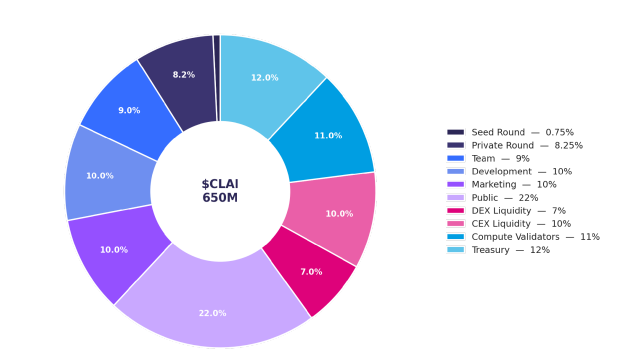
Team, seed, and private tokens have cliffs of six months or more, so nothing from these buckets unlocks at launch. But the public, DEX, and CEX buckets release early and in big steps.
The white paper estimates that about 281 million tokens, roughly 43% of supply, circulate by month six, and it names that as the biggest sell pressure risk. At the announced sale price of $0.135, the fixed supply implies a fully diluted value near $87.75 million. That's a simple calculation, not a market cap.
Crypto Presale, Listing, and Airdrop Status
Per the project's sale announcement, the crypto presale closes on October 30 at $0.135 per token. Buyers can pay in USDT or USDC on BNB Smart Chain, with a $10 minimum and no stated maximum.
The first DEX listing is planned for December 1, 32 days after the close. No live crypto price exists because the token isn't trading yet, and launch timing will come through official updates.
Crypto news about the sale should be checked against the official page. US persons and other restricted regions are excluded, and KYC checks are in place. No crypto airdrop appears in the reviewed official material, so any such claim stays unverified.
Roadmap of Clichmont AI Infrastructure Step by Step
The whitepaper lists five rough phases and says they can change.
Phase 1: build the owned infrastructure and launch the first compute product.
Phase 2: roll out $CLAI and βCLAI use, switch on staking, and start the buyback and burn engine.
Phase 3: add more compute capacity and enterprise partners.
Phase 4: Bring in third-party capacity under Clichmont's quality and routing rules.
Phase 5: move toward a wider decentralized marketplace.
No dates are attached to these phases. The physical plans have clearer timing: a bigger Bodø data center and a solar-powered Alicante hub in late 2027, plus a UAE site in pre-development for 2028.
Risks and Challenges Facing Clichmont AI Infrastructure
Execution comes first. Every site after the two live ones is still a plan, and no funding amount is disclosed for the larger Bodø build. Rules come second, since the whitepaper lists the risk of being treated as a security and bars US persons at launch.
Token demand is third. Compute is paid in stablecoins, so $CLAI demand depends on staking benefits and the buyback, and staking isn't live.
Unfinished papers are a fourth worry, because the white paper has open notes on the buyback reserve, the formula, and the CEX schedule. No audit report appeared in reviewed material.
What Does the Data Say About the Outlook?
The stronger sign is the working base. Live GPU sites give the project something that can be checked. The weaker sign is the link between the token and real revenue, since no compute activity data has been published.
And the 32-day gap leaves open what buyers can do before trading starts. The biggest unknown is whether outside demand can grow fast enough to make staking and burns matter. Readers should verify the sale price and eligibility on the official page.
Final Verdict and Next Checks
Clichmont AI Infrastructure pairs a GPU business with a utility token whose value depends on usage that public data doesn't show.
The live sites, fixed supply, and clear vesting table stand out, while staking, buyback details, and listing results remain unconfirmed. Next checks are the sale page, whitepaper updates, and any audit report.
Disclaimer
This article is for informational purpose only and is not financial, investment, legal, or tax advice. Crypto assets are high risk, prices can swing sharply, and participants can lose some or all of their money. Readers should do their own research and talk to a licensed financial advisor before making any decision.