Coinbase Q3 2026: USDC Balances vs Trading Revenue Explained


How USDC Balances Shaped Coinbase Q3 2026 Revenue
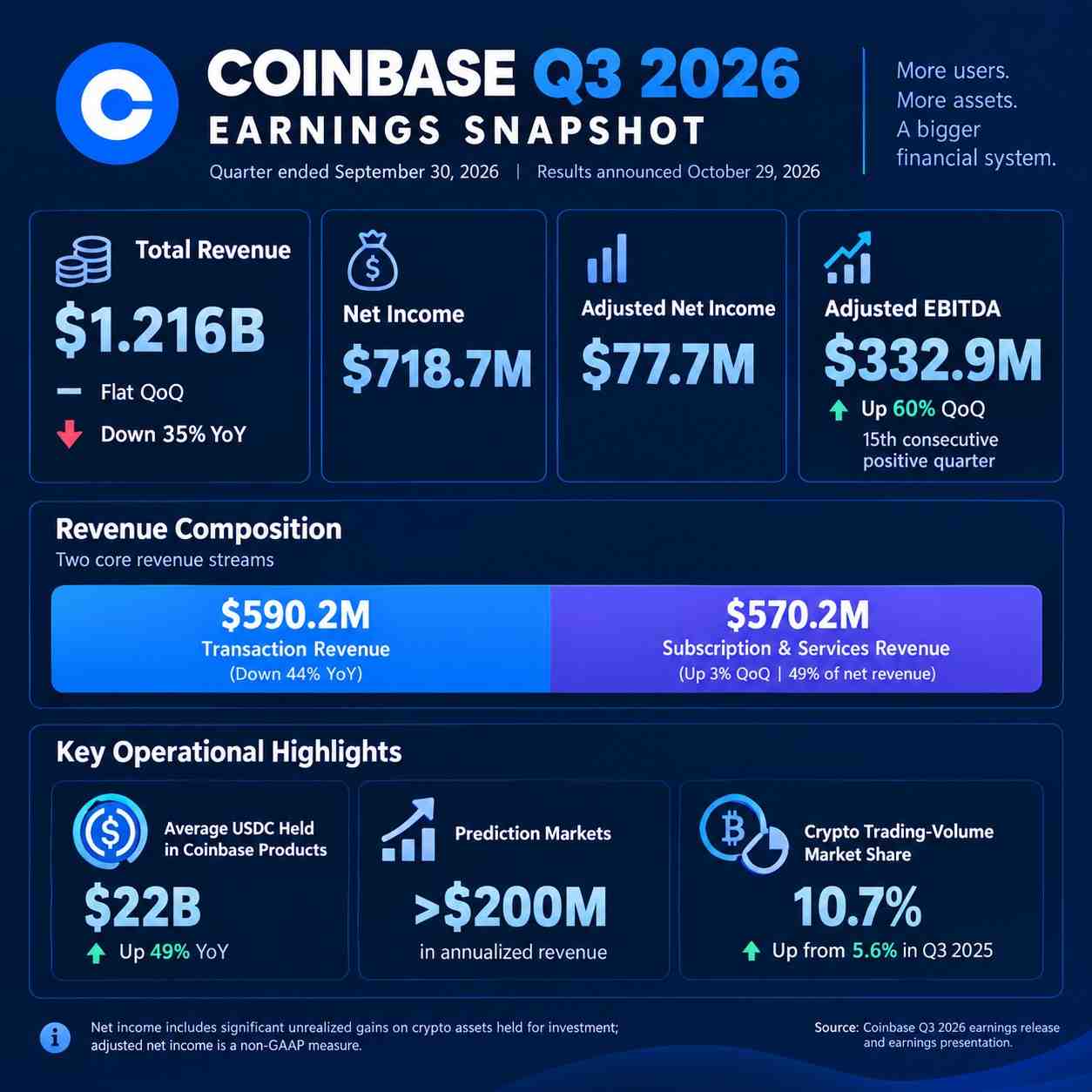
Coinbase Q3 2026 results came out on October 29, and the headline profit number hides more than it shows, because net income reached $719 million mostly thanks to a $715 million gain on crypto that the company holds as an investment.
Adjusted net income, which strips out those investment swings, came in at only $78 million, and that’s the cleaner way to judge how the business actually did.
Here’s the thing: the real story sits in two income lines moving in opposite directions. USDC balances kept growing while trading revenue kept shrinking, and this Coinbase review explains what changed, why it matters, and which risks deserve a closer read.
What Is Coinbase, and Why Does Its Quarter Matter?
Coinbase is a US-listed crypto platform where customers buy, sell, store, and earn on digital assets, and it says it holds more crypto than any other company, with $377 billion in assets on its platform.
That equals 12.5% of total crypto market value, and the company serves consumers through its apps, institutions through Coinbase Prime, and developers through its Developer Platform.
What Did the Coinbase Q3 Update Show?
The Coinbase Q3 update puts total sales at $1.2 billion, which is flat from the second quarter but 35% lower than a year earlier. Transaction income slipped to $590 million, while subscription and services rose to $570 million and now makes up 49% of net revenue.
Adjusted EBITDA, a profit measure that leaves out certain costs, jumped 60% from the prior quarter to $333 million, and the table below puts the main lines side by side.
| Metric | Q2 2026 | Q3 2026 |
| Transaction revenue | $599M | $590M |
| Subscription and services | $555M | $570M |
| Stablecoin income | $292M | $307M |
| Average USDC held in Coinbase products | $20B | $22B |
| Adjusted EBITDA | $208M | $333M |
How Do USDC Balances Create Income?
USDC is a stablecoin , which means a crypto token built to hold a steady value of $1, and Coinbase earns a share of the interest that the reserves behind it generate.
In Coinbase Q3 2026, average USDC held in Coinbase products reached $22 billion, up 49% from a year ago, which equals roughly 30% of the average USDC supply and marks a record for the fourteenth straight quarter.
Turns out, where the USDC sits matters a great deal. Income tied to balances inside Coinbase products rose from $174 million to $202 million, while revenue from off-platform USDC dropped from $146 million to $126 million.
The company says it captured about 50% of all USDC economics over the past year, though that’s a company claim, and the cost side deserves attention too, since higher USDC rewards pushed up marketing expenses. Paid Coinbase One subscribers hit a record, up 24% from last year, and the plan advertises 3.75% APY rewards on USDC, which draw in balances but also add cost.
Coinbase News Today: Why Did Trading Revenue Slow?
Trading depends on price movement, and Q3 didn’t deliver much of it, since Coinbase’s own volatility measure fell 15% from the prior quarter to multiyear lows. Total market spot volume dropped 6% and derivatives volume slid 11%, while Coinbase’s own spot volume fell from $146.4 billion to $134.5 billion.
Consumer transaction revenue held near $450 million because prediction markets passed $200 million in annualized revenue, but institutional income fell 8% to $92 million. Still, the Coinbase exchange gained share, with crypto trading volume market share reaching 10.7%, the fourth gain in a row.
Can Stablecoin Income Offset Weak Trading in Coinbase Q3 2026?
Partly, but not fully, since stablecoin income rose 5% to $307 million while transaction revenue still runs almost twice that size. The stronger signal is cushioning rather than replacement, and that cushion works only while balances stay high and rates stay supportive.
At first, the 49% subscription share seemed like clean proof of diversification. On second thought, part of that share comes from a shrinking trading line, and subscription and services revenue still sits 20% below last year, so how long can a cushion hold if volume stays quiet?
Prediction markets may help, because a Coinbase investor press release says users who trade them also drive extra spot volume. But the balance of evidence points to a company that’s steadier than before, not one that’s less dependent on trading.
How Did Costs and Cash Support the Quarter?
Cost control helped, as adjusted expenses fell to $975 million, which is down 6% from Q2 and below the earlier guidance of $980 million to $1,080 million. Cash and equivalents stood at $8.6 billion, and the company held $2.4 billion in crypto and marketable investments, so that balance sheet gives room to ride out a slow quarter.
Risks Hidden in Coinbase Q3 2026 Revenue Sources
Interest rates come first, since the company links higher average interest rates to its Q4 guidance, which means falling rates could shrink stablecoin income. Off-platform USDC also shows how fast balances can move, because that pool shrank from $57 billion to $51 billion in one quarter.
Coinbase regulations matter too, because the company holds 80+ licenses, yet its own risk list names the regulatory treatment of derivatives and prediction markets as a threat to growth. Coinbase exchange news adds another wrinkle, as the INTX and Deribit integration finished in October and management expects some short-term volume swings while participants adjust.
And then there’s security. Coinbase fraud prevention stays relevant because of the May 2025 data theft incident, which produced a net recovery of $18.4 million in Q3 after $306.7 million in losses during Q2 2025, and Coinbase One also offers a limited warranty against unauthorized transfers, ranging from $1,000 to $250,000 by plan.
What Should Readers Watch After Coinbase Q3 2026?
Q4 guidance matters most, since Coinbase expects subscription and services revenue of $550 million to $630 million and reported about $165 million in transaction income through October 25, a figure the company cautioned against extrapolating. Readers can verify every number in the earnings release and the 10-Q filed on October 29.
Coinbase Q3 2026 earning shows a business leaning harder on stablecoins, subscriptions, and new products while trading cools, and strong balances help.
Even so, dependence on rates and trading cycles hasn’t gone away, and for crypto investors, revenue quality matters as much as revenue size, since interest income and trading fees react to very different forces.
Next checks include USDC balances, rate changes, trading volume, and rules on prediction markets.
Disclaimer
This article is for information only and isn’t financial advice. Crypto and stocks carry high risk, and results can change quickly. Readers should verify company data and consult a licensed advisor before making decisions.