CoinDCX Hack Update: Phishing Campaign Targets Exchange Users

CoinDCX Hack Update: How Fake Alerts Could Put Users at Risk
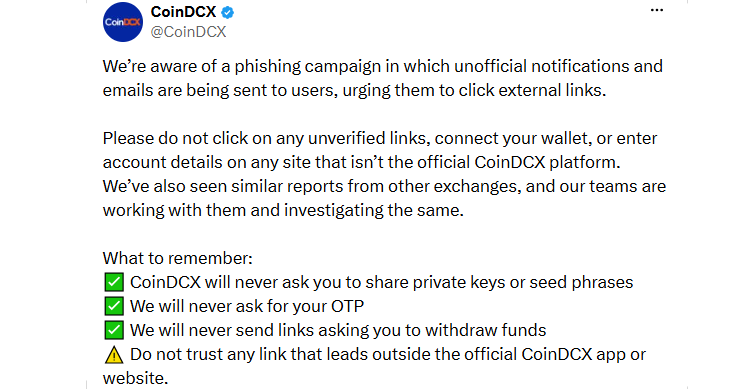
The latest CoinDCX hack update today is centered on a warning, after the 16M theft. On 27 October the exchange said fake emails and app-style notifications are pushing users toward outside links, wallet connections and account forms, per its alert on X.
The timing is uncomfortable. Days earlier, CoinDCX confirmed a 15.99 million USDT loss from retired wallets, so crypto hack news around the exchange had barely cooled.
CoinDCX Hack Update: What the Phishing Warning Says and How It Works
The platform says the unofficial messages try to get people to click external links, connect wallets or enter details on sites it does not run. Similar reports have come from other exchanges, and CoinDCX is working with them on the investigation.
What some label a CoinDCX hack phishing campaign is, by the exchange’s account, impersonation and not a breach of active systems, though that rests on its own word so far.
The exchange also spelled out what it never does, per its verification guide:
Asks for private keys or seed phrases
Requests one-time passwords
Sends links telling users to withdraw funds
Points anyone to a site outside its app or official website
Scammers usually copy branding and invent urgency, such as a security alert or a pending withdrawal. No images of the current emails had surfaced at the time of the warning, so the exact wording is unknown.
This CoinDCX hack news today also carries a gap: no data leak has been confirmed, and how scammers found contact details remains unexplained. Claims of CoinDCX data leaks should be treated with caution.
Fake Fund Recovery Messages: Why the $16M Loss Raises Phishing Risk
Any CoinDCX hack update about refunds deserves skepticism, because fake fund recovery is the lure most likely to land. After a loss makes headlines, messages promising refunds or account restoration can feel believable, and recovery pretexts are a known pattern in impersonation scams.
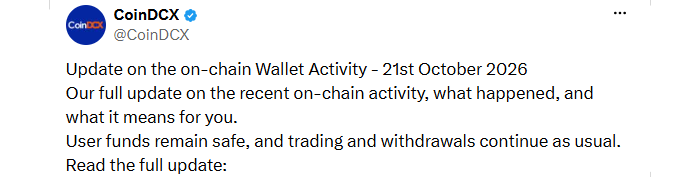
CoinDCX says the 15.99 million USDT loss is separate from the phishing campaign and that customer funds in active systems stayed safe, per its 25 October update.
No independent check of that claim has been published. Until the official app confirms a refund, any unsolicited offer should be treated as a scam.
CoinDCX 16M Breach Timeline: From July 2025 Theft to October Loss
Context matters for this CoinDCX hack update, because the numbers are easy to blur:
July 2025: about $44.2 million lost in the earlier breach
21 October 2026: 15.99 million USDT drained from roughly 40 deprecated TRON deposit addresses, per the official blog
Combined losses: roughly $60 million
Frozen by Tether: 2.21 million USDT, about 14%, per Bitquery’s investigations
Moved onward: 13.78 million USDT
CEO Sumit Gupta first called the reports a false alarm on 22 October. The exchange then conceded the loss, blaming a failed sweeping tool that left deposits sitting in retired addresses, and said it absorbed the cost.
What headlines dubbed the CoinDCX 16M breach, the exchange calls an operational loss from leftover infrastructure, not a breach of live systems.
On-chain sleuth ZachXBT challenged the retired label, saying address TQKJQ still handled deposits in April and May 2026.
Safety Checklist: Official Channels, 2FA and Withdrawal Whitelists
The CoinDCX hack update comes with practical steps from the exchange’s own guidance:
Skip unverified links in emails, texts and notifications
Check the web domain closely before typing anything
Use only the official app and verified support, such as @CoinDCX_Cares
Switch on 2FA and, where offered, withdrawal whitelists
Copy deposit addresses from the app alone, since some customers kept sending funds to deprecated ones
Report suspicious messages to local cybercrime authorities
Two answers will shape what follows: the investigation findings CoinDCX has promised to share, and whether the exchange lets an independent auditor inspect its wallet inventory. In crypto news today, that matters more than any single transfer.
Until both arrive, any message pairing a link with a deadline deserves silence, not a click. CoinDCX hack news moves quickly, so only the exchange’s verified accounts should be trusted.
Disclaimer: This article is for informational purposes only and does not constitute financial or investment advice. Crypto markets carry significant risk. Always do your own research before making any investment decisions.









