Coinone Data Leak Could Your Support Chats Expose Your Crypto Account?


Coinone Data Leak: What Was Exposed and How Korean Users Can Stay Safe
A South Korean crypto exchange has confirmed that customer information was exposed after an outside service provider’s servers were broken into.
In its official notice posted on November 15, 2026, the company said details shared during support chats and phone calls may have been affected.
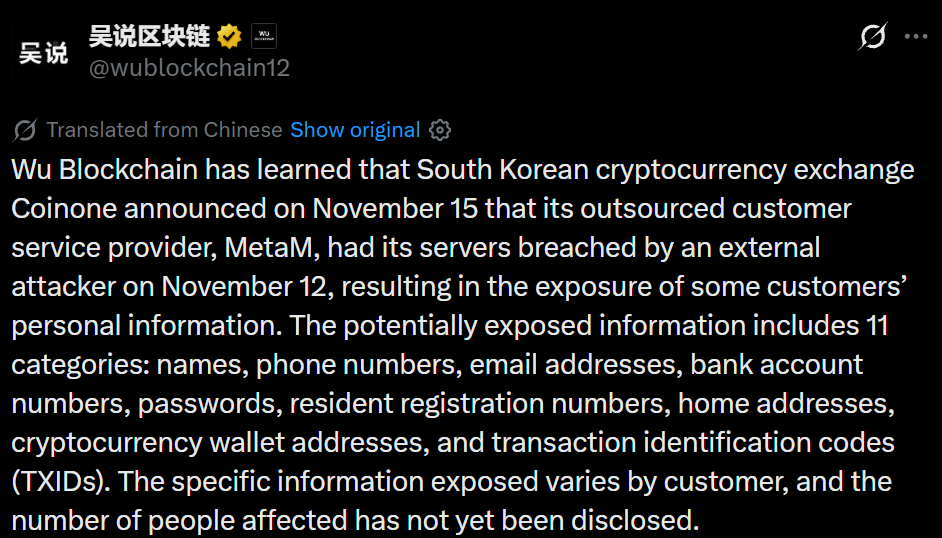
Source: Wu Blockchain Post
What Happened and When
According to the official notice, an outside attacker illegally accessed the servers of MetaM, the company that handles customer support for the exchange, at around 4:00 AM on November 12, 2026.
The attacker viewed or took customer consultation records stored on those servers.
The exchange learned of the breach at about 9:20 AM the same day, when the provider reported it.
The company says the exact time and method are still being investigated together with the provider and expert agencies.
Date and time | Event |
November 12, around 4:00 AM | Attacker breaks into the support provider’s servers |
November 12, around 9:20 AM | The exchange is informed by the provider |
November 15, 8:00 AM | Public notice is posted |
What the Coinone Data Leak May Have Exposed
The notice lists details that customers themselves shared during chat or phone support.
It says the list covers every item that could have been exposed, and that the actual items differ from person to person because each consultation was different.
The possible items are:
The phone number used for the consultation
Name
Email address
Date of birth
Bank account number
Password
Resident registration number
ID issue date
Home address
Crypto wallet address
Transaction ID (TXID)
Customers with no support consultation history are not affected. The notice does not state how many people were involved.
The exchange plans to let users check which of their items were affected through a separate announcement or a lookup service.
Are Trading and Wallet Systems Safe?
The notice says member accounts, trading and crypto wallet systems run separately from the provider’s servers.
It adds that no sign of a direct break-in to those systems has been found so far. Even so, the Coinone data leak matters because passwords may have been spoken or typed during support sessions, so users are asked to take precautions.
What the Exchange Has Done So Far
The official notice lists these actions:
Blocked the IP address used in the attack and the connection to the support provider
Increased live monitoring of unusual logins and unusual transactions
Added extra security measures to prevent further attacks
Reported the incident to the Korea Internet & Security Agency, the Personal Information Protection Commission, and the Financial Supervisory Service
Started checking the provider’s security management directly
Switched the outsourced support desk to email-only consultation
The company also says it will review the security systems of its partner firms, not only its own.
How Users Can Protect Themselves and Claim Their Rights
The notice warns that exposed details could be used for follow-up harm, such as voice phishing that pretends to be the exchange, phishing emails, spam texts and identity theft.
The exchange also published an earlier warning about voice phishing and scams.
Key steps from the notice:
Change your password if you ever said or typed it during support, and change it on any other site where you use the same one.
Remember what the exchange never does. It never asks for passwords, OTP numbers or verification codes by phone, text or email. It also never asks you to withdraw crypto or change a wallet address.
Be careful with callers who mention your past support chat. They may be impersonators.
Do not open links or attachments from unknown messages.
Report anything unusual, such as logins, orders or withdrawal attempts you did not make.
Action | App | Web |
Change password | More > Info/Security > Change Password | My Page > Personal Info Management > Change Password |
Lock account | More > Info/Security > Account Lock | My Page > Personal Info Management > Account Lock |
Check withdrawal addresses | Deposit/Withdrawal > Address Book Management | Deposit/Withdrawal > Withdrawal Address Book |
Users who suffered a loss can claim damages from the company, and the burden of proving it was not at fault rests with the company.
If the court finds intent or gross negligence, it may set compensation at up to five times the loss.
If the loss is hard to prove, users can instead request statutory damages of up to 3 million won (Personal Information Protection Act, Articles 39 and 39-2).
Support is available from the Personal Information Dispute Mediation Committee (1833-6972), the Personal Information Infringement Report Center (118), and the Financial Supervisory Service (1332).
Conclusion
The Coinone data leak came from an outside support provider, not from the exchange’s own account, trading or wallet systems, according to the company’s notice.
The risk is mainly to customers who shared personal details during support, who now face possible phishing and impersonation.
Users should check their accounts, change passwords where needed, and follow the official notice and the exchange’s official X account for updates. This article is for information only.
Disclaimer
This article is for educational and informational purposes only and is not financial or investment advice. Crypto assets are high risk, their prices can be very volatile, and you can lose some or all of your money. Always do your own research and consider speaking with a licensed financial advisor before making investment decisions.






