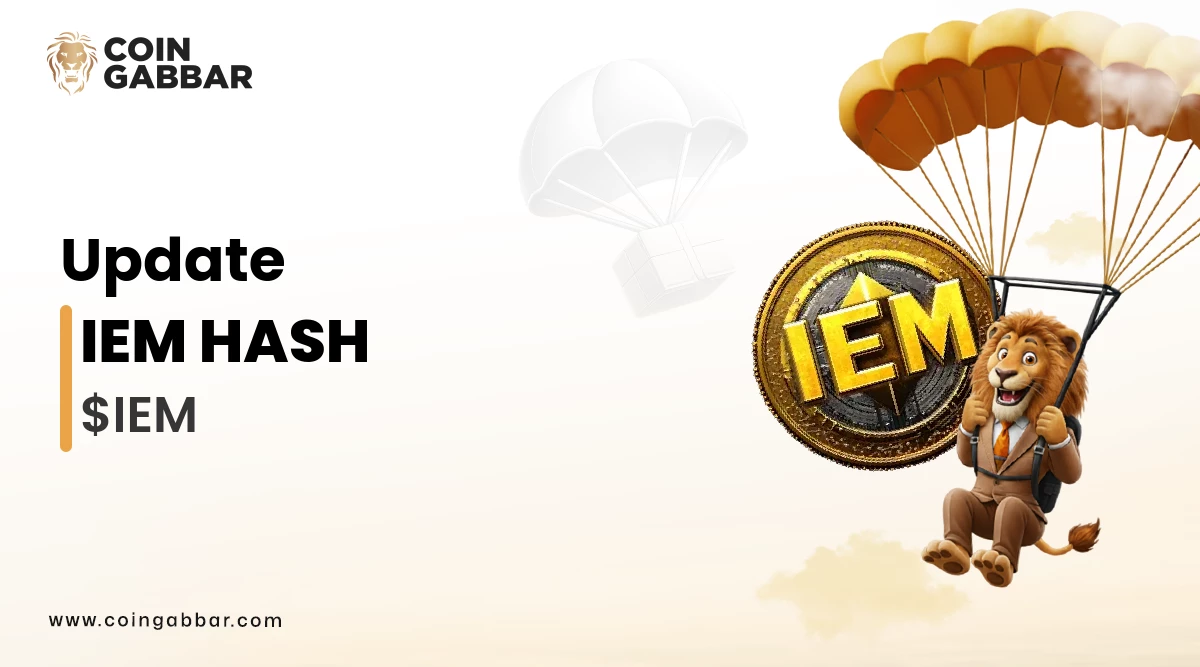
IEM HASH Airdrop on TON Network: Neutral Overview and Guide
IEM HASH Introduction
IEM HASH is running a new crypto airdrop on the TON blockchain. The IEM HASH airdrop uses a Telegram bot for participation and task tracking. This article gives a neutral, factual view of how the airdrop works, what is known about the $IEM token context, and what users should consider before joining.
The focus is on basic airdrop structure, timing, and practical steps, along with key risks. IEM HASH positions itself in the wider trading and exchange category within the crypto space, with activity taking place on the TON blockchain environment.
IEM HASH Overview: Vision and Context
IEM HASH is associated with the trading and exchange segment of the crypto market. The project operates its airdrop on TON, a blockchain that is closely linked with Telegram and its growing ecosystem of mini apps and bots. The IEM HASH airdrop appears to use this ecosystem by relying on a Telegram bot for onboarding and tasks.
From the public airdrop setup, it can be inferred that the project aims to attract early users to its token, $IEM, and to its trading or exchange-related activities. The mission suggested by the airdrop mechanics is to build a base of active participants who are familiar with TON, Telegram, and simple task-based engagement.
IEM HASH Airdrop Purpose and Benefits
The IEM HASH airdrop is designed as a distribution event for the $IEM token on the TON Network. Airdrops like this typically aim to increase awareness, spread token ownership across a wider group, and test interest in the project. The IEM HASH event follows this pattern by setting a fixed pool of tokens and dividing them among eligible participants.
From a user perspective, airdrops can offer exposure to a new token without direct purchase. At the same time, there is no guarantee of future value, liquidity, or listing on major exchanges. The IEM HASH airdrop should be seen as a high-risk, speculative activity, where the main benefit is early access to a token rather than assured financial gain.
Category of Project: Trading and Exchange Airdrop
IEM HASH is linked to the trading and exchange category. This places it among projects that may focus on order execution, liquidity, or trading tools. In this context, the IEM HASH airdrop can be viewed as a category airdrop targeting users who are interested in trading-oriented products or exchange-like services.
Trading and exchange category airdrops often try to seed an initial user base that can later test trading features, provide liquidity, or interact with order books and fee structures. While specific IEM HASH product details are not outlined in the airdrop description, the category tag signals that the $IEM token might later interact with trading flows or exchange mechanics on TON or related platforms.
Blockchain of Project: TON Network Airdrop
The IEM HASH airdrop runs on the TON Network (TON), using the TON token standard. This makes it part of the wider blockchain airdrop trend in the TON ecosystem. TON is known for fast finality, integration with Telegram, and support for bots and mini apps, which explains why IEM HASH uses a Telegram bot for its airdrop entry point.
Being a TON-based blockchain airdrop means users will normally need a TON-compatible wallet to receive potential rewards. Participants should verify which TON wallets are supported by the IEM HASH Telegram bot and ensure they control the private keys. As with any TON airdrop, gas fees, address formats, and contract interactions will follow TON conventions, not those of Ethereum or other chains.
Platform: Telegram Bot-Based Airdrop Distribution
The IEM HASH airdrop is conducted via a Telegram bot. Platform airdrops on Telegram have become common, as they allow quick onboarding through a familiar chat interface. Users typically interact with a bot that guides them through the required steps, logs completion of tasks, and records wallet details for later token distribution.
Telegram bot-based platform airdrops require users to give the bot certain permissions, such as access to a username or chat data. Participants should read any prompts carefully and avoid sharing private keys or seed phrases. The IEM HASH bot acts as the central hub for all airdrop-related actions, so users should make sure they interact only with the official bot link shared by trusted channels.
IEM HASH Key Features and Token Context
The IEM HASH airdrop centers on the $IEM token, which is issued under the TON token standard. While full tokenomics and functionality are not detailed in the airdrop description, some basic contextual features can be inferred from the setup:
- Network: TON Network (TON), using TON token standard contracts.
- Token Name: IEM HASH.
- Token Symbol: $IEM.
- Distribution Method: Task-based airdrop via Telegram bot.
- Category: Trading and exchange related project.
Participants should look for official documentation or future updates from the team for deeper token utility, governance roles, or fee-related functions. Until then, the $IEM token should be treated as a speculative digital asset without guaranteed utility.
IEM HASH Whitepaper or Documentation Summary
At the time of this airdrop-focused overview, detailed whitepaper-style documentation for IEM HASH is not described in the airdrop information. In such cases, users should treat the project as high risk, since core data such as token allocations, governance, revenue model, and roadmap may not be fully documented in public sources.
Users considering participation should regularly check the official IEM HASH website for any future documentation. Clear documentation is critical for understanding if the project has a long-term plan, including how the $IEM token interacts with trading flows or exchange mechanisms on the TON Network.
IEM HASH Roadmap and Ecosystem Growth
The IEM HASH airdrop runs between 21 January 2026 and 31 January 2026. This short, defined period suggests an initial user acquisition phase. A typical roadmap for a project in this situation might later include exchange or trading feature launches, user rewards programs, and integration with TON-based tools. However, concrete phases are not specified in the airdrop details.
Participants should view the airdrop as an early ecosystem step. Real ecosystem growth will depend on whether IEM HASH ships functional products, secures listings or integrations, and maintains active communication with users. Without a published roadmap, expectations should remain cautious.
IEM HASH Token Utility and Allocation Context
The airdrop allocates a total of 50,000 tokens to participants, with up to 1,000 winners. This implies a relatively broad distribution compared to small, winner-takes-all events. The estimated reward pool is shown as 50,000 denominated in USDT terms, which hints at a target valuation, though there is no certainty that this valuation will hold on secondary markets.
Token utility details are not yet defined in the airdrop materials. In many crypto trading and exchange oriented projects, tokens can later be used for fee discounts, reward multipliers, referral incentives, or governance. Until IEM HASH releases clear allocation charts and utility descriptions, users should assume that the token function is still in a preliminary stage and that allocation beyond the airdrop may be concentrated among the team, investors, or liquidity budgets.
IEM HASH Airdrop Tasks and Eligibility
The IEM HASH airdrop uses a Telegram bot as the main interface. While full eligibility criteria are not specified in the public summary, common requirements for such airdrops often include:
- Being a Telegram user and interacting with the official IEM HASH bot.
- Completing basic social or community tasks, such as joining channels or following accounts.
- Submitting a valid TON wallet address under user control.
- Finishing required tasks before the end of the snapshot or airdrop period.
The airdrop runs from 21 January 2026 to 31 January 2026. Users should assume that actions must be completed within this window to count toward eligibility. Any extra conditions, such as regional restrictions or KYC, should be checked directly in the bot or on the project website.
How to Participate in the IEM HASH Airdrop
The following is a simple, neutral guide based on the available details on how to join the IEM HASH airdrop on TON:
Step-by-Step Participation Guide
- Open Telegram on your device and make sure you are logged in to your account.
- Visit the official IEM HASH Telegram bot link shared in trusted sources.
- Start the bot and read the welcome message and instructions carefully.
- Follow any prompts to join required Telegram channels or groups, if requested.
- Prepare a TON-compatible wallet under your control and copy your wallet address.
- Submit your TON wallet address to the bot only in the format requested.
- Complete all listed tasks, such as social or referral actions, within the airdrop dates.
- Check your task status in the bot if a progress or points system is provided.
- Wait for the project to confirm final winners or distribution details after 31 January 2026.
- Monitor your TON wallet carefully for any incoming $IEM token distribution and verify contract details from official channels before interacting with the token.
Risks, Eligibility and Security Considerations
Participating in the IEM HASH airdrop carries several risks, in line with general crypto airdrop practices. Users should treat all new crypto airdrops as high-risk activities with no guarantee of profit or long-term viability.
Key Risk Factors
- Token Value Risk: The future market value of $IEM is unknown. Tokens received may have low or no liquidity.
- Project Delivery Risk: Without a detailed roadmap or whitepaper, there is uncertainty about future feature delivery or exchange integration.
- Smart Contract and Network Risk: TON contracts can contain bugs. Users should be cautious when interacting with unknown contracts.
- Security and Privacy Risk: Telegram bot-based airdrops can be targets for impersonation or phishing. Users must avoid sharing private keys or seed phrases.
- Regulatory and Eligibility Risk: Some regions may restrict participation in token distributions. Users should check local laws and any project terms.
Security Best Practices
- Verify that you are using the official IEM HASH bot link from the project website or known channels.
- Never enter wallet seed phrases or private keys into Telegram or any website claiming to be part of the airdrop.
- Consider using a dedicated wallet for airdrop participation to limit exposure.
- Double-check smart contract addresses from multiple official sources before trading or adding the token to a wallet.
- Be careful with permissions granted to third-party apps or bots linked in the airdrop flow.
Conclusion
The IEM HASH airdrop on the TON Network is a task-based event using a Telegram bot and focusing on the $IEM token. It fits into the broader trend of platform airdrops in the TON and Telegram ecosystem, especially among trading and exchange category projects. With a fixed pool of 50,000 tokens and up to 1,000 winners, it offers broad participation but comes with the usual uncertainty around token value and project delivery.
Users interested in this new crypto airdrop should carefully follow the bot instructions, confirm official links, and maintain strong security practices. Since key token utility and roadmap details are still limited, participants should approach the IEM HASH airdrop with caution and avoid committing more time or data than they can afford to risk.
Disclaimer
This article is for informational purposes only and does not constitute financial, investment, legal, or tax advice. The IEM HASH airdrop is a speculative crypto activity, and participation involves significant risk, including the potential loss of time, data exposure, or any funds used for related transactions such as network fees. Readers should conduct their own research, verify all information from official IEM HASH channels, and consult qualified professionals before making any investment or trading decisions. Nothing in this content should be interpreted as a recommendation or endorsement of IEM HASH, the $IEM token, the TON Network, or any related platform.