Best Crypto to Buy Now Before the Next Crypto Boom 2026


Investors searching for the best crypto to buy now are looking past hype and asking a sharper question: which tokens actually solve a real payment or settlement problem heading into 2026.
Meme-driven picks dominate search results, but a smaller group of established networks keeps showing up in serious portfolios for a different reason.
They move money, and they move it at scale.
This guide looks at four tokens built around that function: Ripple (XRP), Cardano (ADA), Polygon (POL), and Stellar (XLM).
Each plays a distinct role in the same broader shift, faster settlement, tokenized real-world assets, and stablecoin-based payment rails.
None of them promise guaranteed returns.
What they offer instead is a clearer utility case than most names crowding today's search results.
What Makes a Coin the Best Crypto to Buy Now?
Before ranking any token, it helps to apply a simple filter.
A coin worth considering usually solves a specific problem, has active developer support, carries manageable regulatory risk, and still has room to grow relative to its market size.
Price alone tells you very little.
For payment-focused tokens specifically, two extra questions matter.
Does the network already move real transaction volume, or is the use case still theoretical? And does the project have a credible path toward institutional or retail adoption, rather than relying purely on speculative trading? Coins that pass both tests tend to hold up better across market cycles.
What Is the Best Crypto to Buy Now for Payment Utility?
Among the four coins here, XRP, POL, and XLM stand out because each already handles live transaction volume tied to cross-border settlement, stablecoin rails, or tokenized asset transfer.
ADA rounds out the group as a DeFi-adoption bet built on a research-driven, peer-reviewed development model rather than payment rails alone.
Why Real-World Asset Tokenization Matters Here
The Institutional Settlement Gap
Real-world asset tokenization, the process of representing bonds, cash equivalents, or other traditional instruments as blockchain-based tokens, has become a central theme connecting these four projects.
Institutions exploring tokenization need settlement rails that are fast, cheap, and compliant with evolving regulation.
That is precisely the gap these networks are positioning themselves to fill, while Cardano's DeFi ecosystem offers a complementary venue where tokenized assets could eventually be traded, lent, or used as collateral.
None of this guarantees adoption on any specific timeline.
Ripple (XRP): The Institutional Payments Bet
XRP Price and Core Utility
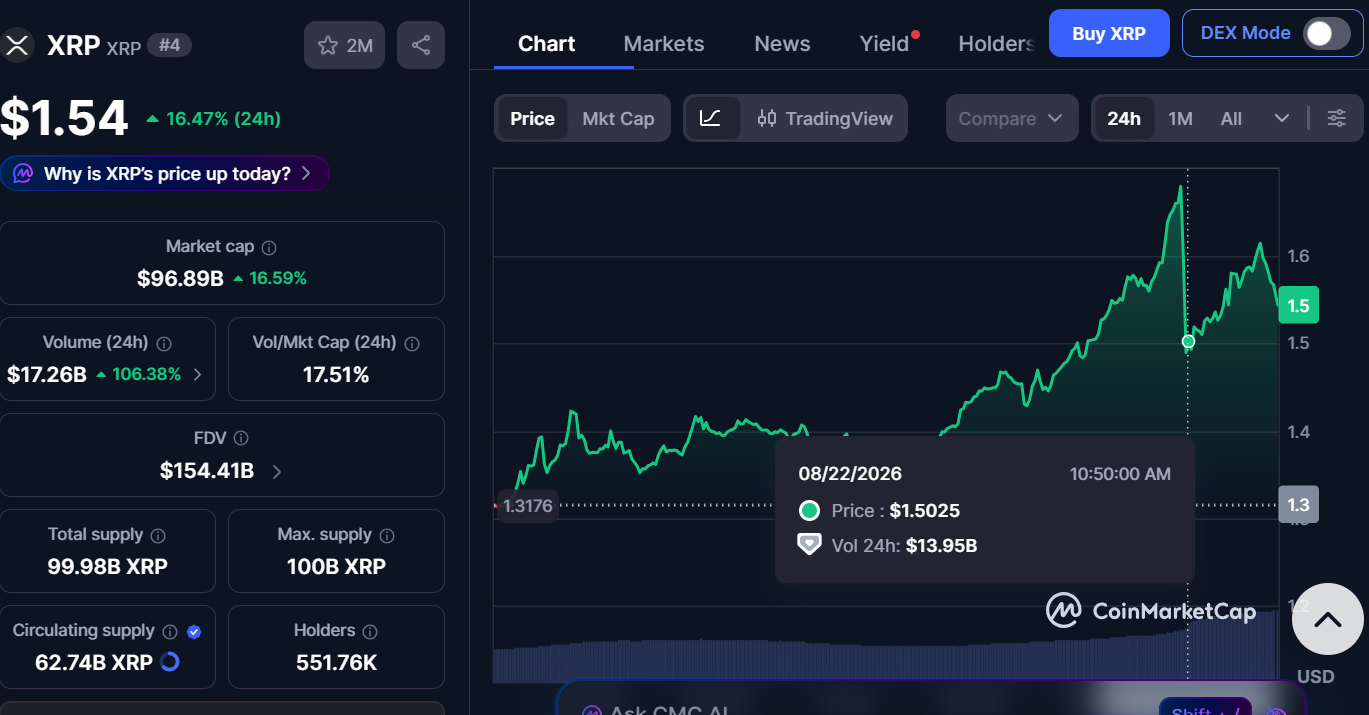
XRP is trading at $1.54, hovering near a level analysts often treat as a psychological support zone.
Its core design goal has stayed consistent since launch: enable fast, low-cost cross-border transactions for banks and payment providers, cutting out the multi-day settlement delays common in traditional correspondent banking.
Source: XRP On CoinMarketCap
That focus on institutional payments separates XRP from tokens built primarily for retail speculation.
Financial institutions piloting XRP-based rails care about settlement speed and cost, not short-term price swings, which gives the network a different kind of demand base than most consumer-facing altcoins competing for the same liquidity.
XRP Growth Drivers and Risk Level
Two developments have shaped the current thesis.
Regulatory clarity following the approval of spot ETFs opened the door to broader institutional exposure that was previously harder to access through traditional brokerage accounts.
Alongside that, Ripple has continued expanding its real-world asset tokenization ledger, positioning the network within the wider RWA tokenization trend rather than payments alone.
Risk remains moderate to high.
Its price still reacts sharply to regulatory headlines, and adoption timelines for institutional payment rails can move slower than markets expect.
A realistic time horizon for this thesis to play out is one to three years.
For allocation, this token can work as a core position for investors specifically seeking payment-infrastructure exposure, though sizing should still account for regulatory-driven volatility rather than treating it as a low-risk holding.
Cardano (ADA): The Research-First DeFi Bet
ADA Price and Core Utility
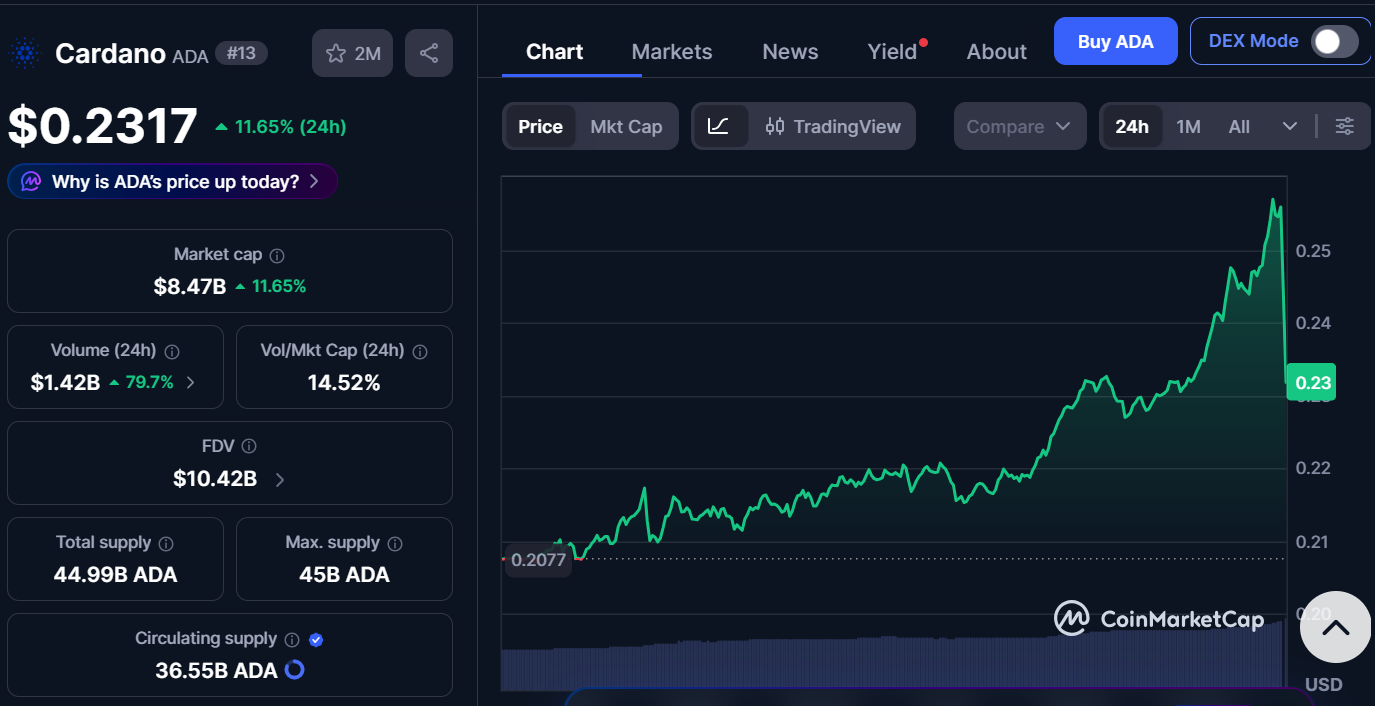
ADA trades around $0.2317, a level that leaves it far below prior cycle highs.
Sources: Cardano On CoinMarketCap
Cardano positions itself as a highly decentralized layer-1 network built on a peer-reviewed development process, a slower but more methodical approach than most competing chains take.
That academic rigor is both ADA's strength and its limitation.
Development moves carefully, which reduces certain technical risks, but it has also meant Cardano historically ships major features later than faster-moving rivals, a trade-off that shapes how patient an investor needs to be with this particular thesis.
ADA Growth Drivers and Risk Level
Cardano's long-term case rests heavily on two factors: one of the largest developer communities in crypto and expanding on-chain DeFi activity that could pull more users and liquidity onto the network.
Neither is guaranteed.
DeFi adoption on Cardano has lagged behind Ethereum and Solana in raw volume, so the growth driver here is closer to a catch-up story than an established lead.
Risk sits in the medium-to-high range, largely tied to execution speed.
Investors weighing ADA against faster-shipping competitors should treat it as a multi-year hold rather than a short-term trade, with a two-to-four-year horizon fitting its research-driven roadmap.
For allocation, ADA fits best as a smaller satellite position sized around conviction in Cardano's developer ecosystem, rather than as a core payment-infrastructure holding like the other three tokens covered here.
Polygon (POL): The Stablecoin Payments Layer
POL Price and Core Utility
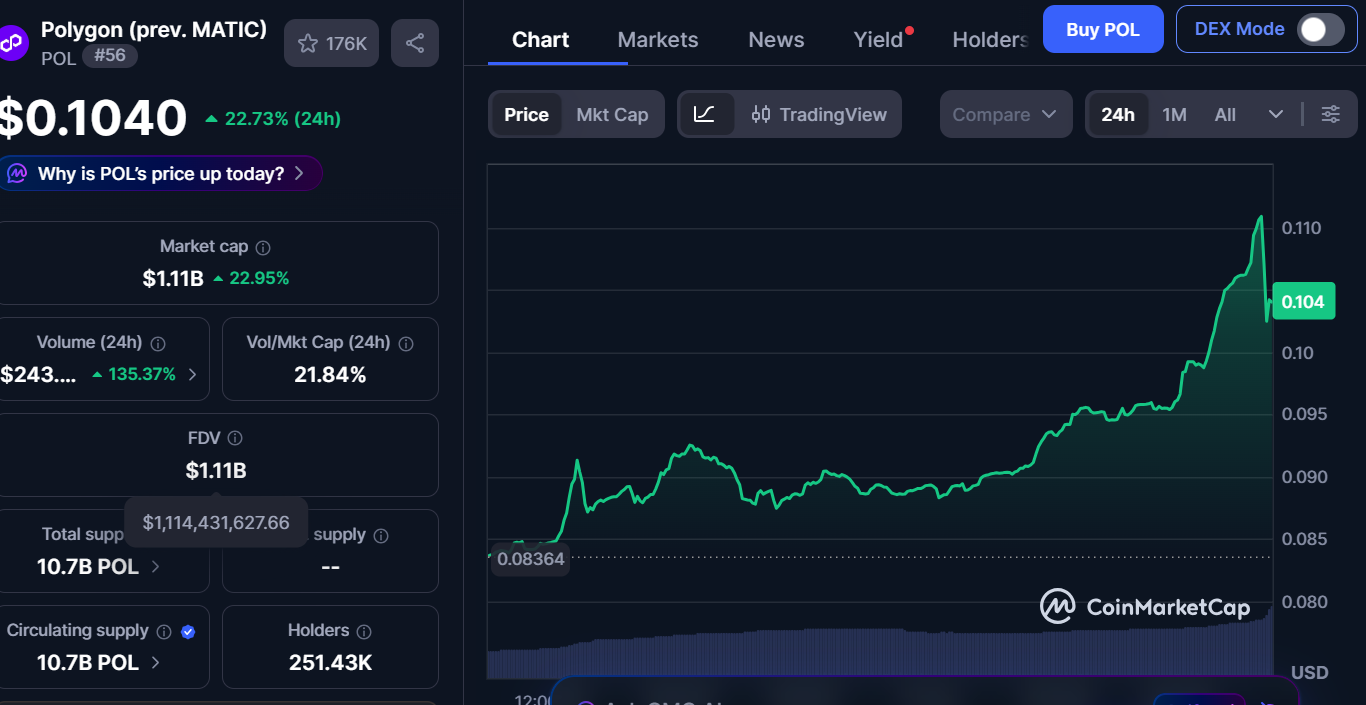
POL trades at $0.1040 depending on the major exchange and liquidity conditions.
Source: Polygon On CoinMarketCap
Formerly known as MATIC, POL now handles transaction fees and network validation for Ethereum layer-2 scaling, giving it a direct utility role rather than a purely speculative one.
That scaling function matters because Ethereum's base layer remains expensive for high-frequency, low-value transactions, which is exactly the use case stablecoin payments require and exactly where a cheaper, faster settlement layer earns its place in the payment stack.
POL Growth Drivers and Risk Level
Polygon's most distinct growth driver right now is geographic and sector-specific: rapid expansion into stablecoin-based retail payments and loyalty reward programs, particularly across Asian retail markets.
That kind of real-world merchant integration is harder to fake than presale hype, since it depends on actual transaction throughput.
Risk is elevated by wide price volatility and continued competition from other layer-2 networks chasing the same stablecoin payment use case.
A one-to-three-year horizon fits POL's faster-moving, adoption-dependent thesis.
For allocation, POL suits investors comfortable with higher volatility in exchange for direct exposure to stablecoin payment growth in emerging retail markets, best sized as a smaller, adoption-tracking position.
Stellar (XLM): The Fiat-to-Crypto Rail
XLM Price and Core Utility
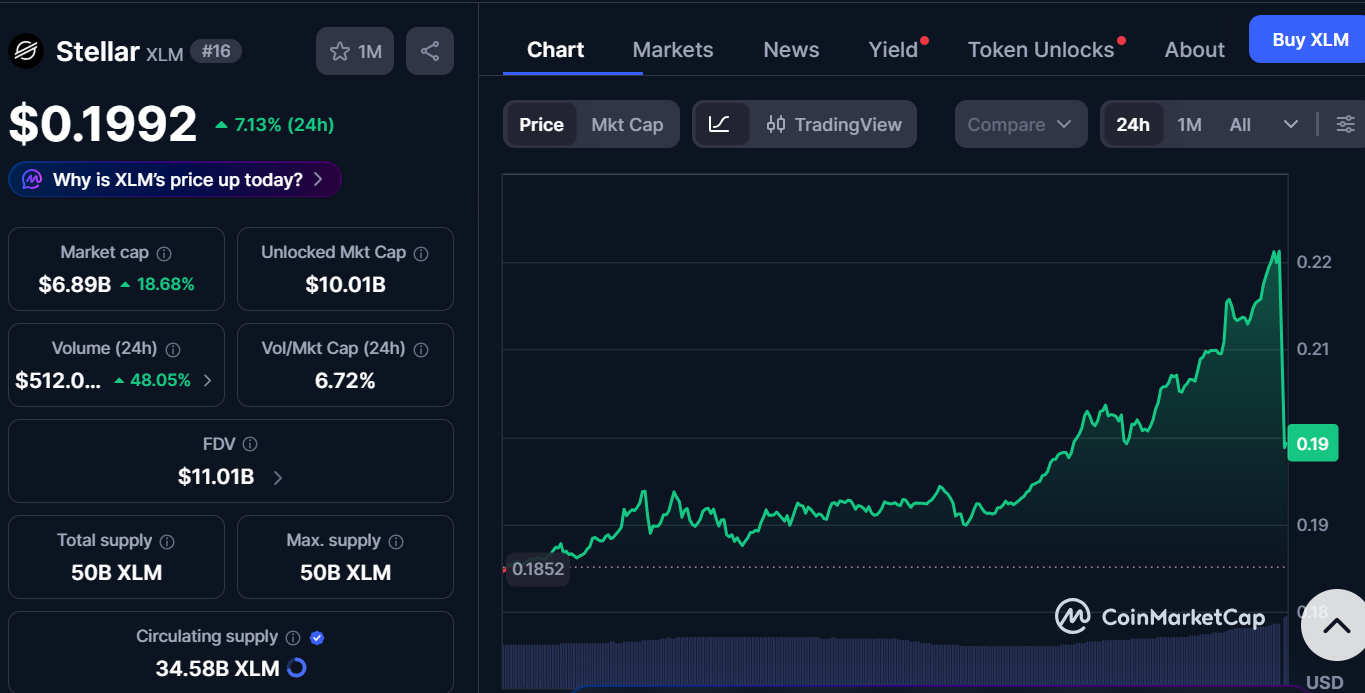
XLM trades under $0.19, keeping it among the more accessible tokens in this group by price.
Sources: Stellar On CoinMarketCap
Stellar was built as an open-source, decentralized protocol specifically designed to track and move money globally, with a network architecture optimized for cheap, fast cross-border transfers.
Unlike XRP's institutional-banking focus, Stellar has leaned into partnerships with payment providers and fintech platforms that bridge fiat currency directly into crypto rails, giving it a more consumer-adjacent adoption path than a purely bank-to-bank settlement network.
XLM Growth Drivers and Risk Level
Stellar's growth case centers on deep integration with fiat to crypto stablecoin infrastructure, positioning it to benefit as institutional real-world asset tokenization expands.
If more issuers choose Stellar's rails for settlement, transaction volume could scale meaningfully from current levels.
Risk stays moderate to high.
Stellar competes directly with other settlement-focused chains, and its growth story depends heavily on continued stablecoin issuer adoption rather than retail trading demand alone.
A one-to-three-year window applies here as well.
For allocation, XLM works well alongside XRP as a second core payment-rail holding, offering diversification across two different institutional and fintech partnership networks rather than betting on a single settlement provider.
Best Crypto to Buy Now: Payment Tokens at a Glance
Coin | Category | Risk Level | Time Horizon | Portfolio Role |
XRP | Institutional cross-border payments | Medium-High | 1-3 years | Core payment exposure |
ADA | Research-first DeFi network | Medium-High | 2-4 years | Ecosystem growth bet |
POL | Ethereum L2 stablecoin payments | High | 1-3 years | Adoption-driven altcoin |
XLM | Fiat-to-crypto settlement rail | Medium-High | 1-3 years | RWA and stablecoin exposure |
This table is a starting point, not a ranking.
Each token carries a different risk and adoption profile, and combining more than one can spread exposure across the broader payment-infrastructure theme instead of concentrating it in a single bet.
Risks to Watch Before You Buy
Any credible payments-focused shortlist needs an honest risk section, since these tokens carry their own specific pressure points beyond general market volatility.
Utility does not remove risk; it changes what kind of risk an investor is taking on.
Watch these factors closely before allocating capital:
Regulatory shifts affecting cross-border payment rails or ETF structures
Slower-than-expected institutional adoption timelines
Competition from rival layer-2 and settlement networks
Token unlocks or supply changes affecting price stability
Overconcentration in a single payment-infrastructure narrative
None of these risks are unique to this group of tokens, but payment-focused projects tend to be more sensitive to regulatory headlines than purely technical narratives like scaling or gaming tokens.
Final Verdict on the Best Crypto to Buy Now
There is no single best crypto to buy now for every investor, but this group offers a coherent alternative to generic top-picks lists built around price momentum alone.
XRP offers the clearest institutional payments case, backed by regulatory clarity from spot ETF approval.
XLM complements that with deeper fiat-to-crypto rail integration.
POL adds a faster-moving, adoption-driven stablecoin payments angle centered on Asian retail markets, while ADA provides broader DeFi ecosystem exposure for investors willing to wait out a slower development cycle.
Investors building a payment-infrastructure allocation could consider weighting XRP and XLM as core positions given their settlement-focused utility, with POL and ADA sized as smaller, higher-conviction bets tied to adoption milestones rather than price action alone.
Rebalancing that mix as regulatory clarity and adoption data develop through 2026 makes more sense than locking in a fixed allocation today.
Expert Opinion
Where the Utility Case Holds Up
Analysts covering the payments and real-world asset tokenization space generally view utility-first tokens as better positioned for the current cycle than speculative presale projects with no live transaction history.
The reasoning is straightforward: regulatory clarity and institutional adoption tend to reward networks that already process real volume, rather than projects still building toward a mainnet launch.
This group also benefits from a diversification argument that pure price-momentum lists cannot offer.
XRP and XLM target overlapping but distinct institutional payment corridors, POL targets consumer-facing stablecoin adoption in a specific region, and ADA offers exposure to a slower-moving but still active DeFi ecosystem.
Analysts note that combining these roles can reduce reliance on any single narrative playing out on schedule.
Where Analysts Urge Caution
Payment-token performance often lags behind speculative altcoins during sharp bull runs, since institutional adoption moves on a slower timeline than retail sentiment.
Regulatory developments can also move faster than network fundamentals, meaning price action may not track utility gains in the short term.
Investors prioritizing utility over short-term momentum may find that trade-off acceptable, while those chasing faster gains may want to look elsewhere or treat this group as a smaller allocation within a broader, more diversified crypto portfolio.
Disclaimer
Crypto investments are highly volatile and risky. Prices and market conditions can change quickly, and all figures cited here reflect a specific point in time. Always do independent research and consider your own risk tolerance before investing. This content is for informational purposes only and is not financial advice.






.webp)