Top Chains by Transactions: Solana Leads the 7-Day Ranking

A Look at the Chains Leading 7-Day Activity
Blockchain activity never really slows down. But once in a while, a snapshot of transaction data tells a clearer story than usual.
Over the past 7 days, Solana processed roughly 21.9 million-transactions, putting it well ahead of every other network on this list. Aptos and TRON followed at a distance, with Ethereum and Bitcoin trailing further behind despite their size and history.
Here's how the Top Chains by Transactions: stacked up, and what the numbers might tell us.
Solana Leads the 7-Day Transaction-Ranking
Solana's 21.9 million-transactions put it at the top of this 7-day ranking by a wide margin. That's more than double Aptos, the second-place chain at 8.6 million.
Solana is a Layer-1 blockchain built for high throughput and low fees. It uses a mechanism called proof-of-history alongside proof-of-stake, which lets it process transactions-faster than most competing networks. That design choice is a big reason activity tends to concentrate on Solana during periods of heavy on-chain usage, whether that's trading, minting, or app-based transactions.
A high transaction-count doesn't automatically mean more real users or more economic value moving through the network. Activity can come from bots, automated trading, or apps that generate many small-transactions per user. Still, a gap this large between first and second place is hard to ignore.
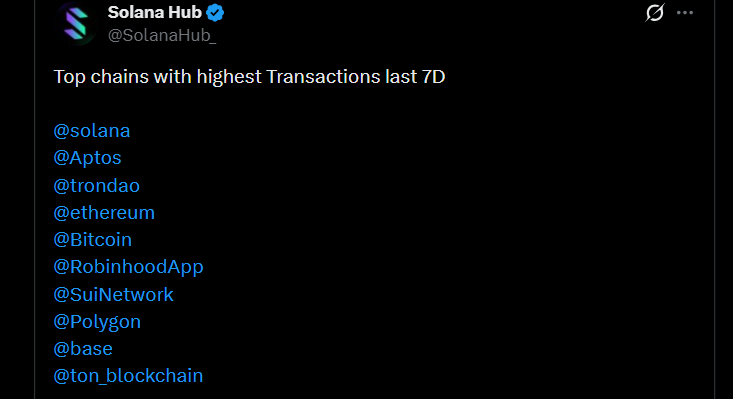
Source: Solana Hub X Post
Top Chains Featured in the 7-Day Ranking
Here's a quick look at each chain in this ranking, based on the same 7-day snapshot.
Solana — 21.9M Transactions
Solana takes the top spot with 21.9 million-transactions over 7 days. The network is known for sub-second block times and fees that typically stay under a cent. Its ecosystem includes heavy DeFi, NFT, and memecoin trading activity, which tends to push transaction counts higher than on many other chains.
Aptos — 8.6M Transactions
Aptos lands in second place with 8.6 million-transactions. It's a Layer-1 chain built by former Meta employees, using the Move programming language. Aptos has periodically posted very high daily transaction spikes tied to specific app launches, so weekly totals can shift quickly depending on what's active on the network.
TRON — 7.5M Transactions
TRON comes in third with 7.5 million transactions. The network is best known as the backbone for a large share of global USDT transfers, particularly in markets where cheap, fast stablecoin transactions matter. That stablecoin traffic is a major driver of TRON's count.
Ethereum — 2.7M Transactions
Ethereum recorded 2.7 million transactions in the same window. As the largest smart contract platform by total value locked, Ethereum's mainnet transaction count is lower than some newer chains partly because higher fees push routine activity onto Layer-2 networks like Base and Arbitrum instead.
Bitcoin — 2.6M Transactions
Bitcoin followed closely with 2.6 million transactions. As the original blockchain, Bitcoin's design prioritizes security and settlement over high throughput. Its transaction count naturally sits lower than networks built specifically for speed and volume.
Robinhood — 2.2M Transactions
Robinhood's network recorded 2.2 million transactions. Its inclusion alongside established Layer-1 chains reflects the platform's move into on-chain infrastructure, tied to its broader push into tokenized assets and crypto trading products.
Sui — 2.1M Transactions
Sui posted 2.1 million transactions over the 7-day period. Sui is another Move-language Layer-1 chain, designed around parallel transaction processing. Its transaction volume tends to move with gaming and DeFi app activity on the network.
Polygon — 1.4M Transactions
Polygon recorded 1.4 million transactions. Originally built as an Ethereum scaling solution, Polygon has expanded into its own ecosystem of payments and enterprise-linked applications, which shapes its transaction-patterns.
Base — 1.2M Transactions
Base logged 1.2 million transactions. Built by Coinbase as an Ethereum Layer-2 network, Base has grown quickly since launch, driven largely by consumer apps, social tokens, and trading activity.
TON — 715K Transactions
TON closes out the list with 715,000 transactions. The network is closely tied to Telegram's user base, and its transaction activity often reflects usage from Telegram-integrated mini-apps and wallets.
How Solana Compares With the Other Top Chains
Solana's 21.9 million-transactions are more than 2.5 times Aptos's 8.6 million, and nearly 3 times TRON's 7.5 million. Against Ethereum and Bitcoin, the gap is even wider — Solana processed roughly 8 times as many transactions as either network in this window.
That said, comparing Solana to Ethereum or Bitcoin on transaction-count alone can be misleading. Ethereum's activity is split across dozens of Layer-2 networks, so its mainnet number understates total ecosystem usage. Bitcoin, meanwhile, isn't designed to compete on transaction volume at all — its value proposition rests on security and scarcity, not throughput.
Against Aptos and TRON, the comparison is more direct, since all three are competing more explicitly on speed and low-cost transactions. Here, Solana's lead looks more meaningful.
Top Chains by Transactions: Last 7-Day Comparison
Rank | Chain | Transactions (7D) |
1 | Solana | 21.9M |
2 | Aptos | 8.6M |
3 | TRON | 7.5M |
4 | Ethereum | 2.7M |
5 | Bitcoin | 2.6M |
6 | Robinhood | 2.2M |
7 | Sui | 2.1M |
8 | Polygon | 1.4M |
9 | Base | 1.2M |
10 | TON | 715K |
What the Transaction Numbers Reveal About Network Activity
A high transaction count usually means a network is seeing heavy on-chain activity, whether from trading, app usage, or transfers. It's one signal of demand for block space.
But transaction count alone doesn't measure network health. A chain can post huge numbers from a single popular app, a bot-driven trading strategy, or low-value spam transactions, without that reflecting broader adoption. It also says nothing about the dollar value moving through the network, which is a very different metric from raw transaction count.
So this ranking is best read as a snapshot of activity, not a verdict on which blockchain is winning.
What Could Shift the Transaction-Ranking?
These rankings shift often, sometimes within days. A new app launch, a viral game, or a spike in stablecoin transfers can move a chain up several spots.
Aptos, for example, has previously posted daily-transaction spikes tied to specific app launches that briefly pushed it past Solana. TRON's numbers move with stablecoin demand, which can shift based on regional payment trends. Even smaller chains like TON can see sudden jumps if a popular mini-app goes viral on Telegram.
Because of that, a single 7-day window is a starting point for comparison, not a fixed picture of where each network stands.
Final Word
Solana's 21.9 million transactions make it the clear leader in this 7-day ranking, with Aptos and TRON following well behind. Ethereum and Bitcoin post noticeably lower transaction counts here, for reasons tied to their design rather than a decline in relevance.
Read this ranking as a snapshot of network activity over a specific week, not a judgment on which blockchain is superior or which will perform better going forward.
Disclaimer
This article presents transaction data in the context of a specific 7-day ranking. Transaction count alone does not constitute investment advice, proof of network superiority, an accurate measure of user count, or an indicator of future performance. Readers should conduct their own research before making any financial decisions.








.webp)