KuCoin Review 2026: Altcoin Depth and Risk Check

What Makes KuCoin Different in 2026?
Altcoin traders keep coming back to KuCoin for one reason: it lists tokens other exchanges won't touch yet. That reputation is why a kucoin review 2026 search brings up so many mixed opinions.
The exchange has grown into one of the larger global platforms by user count. It has also picked up a serious regulatory record along the way, including a nine-figure US settlement.
This review looks at both sides. We'll cover what KuCoin actually offers, what its 2020 security incident and legal cases mean today, and what you should check before funding an account. Research for this piece is dated 29 August 2026.
What Is KuCoin and How Does It Work?
It is a centralized crypto exchange founded in 2017. It brands itself as the People's Exchange and operates across Seychelles, Singapore, and the Cayman Islands rather than from a single regulated headquarters.
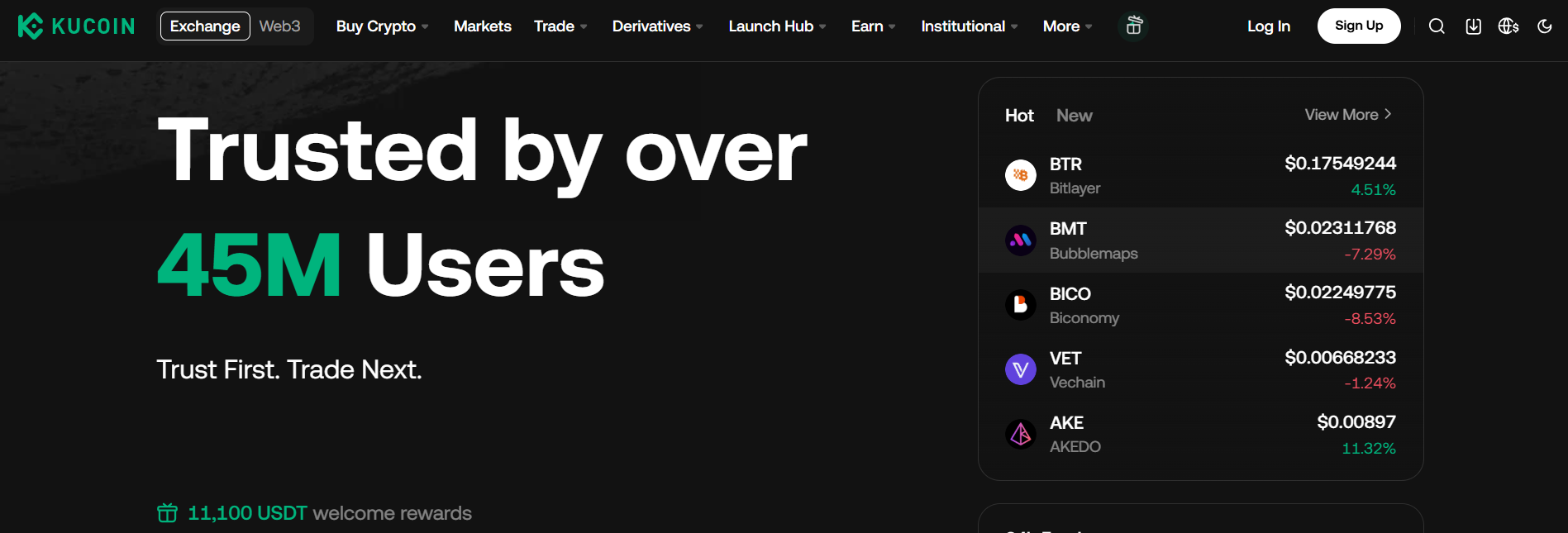
The platform's official homepage states it serves more than 45 million users and lists over 1,000 altcoins alongside Bitcoin and Ethereum. That figure is a company claim, not an independently audited number, so treat it as directional rather than exact.
KuCoin's core pitch hasn't changed much since launch: give traders early access to smaller-cap tokens before they reach bigger, more conservative exchanges.
What Can You Trade on KuCoin?
It runs several products under one account. Spot trading is the base layer, alongside margin trading, futures contracts, and a trading bot marketplace with preset grid and DCA strategies.
Beyond core trading, the exchange offers:
KuCoin Earn – staking and yield products for idle holdings
P2P trading (Express) – buying crypto with local payment methods where supported
KuCoin Pay and KuCard – spending crypto-linked balances
GemSPACE and Spotlight – early-access launch and listing campaigns for new tokens
Token vesting, in case the term is new to you, is simply the schedule that controls when locked tokens become tradeable. It matters most for GemSPACE-style launches, where early participants often can't sell everything on day one.
What Altcoin Access Does KuCoin Offer?
This is where KuCoin separates itself from bigger, more cautious platforms. Independent exchange reviews published in 2026 put the token count anywhere from roughly 700 to over 1,600, depending on how each tracker counts delisted or wrapped assets.
The wide altcoin selection is real, but it comes with a catch. Order books for smaller, low-volume tokens are often thin. A large market order on a niche pair can move the price noticeably more than the same trade on Bitcoin or Ethereum pairs.
If you plan to trade outside the top 50 coins by market cap, check the order book depth before placing size. Limit orders help manage this risk.
What Do Fees and the VIP Program Look Like?
KuCoin's published VIP program groups users into tiers based on 30-day trading volume or KCS token holdings, with discounted spot and futures fees at higher tiers. The exchange's own VIP page states discounts of up to 75% off standard rates for qualifying accounts.
Independent testing by outside reviewers in 2026 reported a baseline spot fee near 0.1% maker and 0.1% taker before any discount, though KuCoin does not publish this exact figure in a single fixed table, so treat it as a reported starting point rather than a guaranteed rate.
Withdrawal fees are network-dependent and change with blockchain congestion, so the final cost only confirms at the transaction step.
What Is KuCoin's Regulatory Status in 2026?
This is the part of any 2026 review that carries the most weight. In January 2025, KuCoin's operator, Peken Global Limited, pleaded guilty to operating an unlicensed money transmitting business in the United States. The case resulted in penalties and forfeitures of roughly $297 million and a commitment to exit the US market for at least two years.
In March 2026, a US federal court approved a separate CFTC consent order permanently barring Peken Global from serving US users unless it registers as a foreign board of trade. That order added a $500,000 civil penalty on top of the earlier criminal case.
US access, in short, is not coming back on the old terms. Existing US accounts have reportedly been able to withdraw funds, but new trading and deposits remain blocked.
In the European Union, reporting from mid-2026 describes a mixed picture: Austria's financial regulator reportedly granted KuCoin's EU entity a MiCA license in late 2025, then restricted new EU customer onboarding months later over compliance staffing concerns. EU availability should be treated as unsettled and worth checking directly before depositing funds.
What Are the Main Risks to Consider?
Regulatory exposure – A completed US criminal case and a permanent US trading ban mean access can change fast depending on where you live, and EU rules are still being finalized.
Thin liquidity on smaller listings – Order books for low-cap altcoins are shallow, so larger orders can move the price more than expected. Limit orders help, but don't remove the risk.
No deposit insurance or regulator backstop – KuCoin isn't a bank. If funds are lost through platform failure or a hack, there's no government-backed protection the way there is with insured bank deposits.
Jurisdiction-dependent protections – Legal recourse if something goes wrong depends heavily on your home country's rules, since KuCoin operates across Seychelles, Singapore, and the Cayman Islands rather than one regulated base.
Self-custody responsibility – Withdrawal fees, network confirmations, and wallet security are on the user. A wrong network or address can result in an unrecoverable loss.
Is KuCoin Safe to Use in 2026?
Safe depends on what you're asking. On the technical side, KuCoin publishes proof-of-reserves data on a regular basis, which is more transparent than many competitors offer.
On the regulatory side, the picture is weaker. A completed US criminal case, a permanent US trading ban, and an unresolved EU licensing situation are not small details. They point to a platform that has struggled with compliance even as it scaled up.
The main concern isn't whether KuCoin can execute a trade it clearly can. The main concern is jurisdictional: whether you're allowed to use it, and what protection exists if something goes wrong. That answer changes depending on where you live, so verify your own region's rules before signing up.
Conclusion
KuCoin remains one of the broadest altcoin venues available, with a product range that goes well beyond simple spot trading. That breadth is genuine, and so is the liquidity risk that comes with smaller-cap listings.
What's less settled is the compliance side. A completed US settlement, a permanent US access ban, and an EU licensing situation still working itself out are real factors, not background noise. Anyone considering KuCoin in 2026 should weigh the altcoin access against that regulatory record, check their own jurisdiction's rules, and avoid keeping more on any exchange than they're prepared to lose.
Disclaimer
This article is for informational purposes only and does not constitute financial, legal, or investment advice. Crypto exchanges carry regulatory, security, and market risk, and readers should verify current terms directly with KuCoin before using the platform.
Also read: