Pepedo Tokenomics: $PDO Supply, Allocation & Distribution Explained

Understanding Pepedo’s $PDO Supply and Distribution
Pepedo has set its total supply at 200 billion $PDO, and how that number gets carved up says more about the project than the price chart does. Pepedo Tokenomics covers presale, staking, liquidity, marketing, ecosystem, and team allocations — each with its own share and its own rules for when tokens actually move.
Pepedo is an Ethereum-based ERC-20 meme coin built around a "rebellion" theme, with a live staking-vault and a leaderboard-style reward system layered on top of the token sale. This piece lays out exactly how the $PDO supply is split, what's locked versus liquid, and what the staking pools and reward system are offering — using the numbers the project has published on its own site.
What Is Pepedo ($PDO) Token?
$PDO is Pepedo's native Ethereum-based ERC-20 token, powering a meme coin project built around a "rebellion" theme. Its total supply is fixed at 200 billion, split across presales, staking-rewards, liquidity, marketing, ecosystem, and team allocations.
Token Details at a Glance
Before getting into allocation percentages, here's the basic structure of the token itself, as listed by the project:
Detail | Info |
Token Name | Pepedo |
Symbol | $PDO |
Network | Ethereum |
Standard | ERC-20 |
Total Supply | 200,000,000,000 $PDO |
Running on Ethereum's ERC-20 standard means $PDO works with standard wallets and DEX infrastructure without needing a custom chain or bridge.
What Is the Total Supply of $PDO
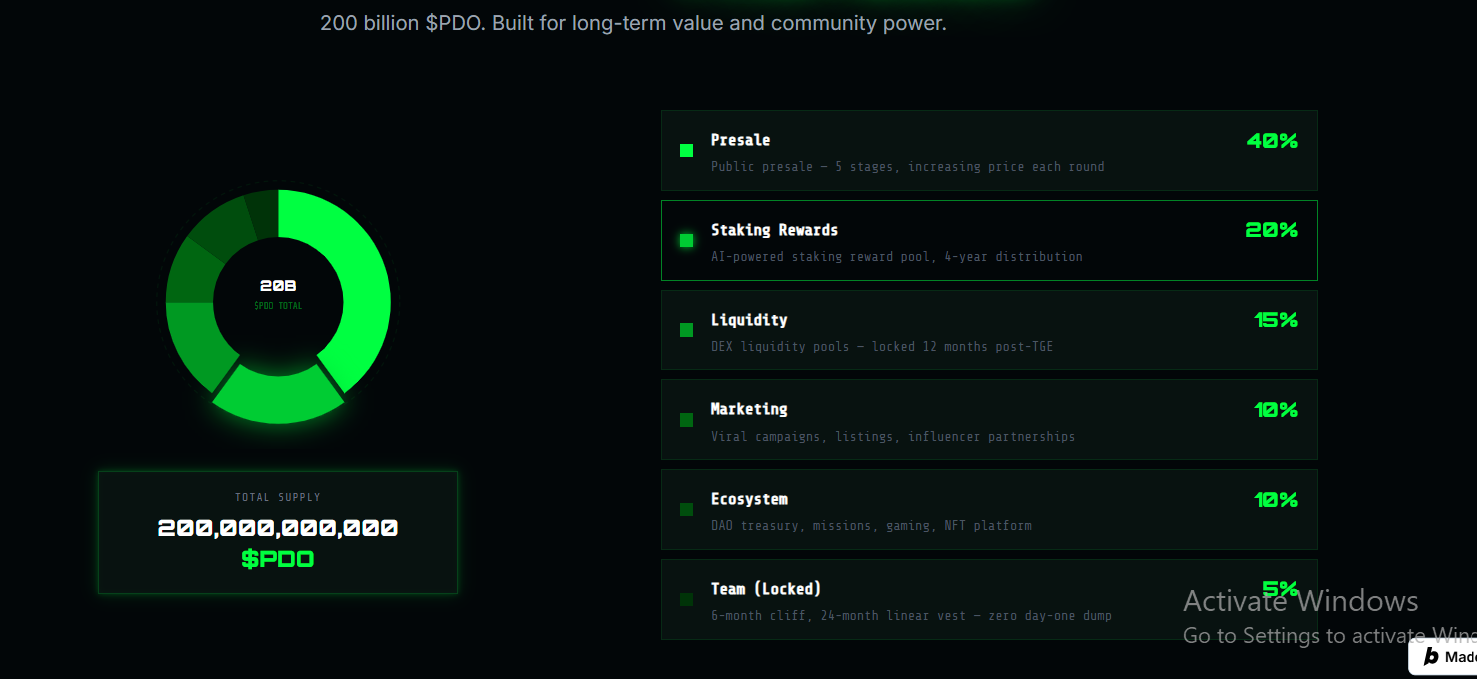
The project lists a fixed total supply of 200,000,000,000 (200 billion) $PDO. Here's how that supply is allocated:
Allocation | Percentage | Purpose |
Presale | 40% | Public token sale across five stages, with price increasing each round |
Staking Rewards | 20% | Staking reward pool, distributed over 4 years |
Liquidity | 15% | DEX liquidity pools, locked for 12 months after TGE |
Marketing | 10% | Campaigns, exchange listings, influencer partnerships |
Ecosystem | 10% | DAO treasury, community missions, gaming and NFT plans |
Team (Locked) | 5% | 6-month cliff, then a 24-month linear vest |
Presale takes the largest single cut at 40%, or 80 billion tokens, followed by staking rewards at 20%, or 40 billion tokens. Liquidity gets 15% (30 billion tokens), marketing and ecosystem 10% each (20 billion tokens apiece), and the team sits at just 5%, or 10 billion tokens, locked behind a cliff and a linear vesting schedule — meaning tokens release gradually over 24 months after an initial 6-month freeze, rather than all at once.
The presale itself runs across five separate stages, with the price rising at each step. That structure rewards earlier buyers with a lower entry price, though the exact price per stage isn't listed on the pages reviewed for this article.
How Does $PDO Staking Work?
Alongside the token sale, Pepedo runs a staking vault with four pools:
Pool | Lock Period | Stated APY | Minimum Stake |
Flexible Vault | None — withdraw anytime | 48% | 1,000 $PDO |
Rebel Lock 30 | 30 days | 85% | 5,000 $PDO |
Rebel Lock 90 | 90 days | 148% | 10,000 $PDO |
Supreme Lock 180 | 180 days | 240% | 25,000 $PDO |
Locked pools compound rewards automatically every 24 hours, according to the project, and stated APY rises with the length of the lock. The Supreme Lock 180 pool also carries a 1% daily rate figure alongside its APY, while the other three pools list 0% for that same daily-rate field on the project's dashboard.
The staking vault's published stats show 102.10 billion $PDO in total value locked across all pools, with 3,847 active staking positions and 8.42 billion $PDO already paid out in rewards. The staking reward pool available for future payouts is listed at 40 billion $PDO, which lines up with the 20% staking allocation from the total supply table above. Pool-by-pool, the project reports 12.40 billion staked in the Flexible Vault, 28.70 billion in Rebel Lock 30, 41.20 billion in Rebel Lock 90, and 19.80 billion in Supreme Lock 180.
How Does the Pepedo Reward System Work?
Separate from staking APY, Pepedo runs a monthly USDT reward system for holders. The project describes three components:
Top 10 Rebels — the largest USDT payouts go to the biggest holders on a leaderboard, ranked by wallet balance.
Random Rebels — 30 wallet addresses are drawn at random each month, giving smaller holders a chance at a reward regardless of position size.
Variable Pool — additional USDT rewards distributed to long-term stakers and holders who complete stated "missions."
The project outlines the process in three steps: buy $PDO during the presale, hold or stake the tokens, then become eligible for USDT payouts roughly every 30 days. The leaderboard itself resets on a recurring basis, and the dashboard displays live rankings, wallet addresses (partially masked), USDT amounts, and token balances for the current top holders.
How Are Pepedo’s Ecosystem and Marketing Allocations Used?
Two smaller slices of the pie — 10% for marketing and 10% for ecosystem — cover different parts of the roadmap. The marketing allocation is earmarked for viral campaigns, exchange listings, and influencer partnerships, which is fairly standard for a presale-stage meme coin trying to build visibility before and after launch.
The ecosystem allocation is described as funding a DAO treasury, community "missions," a gaming layer, and an NFT platform. None of these are live products based on the pages reviewed — they're stated plans tied to future development, not features available today. Anyone evaluating this allocation should treat it as a funding reserve for planned work rather than proof that the gaming or NFT components already exist.
What Do the $PDO Tokenomics Numbers Mean?
A 40% presale share is on the larger side compared to many token launches, which usually spreads tokens across more wallets early but can also mean more sellers once those tokens unlock. The 15% liquidity lock and the team's cliff-plus-vest structure are both fairly standard ways of slowing down early sell pressure, without removing it entirely.
The staking APYs are paid out in $PDO from the project's own 20% reward allocation — not from outside revenue — so the token count in a wallet grows over time even if the token's market price doesn't. Combined, the presale and staking-reward allocations account for 60% of total supply, which is the largest share of tokens that will eventually reach the open market as vesting and reward schedules run their course.
Conclusion
Pepedo's tokenomics follows a standard meme coin structure — a fixed 200 billion supply, a large presale share, locked liquidity, and a vested team allocation, along with a staking system that includes monthly USDT rewards. The presale and staking-reward allocations together make up 60% of supply, which is the portion worth watching most closely as it unlocks over time.
Before making any decision, be sure to check the unlock schedule and staking lock-in periods, since rewards are paid out from the project's own pool rather than external revenue. All figures are based on the project's published information.
Disclaimer
This article is for informational purposes only and is not financial advice. Cryptocurrency presales and staking products carry high risk, including total loss of capital. Always verify project data independently and consult a qualified financial advisor before investing.
Also read:







.webp)