Pi Network Review 2026: Full Update on Price and Roadmap


This Pi Network Review 2026 looks at where the project stands after its first full year on open mainnet.
Pi has moved through several protocol upgrades, a slow but steady KYC migration process, and repeated exchange listing debates.
The token trades far below its 2025 opening price, yet the $Pi Core Team keeps shipping technical updates on a fairly steady schedule.
This review breaks down the current price, the Protocol 26 and Protocol 27 upgrades, ecosystem growth, and the risks Pioneers should weigh before treating $PI as more than a speculative holding.
What Is Pi Network
Pi Network began in 2019 as a mobile mining app that let users earn $PI without draining their battery.
The project ran a long enclosed mainnet phase before opening external transfers on February 20, 2025.
Since then, the network has shifted focus toward Stellar-based protocol upgrades, KYC verification at scale, and building an app ecosystem around the coin.
The long-term goal is turning a mining community into a working payment and DeFi network rather than a speculative token with no real use.
Whitepaper and Token Supply Basics
Pi Network's official Pi Network white paper states the project's mission as building a cryptocurrency and smart contracts platform secured and operated by everyday people rather than large mining farms.
The Mainnet token model sets a maximum supply of 100 billion $PI, split so the $Pi community eventually holds 80% and the Pi Core Team holds 20%.
Within the community share, 65% is reserved for past and future mining rewards, 10% for ecosystem building through a future $Pi Foundation, and 5% for liquidity pools.
Mainnet mining rewards also factor in lockup duration, node uptime, and app usage rather than the simpler formula used before mainnet, a design meant to favor long-term contributors over short-term speculation.
Price and Market Snapshot
$PI trades near $0.09 today.
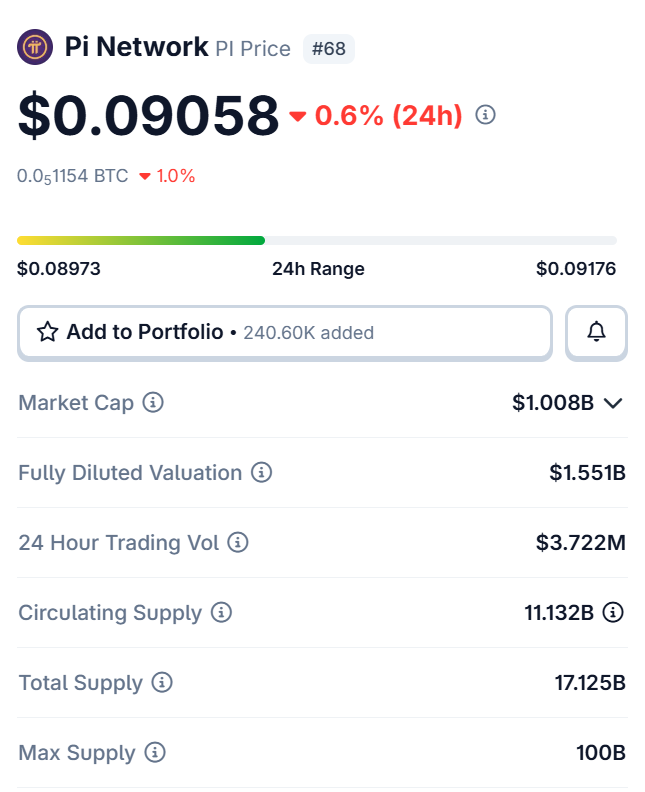
That is a steep drop from its opening-day peak of $2.10 and its all-time high of $2.99, both hit soon after the mainnet launched in February 2025.
The total market value of all $PI in circulation is around $1 billion, and only a small part of the 100 billion max supply is in circulation so far, according to CoinGecko live price data.
Daily trading volume stays low compared to $PI's large user base, based on OKX price data.
In simple terms, the price has been range-bound for weeks, moving up and down in a narrow band rather than trending strongly in either direction, and traders are watching whether it breaks out above recent highs or falls back toward its July 2026 low.
Protocol 26 and Protocol 27 Roadmap
The biggest technical story this year is the shift from Protocol 25 to Protocol 26, then toward Protocol 27.
Node operators had to complete the Protocol 26 upgrade by August 11, 2026, or risk disconnection from mainnet, according to the official Protocol 26 announcement.
Protocol 27 is targeted for a mainnet release on September 15, 2026, and is described as the final planned infrastructure upgrade, adding flexible smart contract authentication needed for a native decentralized exchange.
The Pi Day 2026 update confirmed this direction, tying the roadmap to broader ecosystem participation for Pioneers who have completed migration.
Note that Pi's own Pi Network roadmap page is explicitly marked as a legacy, pre-Open Network document that the Core Team is no longer updating, so current On-Chain System dates are best tracked through official blog posts and announcements rather than that page.
KYC and Mainnet Migration Progress
KYC and migration remain the slowest part of the $Pi story.
By early 2026, more than 16 million Pioneers had migrated mined tokens to mainnet wallets, with roughly 16.5 million users KYC-approved around Pi Day 2026.
The validator system built to support KYC has processed over 526 million human verification tasks, a figure the Core Team now frames as part of a wider human-identity infrastructure play tied to AI applications.
Migration eligibility continues to expand in phases, so users who mined earlier but have not yet completed KYC may still see their balances unlocked over time.
Pi DEX and Ecosystem Utility
On-Chain System 23 brought Soroban smart contracts to $Pi Network in May 2026, opening the door to DeFi apps built directly on the chain.
The planned Pi DEX aims to let Pioneers trade PI peer-to-peer without relying on centralized exchanges once On-Chain System 27 is live.
Third-party wallets such as OpenPay have already moved from testnet to a live mainnet setup, though they are not yet on the official KYB-verified business list.
App Studio pricing also changed on August 24, 2026, replacing a flat creation fee with usage-based pricing tied to actual AI resource costs.
Exchange Listings and Liquidity
Binance has not listed PI, and that gap remains the most common complaint among Pioneers watching liquidity and price discovery.
coin does trade on OKX and a number of mid-tier exchanges, but volume stays thin relative to the claimed user base of tens of millions.
Wider listings tend to move the market data tracked on CoinMarketCap's latest updates more than any single On-Chain System release, since liquidity access still shapes short-term price action for coin more than technical progress does.
Protocol Upgrade Timeline
| Milestone | Date | Status |
| Open Mainnet Launch | Feb 20, 2025 | Completed |
| On-Chain System 23 (Soroban contracts) | May 11, 2026 | Completed |
| Protocol 26 (node upgrade deadline) | Aug 11, 2026 | Completed |
| Pi Node v0.6.2 release | Aug 14, 2026 | Completed |
| Protocol 27 (final planned upgrade) | Sep 15, 2026 | Targeted |
| Full DEX and AMM launch | After Protocol 27 | Planned |
Source: Pi Core Team announcements and CoinMarketCap AI update tracker, compiled August 2026.
Risks Pioneers Should Weigh
coinstill carries heavy token dilution risk, with a large share of the 100 billion max supply yet to enter circulation.
The coin sits more than 90% below its all-time high, and no major top-tier exchange has confirmed a listing.
Utility depends entirely on On-Chain System 27 shipping on schedule and the coin DEX attracting genuine trading activity rather than internal transfers among Pioneers.
Anyone reviewing coin in 2026 should treat roadmap dates as targets, not guarantees, given the project's history of shifting deadlines across earlier On-Chain System versions.
Expert Opinion
Market analysts following Pi Network's 2026 progress generally agree that the project has made real technical headway, particularly with Soroban smart contracts and the phased On-Chain System upgrade schedule.
At the same time, most note that shipping infrastructure does not automatically translate into demand.
The gap between a 60-million-user claim and thin daily trading volume remains the central tension analysts flag when assessing whether PI's price can recover meaningfully before the coin DEX proves itself with real liquidity.
Disclaimer
This coin Network Review 2026 is for informational purposes only and does not constitute financial or investment advice. Cryptocurrency prices are volatile, and Pi Network carries additional risks tied to token dilution, exchange access, and roadmap execution. Readers should conduct independent research and consult a licensed financial advisor before making any investment decision involving coin or any other digital asset.