Sonic Token Explained: How Sonic Token S Works in 2026

A Closer Look at the Sonic S Token
A layer-1 chain that promises 400,000 transactions per second, pays developers up to 90% of the fees their apps generate, and is now pushing into Nasdaq and ETF territory is bound to draw questions. That's exactly what's happening with Sonic, the network that replaced Fantom.
If you're searching for sonic token explained content, you're probably trying to figure out what S actually does, how its supply works, and whether the recent tokenomics changes matter. This article breaks all of that down using Sonic's own published documentation, not price hype.
We'll look at how the network functions, what the S token is used for, how the supply has changed in 2025 and 2026, and where the real risks sit. Read this before you check a price chart, not after.
What Is Sonic and How Does It Work?
Sonic is an EVM compatible layer-1 blockchain, meaning developers can build on it using the same Solidity code that runs on Ethereum. The project positions itself as the fastest EVM chain, citing roughly 400,000 transactions per second and sub-second transaction finality.
Sonic isn't a brand-new chain from scratch. It's the successor to Fantom Opera. Holders of the old FTM token could upgrade to S on a 1:1 basis, and Fantom's original block reward pool was redirected to fund Sonic validators.
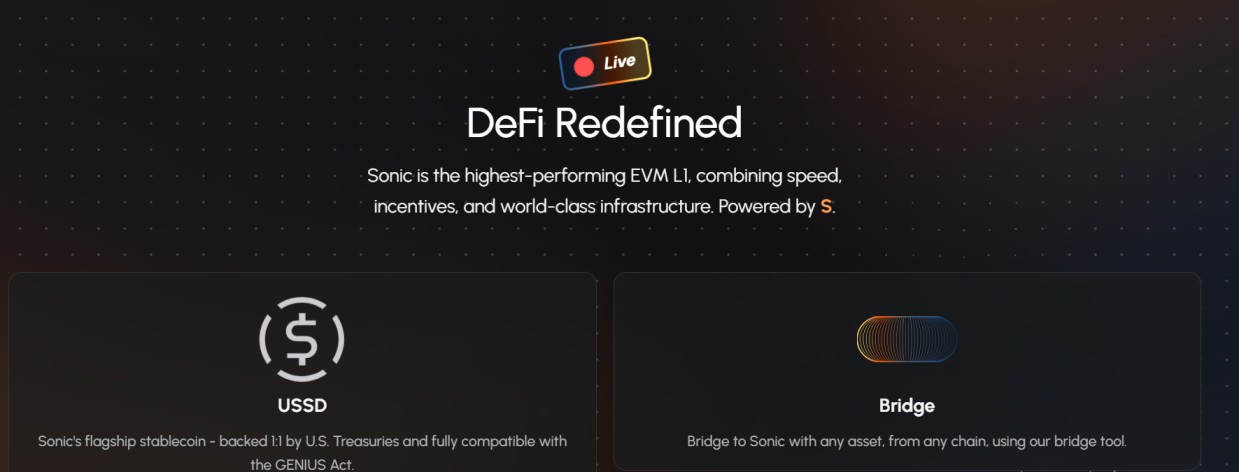
Two features stand out in Sonic's own documentation. The first is Fee Monetization, a program where developers earn a share of the network fees their apps generate, similar to how ad revenue works for web publishers. The second is the Sonic-Gateway, a native bridge that connects Sonic to Ethereum and other chains, audited by three separate security firms.
What Is the Sonic S Token Used For?
S is the token that runs the network. According to Sonic's documentation, it has three core jobs:
Gas – users spend S to pay transaction fees on the network.
Staking – S can be delegated to validators to help secure the chain and earn rewards.
Governance – staked S gives holders a say in proposals that shape Sonic's direction.
Staking works through delegation. You pick a validator, delegate your S, and earn a share of block rewards and network fees. Sonic's docs note a 14-day waiting period if you decide to withdraw a stake, and they warn that a poorly run validator can affect delegators too. That's a real operational risk worth understanding before you stake, not an afterthought.
How Does Sonic’s Tokenomics Model Work?
Sonic doesn't run on a fixed, one-time supply. Instead, the project uses a mix of scheduled issuance and burn mechanisms that adjust the supply over time. According to the project's published tokenomics, the main components are:
Allocation Stream | Purpose | Stated Detail |
Block Rewards (first 4 years) | Validator rewards | Funded from leftover Fantom Opera rewards, no new S minted |
Block Rewards (after year 4) | Validator rewards | New issuance resumes at 1.75% per year |
Airdrop Program | Community distribution | 190.5 million S issued in phases |
Ongoing Funding | Growth and marketing | 47.625 million S issued yearly for six years, unused tokens burned |
Institutional Expansion | ETF, Nasdaq DAT, Sonic USA | Roughly 633.9 million S approved by governance vote |
The institutional expansion allocation is the newest change. A governance proposal approved issuing S to back an ETF push, a Nasdaq-linked vehicle, and a new entity called Sonic-USA, and the first tranche of roughly 472 million S was issued in September 2025. This is a stated plan, not a confirmed ETF or Nasdaq listing; the docs note unused funds get returned or burned if it falls through.
Sonic also runs two burn mechanisms: early airdrop claims forfeit tokens, and any unused portion of the annual ongoing funding allocation is burned rather than held.
How Is the Sonic S Token Supply Distributed?
This is where readers need to be careful, because tracker figures vary depending on the exact date they pull data. As of early September 2026, S showed a circulating supply in the range of roughly 2.9 billion to 3.9 billion tokens across different data platforms, with total supply figures clustering close to 3.9 billion after the institutional expansion issuance. Market cap estimates across major trackers sat roughly between $70 million and $110 million, with the token trading in the low single-digit cents.
That's a steep drop from Sonic's all-time high near $1.03, hit in January 2025. The all-time low, closer to $0.019, was recorded in mid-2026. The available data suggests the token has spent most of 2026 in a prolonged downtrend, even as the network's institutional plans expanded.
It does not use a hard-capped maximum supply. Several trackers list it as uncapped, which matters for anyone comparing S to fixed-supply assets. That structure puts extra weight on the burn mechanisms actually offsetting new issuance over time.
What Makes Sonic Different From Other Layer-1 Networks?
Sonic's stated differentiators are speed, fee monetization, and its stablecoin push. The network's claimed throughput and near-instant finality target the same use case as other high-performance chains: DeFi apps that need fast settlement.
Fee Monetization is arguably the more distinctive piece. Instead of developers relying purely on token incentives, Sonic lets registered apps claim up to 90% of the network fees generated by their own users. The project also launched USSD, a stablecoin it describes as backed 1:1 by U.S. Treasuries and built to align with the GENIUS Act framework in the United States.
What Are the Main Risks to Consider?
Token price has fallen sharply from its highs, and staking or holding S carries the same volatility risk as any small-cap token.
Supply dilution is an open question: New issuance for institutional expansion and ongoing funding adds tokens; whether burns keep pace is not guaranteed.
Institutional plans are not confirmed outcomes: An ETF or Nasdaq vehicle succeeding is a stated goal, not a completed event.
Validator risk in staking: Delegating to a poorly run validator can affect your own rewards, per the project's own staking guidance.
A 14-day unstaking window means your S isn't instantly liquid if you need to exit a delegated position.
What Does the Data Say About Sonic in 2026?
The stronger signal is that Sonic-keeps shipping concrete infrastructure: a live bridge with multiple audits, a working fee-sharing model for developers, and a stablecoin aligned with U.S. regulatory language. That's more tangible than most layer-1 roadmaps.
The main concern is the gap between token price and institutional ambition. A network issuing hundreds of millions of new tokens toward Nasdaq and ETF goals needs those goals to land, or the added supply becomes pure dilution.
The biggest unknown remains whether the Nasdaq DAT and ETF pursuit actually close, since both are still in progress as of this writing. Readers should verify current supply and price figures directly through Sonic's own documentation before acting on any number in this article, since token data shifts daily.
Is Sonic Worth Watching in 2026?
Sonic fits readers who want exposure to a fast EVM chain with an active institutional strategy, not those looking for a settled, low-volatility asset. The token utility itself, gas, staking, governance, is straightforward.
The uncertainty sits in supply growth and whether the U.S. expansion plans convert into real approvals rather than remaining proposals.
Conclusion
Sonic is a high-throughput EVM layer-1 that evolved out of Fantom, built around fast settlement, a developer fee-sharing model, and a growing push into U.S. institutional markets. The S token pays for gas, secures the network through staking, and carries governance rights.
Its tokenomics combine scheduled issuance for validators, airdrops, and growth funding with two burn mechanisms meant to offset that new supply. What stands out is how much of Sonic's 2025 to 2026 story has been about institutional infrastructure rather than just throughput numbers. What remains uncertain is whether that infrastructure push, and the token issuance funding it, pays off for holders. Anyone researching S should check live supply and price data directly before making any decision.
Disclaimer
This article is for informational purposes only and does not constitute financial advice. Cryptocurrency prices are volatile, and past performance does not indicate future results. Always do your own research before making any investment decision.