Top Altcoins to Buy: 5 Coins Worth Watching in August 2026

Top Altcoins to Buy: Key Factors, Trends, and Market Insights
Bitcoin usually gets the spotlight, but a lot of real market action happens outside of it. That's exactly where altcoins come in, and it's exactly why so many traders are searching for the top altcoins to buy right now.
Whether prices are climbing or cooling off, tracking the right names can tell you a lot about where market interest is shifting. This breakdown covers five major names currently active in the market, with real numbers, real trends, and no filler.
If you're building your own list of the top picks this month, this is a solid place to start.
Key Takeaways
Solana is showing the strongest short-term momentum on this list, up over 1.7% in 24 hours with rising volume.
Tether remains the most heavily traded asset here by far, with over $38 billion in daily volume.
XRP has pushed back above the $1.00 mark, gaining more than 1% in the past day.
What Exactly Is an Altcoin?
An altcoin is simply any cryptocurrency that isn't Bitcoin. The term covers everything from major Layer 1 blockchains to stablecoins to payment-focused tokens.
Some altcoins aim to solve technical problems, like faster transactions or lower fees. Others, like stablecoins, exist purely to hold steady value. Understanding which category a coin falls into matters just as much as watching its price.
How to Choose the Top Altcoins to Buy
Picking altcoins isn't just about chasing green candles. A few things are worth checking before adding any coin to your list:
Market cap and ranking: Larger market caps generally mean more stability and liquidity.
24-hour volume: Higher volume usually means it's easier to buy and sell without major price slippage.
Circulating vs. max supply: Coins with capped supply behave differently than those with unlimited issuance.
Use case: A coin built for payments behaves differently than one built for smart contracts or stability.
With that in mind, here's a closer look at five names currently worth watching.
1. Solana (SOL)
Solana is a high-speed Layer 1 blockchain built for fast transactions and low fees. It was designed from the ground up to handle a large volume of transactions per second, which makes it especially popular among developers building decentralized apps, NFT platforms, and DeFi projects.
Unlike some older blockchains, Solana uses a unique combination of technologies to process transactions in parallel, which is a big part of why it can move so quickly. Over time, it's built one of the more active developer ecosystems in crypto, with a wide range of projects running directly on its network.
Price: $77.36, up 1.76% in the last 24 hours.
Market cap sits at $45.1 billion, up 1.87%. Daily volume came in at $1.45 billion, climbing 3.52%. Circulating supply stands at 583 million SOL out of a 632.51 million total supply, with no maximum cap.
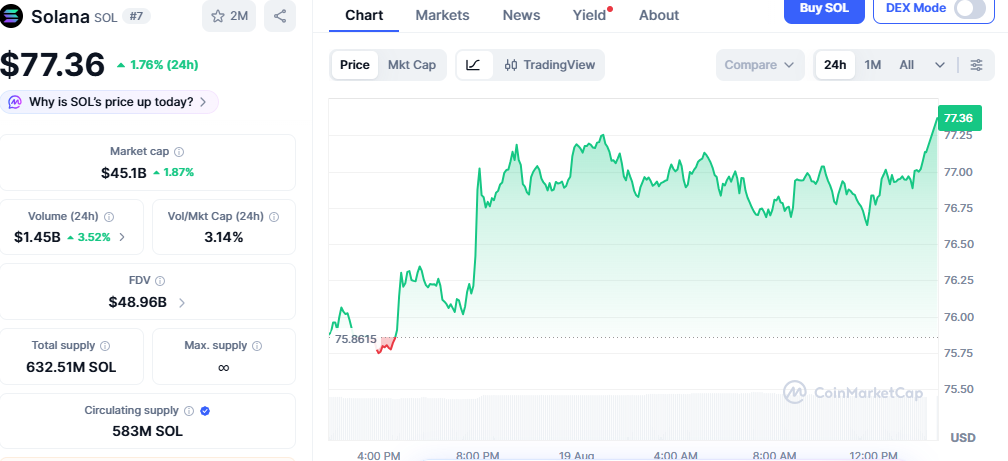
Source: CoinMarketCap data
Features:
Extremely fast transaction speeds, often processing thousands per second
Low transaction fees compared to many other major blockchains
Strong developer activity, with a wide range of decentralized apps built on the network
Popular choice for NFT marketplaces and DeFi platforms
Weakness: An uncapped max supply means ongoing token issuance, which can create long-term dilution pressure.
2. BNB
BNB is the native token of the Binance ecosystem, one of the largest cryptocurrency exchanges in the world. It started out mainly as a token for trading fee discounts on Binance, but it has since grown into something much bigger. BNB now powers the BNB Chain, a blockchain network used for everything from decentralized apps to token launches. Because it's so closely tied to Binance's operations, BNB tends to reflect the overall health and activity of that broader ecosystem, not just simple market speculation.
Price: $602.37, up a slight 0.03% in the last 24 hours.
Market cap stands at $80.21 billion. Daily volume was $968.9 million, down 0.54%. Both total and circulating supply sit at 133.16 million BNB, a fully capped supply.
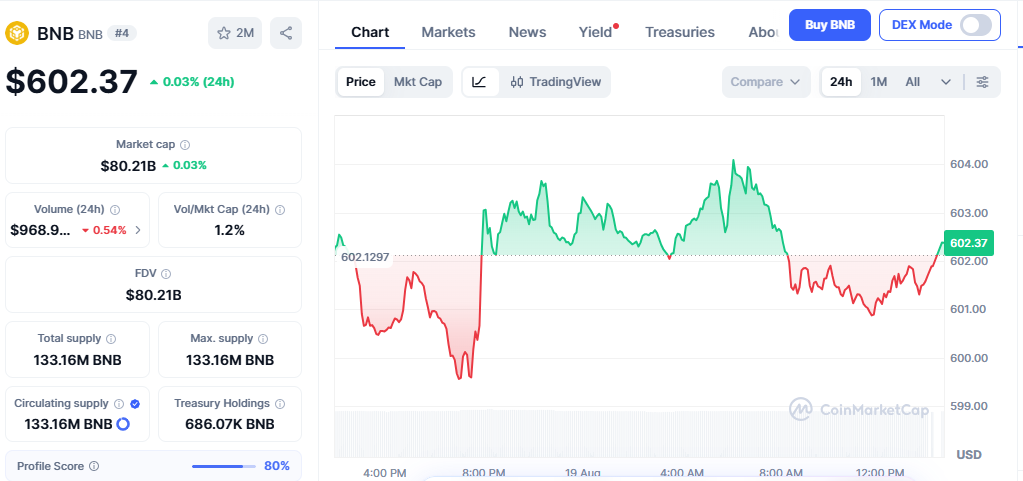
Source: BNB price chart
Features:
Used for trading fee discounts across the Binance exchange
Powers the BNB Chain, supporting a wide range of decentralized apps
Fully capped supply, with no further token issuance expected
Backed by one of the largest and most active exchange ecosystems in crypto
Weakness: Heavy ties to a single exchange ecosystem mean regulatory news around that platform can directly affect price.
3. Tether (USDT)
Tether is the largest stablecoin by market cap, designed to hold a steady 1:1 value against the US dollar at all times. Unlike coins such as Solana or XRP, Tether isn't meant to grow in value. Instead, its entire purpose is to stay stable, giving traders a reliable way to hold value on an exchange without converting back to actual dollars. Each USDT is supposed to be backed by reserves held by the company behind it, which is what allows the peg to hold steady even during periods of heavy market volatility elsewhere.
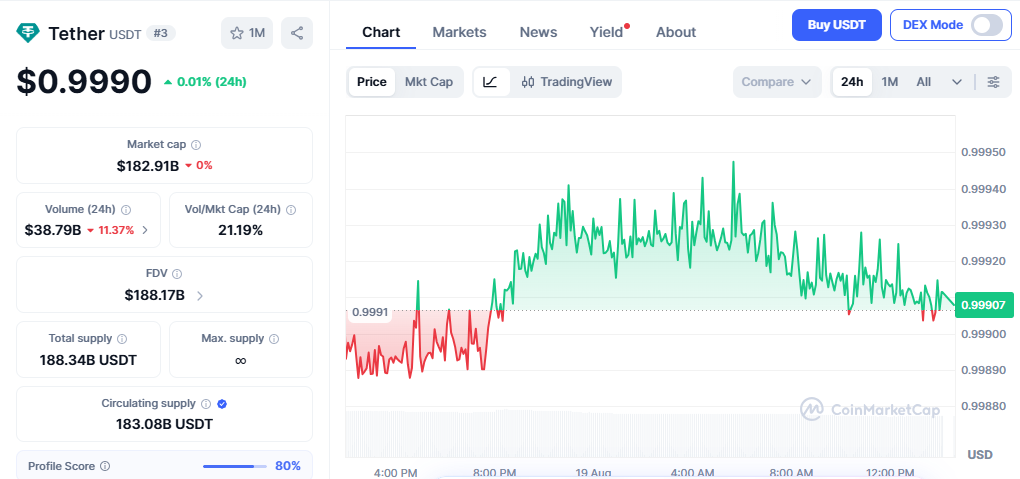
Price: $0.9990, essentially flat, up 0.01% in the last 24 hours.
Market cap sits at $182.91 billion, making it the third-largest crypto asset overall. Daily volume is massive at $38.79 billion, though down 11.37% from the prior day. Circulating supply is 183.08 billion USDT.
Source: CoinMarketCap official
Features:
Designed to maintain a stable 1:1 value against the US dollar
Extremely high daily trading volume, among the highest of any crypto asset
Widely accepted across nearly every major exchange
Commonly used to move funds between trades without exiting to fiat currency
Weakness: Since it's designed to stay flat, it offers no price appreciation potential, and its value depends heavily on trust in reserve backing.
4. XRP
XRP is built for fast, low-cost cross-border payments and has long been positioned around banking and remittance use cases. The idea behind it is fairly straightforward: moving money across borders through traditional banking channels is often slow and expensive, and XRP aims to make that process faster and cheaper.
It's been used in partnerships with financial institutions looking for quicker settlement options, which sets it apart from coins built mainly for general-purpose smart contracts or decentralized apps.
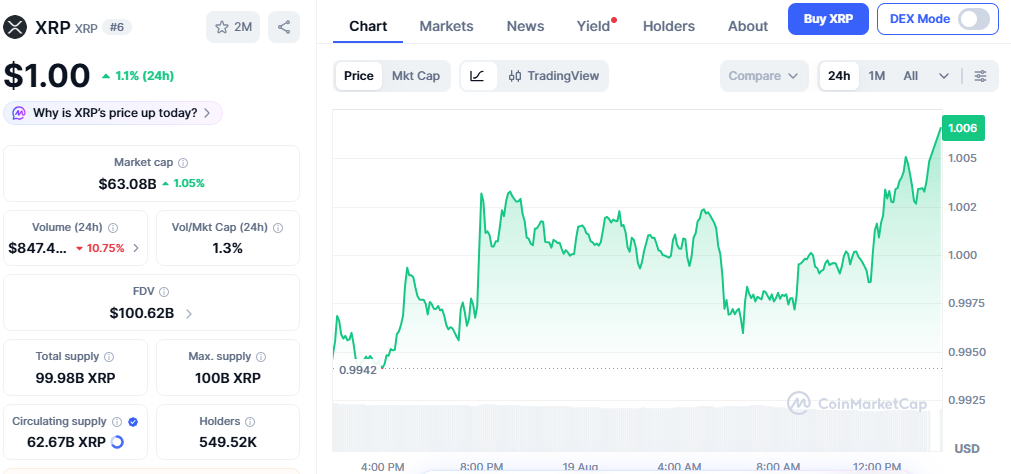
Price: $1.00, up 1.1% in the last 24 hours.
Market cap comes in at $63.08 billion, up 1.05%. Daily volume was $847.4 million, though down 10.75%. Circulating supply sits at 62.67 billion XRP out of a 100 billion max supply, with over 549,000 holders tracked.
Source: CoinMarketCap price chart
Features:
Fast transaction settlement, often completing in just a few seconds
Low transaction costs compared to traditional cross-border transfers
Long-standing focus on real-world banking and remittance partnerships
Capped max supply of 100 billion tokens
Weakness: Price movement has historically been tied closely to regulatory and legal developments, adding an extra layer of uncertainty.
5. TRON (TRX)
TRON is a Layer 1 blockchain known for high transaction throughput and heavy usage in stablecoin transfers, particularly USDT. It was built to handle a large number of transactions quickly and cheaply, which has made it one of the most widely used networks for sending stablecoins around the world.
A big part of TRON's real-world relevance comes from this practical use case, rather than speculative trading alone. Millions of everyday stablecoin transfers move through the TRON network specifically because of its speed and low cost.
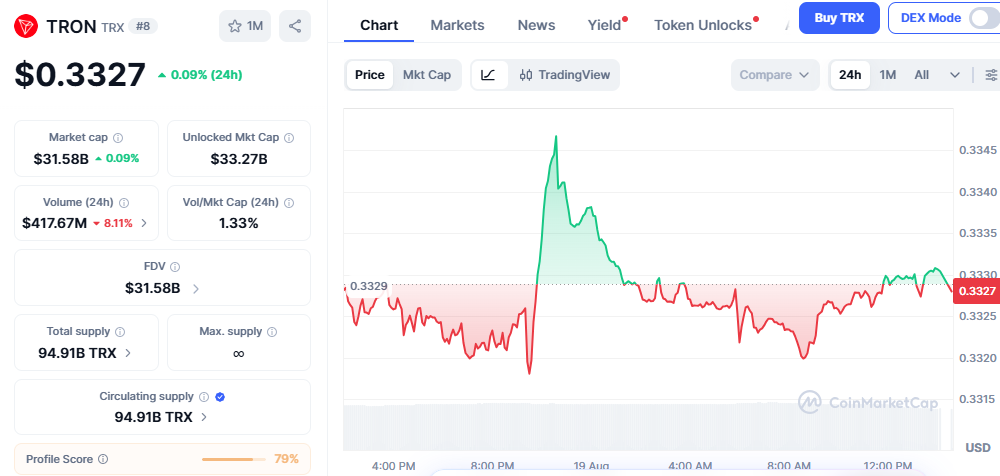
Price: $0.3327, up 0.09% in the last 24 hours.
Market cap sits at $31.58 billion. Daily volume was $417.67 million, down 8.11%. Circulating supply matches total supply at 94.91 billion TRX, with no maximum cap.
Source: Price chart from CoinMarketCap
Features:
High transaction throughput, supporting a large volume of daily transfers
Extremely low transaction fees, especially for stablecoin transfers
One of the most widely used networks for moving USDT globally
Established real-world usage beyond pure speculation
Weakness: An uncapped supply, similar to Solana, means new tokens can continue entering circulation over time.
Comparing These Five Altcoins
Looking at this group side by side, a clear split shows up. Solana and TRON lean toward high-throughput infrastructure, BNB ties closely to exchange activity, XRP focuses on payments, and Tether exists purely as a stability tool.
That range matters. Anyone reviewing top altcoins 2026 list picks should think about diversification across use cases, not just picking coins with the biggest green numbers on a given day.
Volume and Liquidity Matter More Than People Think
It's easy to focus purely on price movement, but volume tells a deeper story. Tether's massive $38 billion daily volume shows just how central it is to daily crypto trading, even though its price barely moves.
Meanwhile, Solana's rising volume alongside its price gain suggests genuine buying interest, not just a random spike. When comparing top altcoins to watch august 2026 compared side by side, volume trends are often just as telling as price charts.
Quick Comparison Table
Coin | Price | 24h Change | Market Cap | 24h Volume | Max Supply |
Solana (SOL) | $77.36 | +1.76% | $45.1B | $1.45B | No cap |
BNB | $602.37 | +0.03% | $80.21B | $968.9M | 133.16M |
Tether (USDT) | $0.9990 | +0.01% | $182.91B | $38.79B | No cap |
XRP | $1.00 | +1.1% | $63.08B | $847.4M | 100B |
TRON (TRX) | $0.3327 | +0.09% | $31.58B | $417.67M | No cap |
Final Thoughts
Each of these five altcoins serves a different purpose in the market, from Solana's speed-focused infrastructure to Tether's role as a stability anchor. There's no single "best" pick here, since the right choice depends entirely on what you're looking for, growth potential, stability, or real-world utility.
If you're putting together your own top altcoins to watch in august 2026, treat price as just one data point among many. Market cap, volume, and supply structure all tell part of the story too.
Disclaimer
This article is for informational purposes only and does not constitute financial or investment advice. Cryptocurrency prices are highly volatile and can change rapidly. Please do your own research (DYOR) and consult a qualified financial advisor before making any investment decisions.
Also read:





.webp)