7 Ways Maczo Makes Provably Fair Results Independently Verifiable


Maczo publishes verifiers, source code, test vectors and game odds so players can independently check Lucky Spin and 31 Maczo Originals.
In crypto gaming, trust should be something players can test rather than something they are simply asked to accept. A platform may describe its games as fair, but a stronger standard is to publish enough information for an independent user to reproduce the result.
Maczo takes that approach through its Provably Fair help center and a verification stack that combines pre-play commitments, browser tools, published odds, test vectors and public source code. The materials cover Lucky Spin and every Maczo-developed Original, allowing a player to start with a settled result and follow the evidence back to the inputs, resolver and game data used to produce it.
Maczo Provably Fair at a Glance
-
Lucky Spin and 31 Maczo Originals can be independently checked after settlement.
-
Every Maczo-developed Original is represented by a public game-specific repository.
-
Players can use browser-based tools without installing specialist software.
-
Lucky Spin wheel weights and Originals paytables are published for reproducibility.
-
The verification code includes test vectors that help users compare expected and reproduced results.
1. It Commits to the Server Seed Before Play
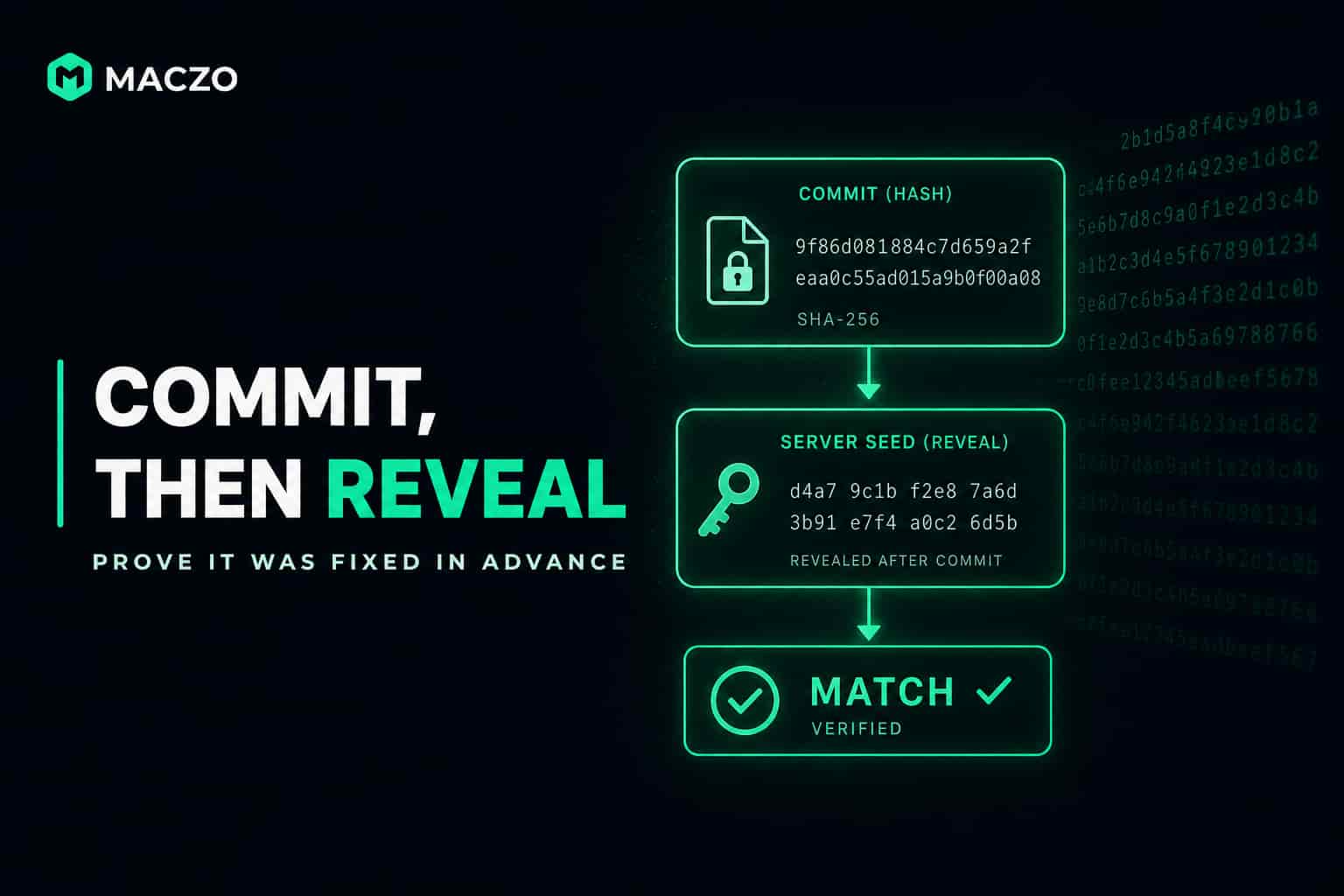
The first layer of transparency is the commitment process. Before a Lucky Spin or an Originals bet is settled, Maczo publishes a SHA-256 commitment derived from a secret server seed. The final outcome is then calculated from that server seed together with a client seed and a nonce.
The client seed gives the player an input into the calculation, while the nonce changes with each round. When the server seed is later revealed, the player can hash it and compare it with the commitment that appeared before play. If the values match, the evidence shows that the operator did not replace the committed seed after seeing the bet.
This is the practical meaning of provably fair: the platform commits first, reveals later and leaves the player with the data needed to check the result.
2. It Provides an Instant Browser-Based Verifier
Transparency is less useful when verification requires advanced programming knowledge. Maczo therefore provides a Lucky Spin verifier that runs in a web browser. Players can enter the revealed server seed, the earlier commitment, their client seed and the relevant nonce to reproduce the result.
According to the published documentation, the verifier can also run offline and does not need to send the entered values elsewhere. Technically minded users can inspect the page source, while non-developers can use the interface as a straightforward checking tool.
Maczo also provides a separate Originals verifier covering Dice, Limbo, Mines, Plinko, Coin Flip, Keno, Wheel, Crash, Baccarat, Blackjack and the rest of its 31-game in-house collection.
3. It Publishes the Lucky Spin Source Code
The Lucky Spin repository does more than describe the system. It publishes the implementation under an MIT license, including a browser tool, a zero-dependency Node.js verifier and known-answer test vectors.
This distinction matters. A marketing page can explain that a game is transparent, but public code lets developers inspect the actual formula, run it independently and compare the output with the official tool. The Lucky Spin repository documents how HMAC-SHA256 combines the server seed, client seed, nonce and cursor before selecting a wheel segment.
Users do not have to understand every technical detail to benefit. The fact that the method is open means specialists, communities and independent reviewers can examine the same rules.
4. It Publishes the Wheel Odds Used for Verification
Publishing a random-number formula is only part of the picture. A wheel result also depends on the weight assigned to each segment. If those weights remain hidden, a user may reproduce a number without being able to confirm how it maps to a prize.
Maczo addresses this by publishing the Lucky Spin weights in weights.maczo.json. The file lists the visible reward values and the relative weight used for each wheel segment. Verify links can carry the exact weights used for a spin, allowing the verifier to reproduce both the cryptographic output and the segment selection.
For Maczo Originals, game repositories similarly publish the relevant paytable or odds data alongside the resolver. That connects the randomness layer to the actual game outcome.
5. Every Maczo Original Has Public Verification Code
Maczo's public GitHub organization contains a separate repository for each of its 31 Originals. The list includes familiar formats such as Dice, Mines, Plinko, Roulette and Crash, as well as Maczo titles such as Crystal Codex and Ronin Reels.
Each game-specific repository connects to a shared cryptographic engine and adds the resolver needed for that game's rules. This structure makes it easier to inspect one title without searching through an unrelated codebase. It also reduces the risk that different games quietly use inconsistent verification logic.
The accurate scope is important: the public code covers Maczo-developed Originals and Lucky Spin. Games supplied by external studios remain the intellectual property of their respective providers and should not be described as Maczo open-source games.
6. Test Vectors Make the Claims Reproducible
Open code is stronger when it includes known inputs and expected outputs. Maczo's verification repositories include test vectors that pair server seeds, client seeds, nonces and game parameters with expected outcomes.
A developer can run the supplied self-test and confirm that the public verifier reproduces those known answers. Individual Originals repositories also expose their resolver and published paytable, while the shared Originals engine keeps the core HMAC-SHA256 process in one place.
This does not replace an independent security audit, and it should not be presented as one. It does, however, make the fairness calculation repeatable instead of leaving it as an unsupported claim.
7. Game-Specific Resolvers Keep Different Outcomes Inspectable
Provably fair systems must do more than generate an unpredictable number. Each game also needs a transparent rule for turning that number into a result. Dice resolves a roll threshold; Mines maps values to board positions; Plinko selects a path through pegs; and card games such as Blackjack or Video Poker must reproduce deck order and hand evaluation.
Maczo addresses this through game-specific repositories built around a shared verification engine. Familiar formats such as Roulette, Baccarat and Crash can be reviewed alongside distinctive titles including Crystal Codex and Ronin Reels, without pretending that every game uses the same resolver.
This separation gives reviewers a more precise question to ask: not only whether the random input can be reproduced, but whether the published rules map that input to the displayed outcome correctly. It also creates room to examine different games on their own technical merits instead of repeating one platform-wide claim.

How Players Can Verify a Lucky Spin
-
Open the Maczo Provably Fair help center and review the Lucky Spin explanation.
-
Before spinning, record the displayed server-seed commitment, client seed and nonce.
-
After the seed is rotated and revealed, confirm that its SHA-256 hash matches the earlier commitment.
-
Open the Lucky Spin verifier and enter the revealed seed, commitment, client seed, nonce and wheel weights.
-
Compare the reproduced segment with the settled Lucky Spin result.
The same principle applies to Maczo Originals: use the Originals verifier, choose the game and enter the settled bet data required by that title.
Official Verification and Source-Code Links
-
Maczo Provably Fair Help: https://maczo.co/help
-
All Maczo Public Repositories: https://github.com/maczo-co
-
Lucky Spin Browser Verifier: https://verify.maczo.co/
-
Lucky Spin Source Code: https://github.com/maczo-co/lucky-spin
-
Lucky Spin Documentation: https://verify.maczo.co/docs.html
-
Published Lucky Spin Weights: https://github.com/maczo-co/lucky-spin/blob/main/weights.maczo.json
-
Maczo Originals Verifier: https://verify.maczo.co/originals/
-
Shared Originals Verification Engine: https://github.com/maczo-co/originals-verify
What Provably Fair Does - and Does Not - Mean
Provably fair technology allows a settled result to be reproduced from disclosed inputs. It helps show that the committed seed and published game rules produced the recorded outcome. It does not promise that a player will win, remove the house edge or turn gaming into an investment.
Players should still review game odds, bonus conditions, withdrawal rules and local restrictions. A transparent formula improves accountability, but responsible decisions remain essential.
Responsible Gaming Note
This article is for informational purposes only and is not legal, financial or gambling advice. Online gaming involves financial risk and may be restricted in some jurisdictions. Participation should be limited to adults who meet local age requirements. Set personal limits, never chase losses and seek support if gaming stops being recreational.
Final Takeaway
Maczo's transparency model is built around a simple idea: users should be able to check the math. The platform publishes pre-play commitments, browser verifiers, Lucky Spin weights, a shared Originals engine and public repositories for every Maczo-developed Original.
For a crypto gaming platform, that approach creates a clearer standard than asking players to rely on brand trust alone. The evidence is visible, the tools are accessible and the code can be inspected by anyone who wants to verify how a settled result was produced.
Also read: