Bitcoin News Today: Miners Shift to AI, Could It Pressure BTC Price?


Bitcoin News Today: Miners Race to AI as Hashrate Sinks, What’s Next?
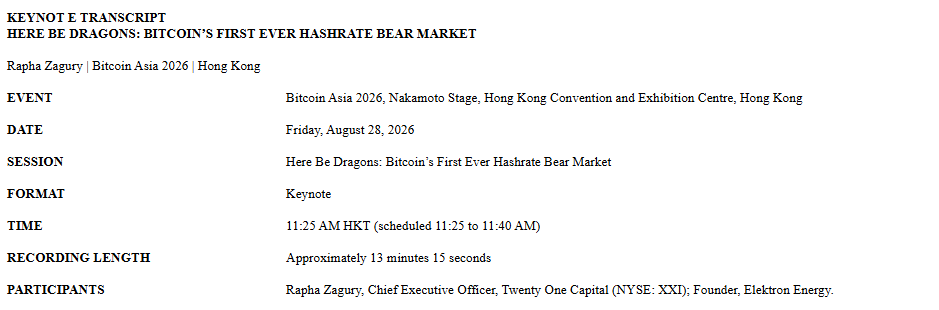
The Bitcoin mining industry is going through something it has never seen before. The top story in Bitcoin News Today centers on what Twenty One Capital CEO Rapha Zagury called the network's first-ever "hashrate bear market," a stretch where computing power has stayed well below its peak for far longer than any prior cycle.
Source: SEC Official Archive
Speaking at Bitcoin Asia 2026, Zagury said network hashrate climbed near 1.3 ZH/s late last year before sliding steadily. Nearly a year later, it still has not set a new high, marking the longest recovery stretch in Bitcoin's history.
His explanation points to one main cause: miners are leaving Bitcoin for AI.
Bitcoin News Today: What a BTC Hashrate Bear Market Actually Means
Hashrate measures the total computing power securing the BTC network. It peaked somewhere between 1.15 and 1.4 ZH/s in late 2025, then began falling. Current estimates put it in the 800 to 950 EH/s range, more than 20% below that peak.
The decline has lasted around 316 days without a new high. A few numbers frame the scale of the shift:
Peak hashrate: near 1.3 ZH/s, reached in late 2025
Current range: 800 to 950 EH/s, fluctuating daily
Mining difficulty: around 125.8 T, adjusted down automatically to keep block times near 10 minutes
Length of decline: about 316 days without a new all-time high
Zagury drew a clear line between this Bitcoin hashrate bear market and the sharp 2021 drop that followed China's mining ban. It separates a policy shock from a slower, economics-driven shift.
Bitcoin News Today: Why Miners Are Betting Big on AI and HPC Deals
AI vs BTC mining has become the defining choice for public mining companies.
Lower BTC prices earlier in 2025 squeezed hashprice, the revenue miners earn per unit of computing power. AI and HPC contracts often pay more reliably than mining rewards right now. Multi-year hosting deals give steadier revenue than mining under current conditions, and several major miners have already signed them.
Falling difficulty improves margins for miners who stay
Large AI hosting deals are already signed by multiple public miners
Flexible power use also supports grid-stabilization revenue, a second income stream beyond block rewards
This BTC miner exodus reflects a business decision, not a technical failure of the network.
Can This AI Shift Could Actually Move BTC Price
This is the part traders care about most. Hashrate itself does not move the price. A few specific channels do, and they pull in different directions.
Less miner selling: Miners often sell newly mined BTC to cover costs. Fewer pure-mining operations means less routine sell pressure from that source.
Treasury sales: Some public miners hold BTC on their balance sheets. Funding AI data centers can push them to sell part of that treasury, which is direct sell pressure tied to the pivot.
Slower supply response: Long AI contracts lock hardware away from mining for years. Rising prices may no longer pull idle miners back online as fast as before.
Weaker equity correlation: Mining stocks used to track BTC closely. As AI revenue grows, those stocks move more with data-center sentiment, so they are a less reliable BTC proxy now.
Security risk premium: Still theoretical. Hashrate remains far above what any realistic attack would need, but a much deeper decline would be worth watching.
None of these channels point to a single, obvious direction. Reduced miner selling leans supportive. Treasury liquidations lean the other way. The net effect depends on which force dominates at any given moment.
Bitcoin News Today: How the BTC Miner Exodus Affects Network Security
Falling hashrate naturally raises questions about Bitcoin security. Security remains extremely high by historical standards, far above what would be needed to resist any realistic attack.
Lower hashrate does reduce the theoretical cost of a 51% attack in absolute terms, but it does not create any immediate weakness. A few effects are worth tracking:
Surviving miners, typically the more efficient ones, gain a larger share of fixed block rewards as competition thins out
Block production runs slightly slower until the next difficulty adjustment corrects it automatically
Industry consolidation is accelerating, with several firms shifting toward hybrid AI and power-infrastructure business models
Long-term AI contracts could keep some capacity locked away from mining even if profitability improves later, which may slow a full hashrate rebound
They describe a leaner, more efficient mining sector taking shape rather than an immediate security crisis.
Where Bitcoin Price Today Stands Amid This Mining Shift
BTC price today sits at $76,640, down 1.84% over the past 24 hours. This BTC update today from CoinMarketCap fills in the broader picture:
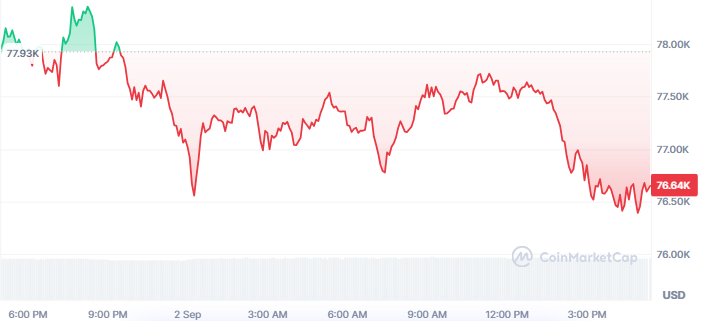
Market cap: $1.53 trillion, down 1.91%
24-hour volume: $30.21 billion, down 0.28%
Fully diluted valuation: $1.6 trillion
Circulating supply: 20.07 million BTC
Hashrate typically follows price rather than leading it, so today's decline reflects earlier price weakness more than it forecasts where price goes next.
Conclusion: Key Takeaways From Bitcoin News Today
Today's dip lines up with a broader risk-off move across markets. Renewed U.S. strikes tied to tensions with Iran pushed oil prices higher, adding inflation pressure just as markets price in a possible Federal Reserve rate hike at its September 16 meeting. That macro backdrop, not the mining shift, is driving the immediate BTC price analysis for the day.
For context, Bitcoin has still climbed roughly 20 to 25% over the past month, moving from the mid-$60,000s into the mid-to-high $70,000s. A leaner mining sector, built around efficient operators and flexible power deals, can be neutral to constructive for the network longer term.
The future of crypto mining looks less like pure BTC extraction and more like a hybrid energy-and-compute business, and this week's numbers in Bitcoin News Today mark one more data point in that ongoing transition.
Disclaimer: This article is for informational purposes only and does not constitute financial or investment advice. Crypto markets carry significant risk. Always do your own research before making any investment decisions.






