Cardano ADA News: Epoch 647 Closes, ADA Reward Payouts Land

Cardano ADA News: ADA staking Reward, Price Today, and 2026 Upgrades
Cardano ADA news today centers on staking rewards going live for epoch 647, which closed after running from roughly August 2 to August 7, 2026.
Every eligible $ADA delegator who staked correctly during that window now receives staking rewards, as a part of a payout cycle that repeats about every five days.
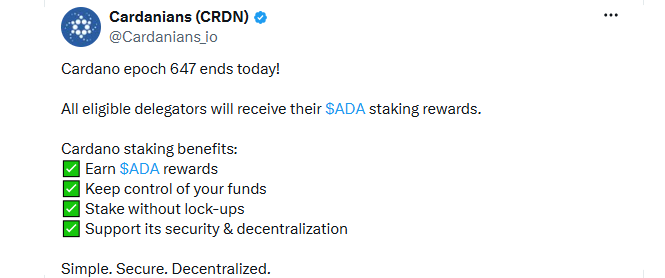
Source: Cardanians Official (dRep Platform)
At the same time, ADA price today sits slightly lower, down 1.32% over the past 24 hours. This update today also covers that price picture, along with the updates on Cardano Ouroboros Leios and July ecosystem progress.
How Cardano ADA Staking Rewards Work at Every Epoch Close Right Now
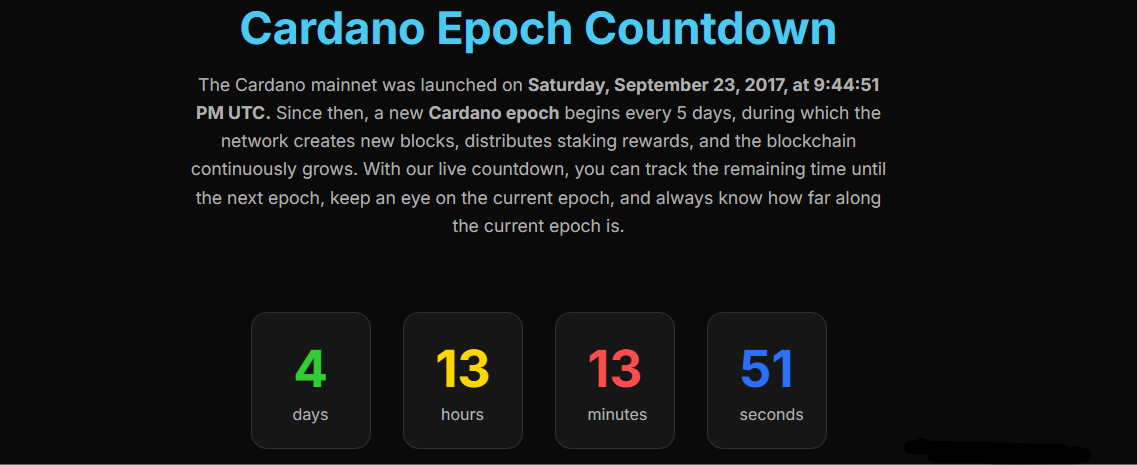
The blockchain organizes activity into epochs of close to five days each. Stake pools produce blocks based on delegated stake under the Ouroboros proof-of-stake protocol. The network, then, takes a snapshot at each boundary to calculate performance and pay rewards from transaction fees plus a small share of the reserve.
The process behind $ADA rewards stays simple for holders, and this Cardano ADA News breakdown lays out each step:
Register a stake key with a small refundable deposit.
Issue a delegation certificate pointing funds to a chosen pool.
Keep full control of the wallet, since $ADA never leaves it and stays spendable at any time.
Wait through a short multi-epoch delay, usually 15 to 20 days, before the new stake becomes active.
Receive rewards automatically roughly every five days once active, with auto-compounding and withdrawal available anytime.
This overview also notes that pool performance, saturation limits, and operator fees all affect the final rate.
This design lets holders support network security and decentralization without locking funds or handing over custody, which keeps this ADA update approachable for newcomers and long-term holders alike.
Cardano ADA Price Today: Market Numbers Now
The token price sits at $0.1996, down 1.32% over the past 24 hours. A few other figures round out the picture:
Market cap: $7.2 billion
24-hour trading volume: $330.08M, down 60.43%
Fully diluted value: $8.98B
Circulating supply: 36.55B $ADA out of a 45B max supply
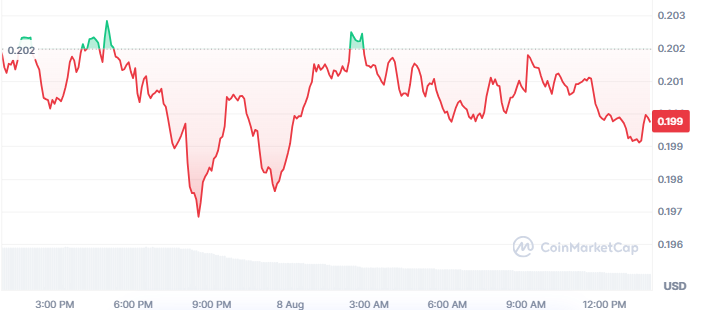
Source: CoinMarketCap Official
This $ADA price movement does not change how staking rewards get calculated, since the reward formula runs on protocol rules rather than market swings.
Cardano Upgrades 2026: Ouroboros Leios Targets 50x Throughput Gain
Among this year's network upgrades, Ouroboros Leios stands out as the biggest scaling step planned. The next-generation consensus upgrade targets up to a 50 times increase in transaction throughput compared to current levels. Mainnet readiness for this upgrade expected within roughly four months of early August reports.
Development follows a five-phase rollout, moving from an early phase called Earth toward a final phase called Void.
The Musashi Dojo testnet launched in June 2026 and is now advancing toward full validation ahead of a planned network hard fork tied to the Dijkstra era, expected in the fourth quarter of 2026.
This $ADA news today timeline places mainnet readiness well ahead of that hard fork window.
What the July Cardano Ecosystem 2026 Update Actually Delivered Now
The Cardano Foundation's July recap points to steady progress across the 2026 ecosystem growth:
A hard fork was enacted successfully on the network.
A new Constitutional Committee was elected under the governance framework.
The Catalyst treasury transfer was completed.
Cardano-Summit 2025 was named Best International Event.
Twenty-one of forty-two UNDP report use cases now run on the blockchain.
This Cardano ADA News recap shows a network moving toward measurable adoption across governance, funding, and real-world reporting.
Between steady staking payouts and a scaling upgrade aimed at major throughput gains, this stretch of $ADA update points to a network building toward higher capacity while keeping its core reward system unchanged for everyday holders.
Disclaimer: This article is for informational purposes only and does not constitute financial or investment advice. Crypto markets carry significant risk. Always do your own research before making any investment decisions.










