Chainalysis Sues ICE Over $94.6M Contract Awarded To TRM Labs

Chainalysis Takes ICE To Court Over $94.6M Contract To TRM Labs
Chainalysis sues the United States government, and the reason is straightforward: Immigration and Customs Enforcement gave a $94.6 million blockchain forensics contract to its rival, TRM Labs, without opening it up to competitive bidding.
Chainalysis Government Solutions filed the bid protest on July 27, 2026, in the US Court of Federal Claims, per court records accessed through CourtListener's RECAP archive.
The one-year deal, listed on SAM.gov, covers forensic software and support services for Homeland Security Task Force investigations, running from July 1, 2026, through June 30, 2027.
As of August 19, 2026, this remains a key development in crypto news today, with the case still active and oral arguments set for early September.
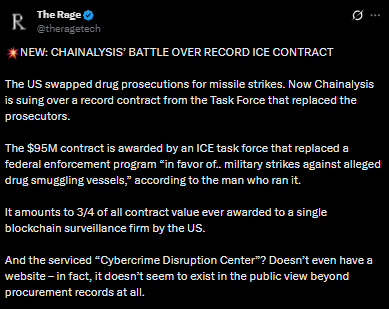
Source: The Rage Official Post
Why Is Chainalysis Challenging The Award?
Chainalysis sues ICE after arguing that the agency's decision was “arbitrary, capricious, and unreasonable.”
According to the filing, it had submitted a capability statement after the agency issued a notice of intent back in June 2026 to source the work from just one provider.
Here's the thing: the firm says it was fully capable of competing but got sidelined once things moved to a sole-source basis, where an agency buys directly from a single vendor instead of running an open bid.
Federal rules require some justification for that. Procurement records list the award as "not competed," which basically means only one offer made it into consideration before the contract was finalized.
Both companies are fighting hard for federal cybercrime-tracking work right now, and this has turned into one of the biggest procurement clashes the blockchain analytics space has seen so far.
Chainalysis Sues ICE: How This Unfolded
Date | What Happened |
June 2026 | ICE announces intent to source services from TRM Labs |
July 1, 2026 | Contract (number 70CMSD26C00000005) formally goes to TRM Labs |
July 27, 2026 | Chainalysis Government Solutions files its bid protest |
July 28, 2026 | TRM Labs steps in as a defendant alongside the government |
July 31, 2026 | Court allows the complaint to stay under seal |
September 2, 2026 | Oral arguments scheduled |
September 10, 2026 | Government has asked for a decision by this date |
The following timeline is based on court docket records available through CourtListener's RECAP archive.
What Exactly Does The Contract Involve?
It supports the Homeland Security Task Force's National Coordination Center Cyber Disruption Center.
WuBlockchain also reported on the development, highlighting the $95 million ICE contract and its broader implications for the blockchain analytics industry.
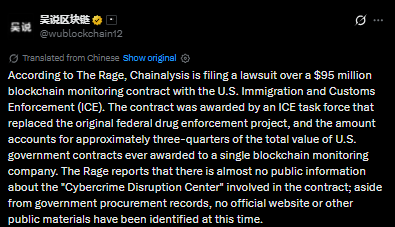
Source: Official WuBlockchain X Post
Per the federal award notice, the funding covers forensic software and investigative support, everything from tracing crypto transactions and blockchain analysis to open-source intelligence, asset recovery, and mapping criminal networks behind cybercrime, fraud, and scam operations.
The complaint itself stays sealed. The Court of Federal Claims ruled on July 31 that it holds confidential business information and trade secrets, so we don't yet know the exact remedy being sought.
Here's what's actually confirmed so far:
Contract value: approximately $94.6 million
Contract period: July 1, 2026 to June 30, 2027
Awarding agency: Immigration and Customs Enforcement (ICE)
Winning vendor: TRM Labs
Challenger: Chainalysis Government Solutions
Filing venue: US Court of Federal Claims
Since this venue handles federal spending disputes specifically, whatever the court decides could end up shaping how future blockchain-analytics contracts get structured across the board.
What Does ICE Have To Say?
An agency spokesperson told TheStreet Roundtable that ICE brought in TRM Labs to help the Homeland Security Task Force stop transnational criminal groups from targeting Americans through cybercrime, fraud, and predatory schemes.
New funding under recent legislation, the spokesperson added, has widened the agency's ability to go after these networks. TRM Labs hasn't commented publicly on the lawsuit, and Chainalysis isn't saying much beyond what's already in its court filing.
Expert Take
Procurement specialists point out that if the protest succeeds, it could force ICE to reopen the contract for competitive bidding altogether, which would reshape how federal agencies handle blockchain-analytics deals going forward.
The dispute also captures just how intense the rivalry between these two vendors has become, especially as government spending on crypto-tracing tools keeps climbing and the issue gains attention across the broader crypto news landscape.
Some analysts believe the ruling could set a tone for how other agencies defend sole-source awards in this space. That said, with the complaint still sealed, it's hard to judge how strong the underlying case actually is.
Disclaimer This article is for informational purposes only and doesn't constitute investment, legal, or financial advice. Litigation outcomes are never guaranteed, so treat any figures or projections here as developing, not final. Always check official court filings before making decisions based on this case.
Also read:






