Chainlink News: Why 5 Central Banks Chose LINK Infrastructure


Chainlink News: Which Five Central Banks Are Using LINK?
The biggest Chainlink news today isn't a price chart — it's a map. Chainlink's infrastructure is now running inside government and central bank systems across five separate countries, a footprint that's rare for any blockchain protocol.
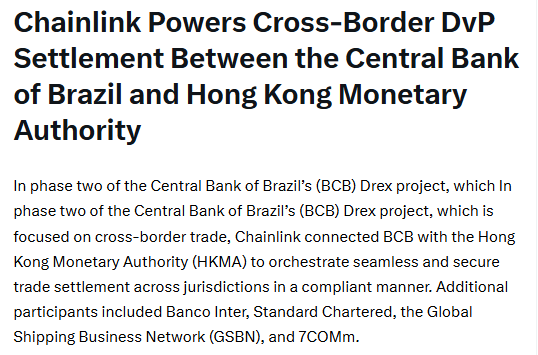 Source: X(formerly Twitter)
The U.S. Department of Commerce, the Central Bank of Brazil, the Hong Kong Monetary Authority, the Monetary Authority of Singapore, and the Reserve Bank of Australia are each using Chainlink to bring government data onchain and to power cross-border settlement of tokenized assets and central bank digital currencies. This isn't a single pilot — it's five separate, documented deployments running in production or advanced testing simultaneously.
Chainlink News: LINK Embedded in Five Countries
In the United States, the Department of Commerce has used LINK to publish official economic data directly onchain, giving smart contracts verified access to government statistics without a centralized intermediary.
In Brazil, the central bank's Drex CBDC project reached its second phase using LINK, connecting the Central Bank of Brazil with the Hong Kong Monetary Authority through digital bank Banco Inter to settle cross-border trade transactions in real time — turning what used to be a paperwork-heavy process into a live, programmable settlement pipeline.
Hong Kong's own e-HKD Phase 2 program uses Chainlink's CCIP and Automated Compliance Engine to let ANZ, China AMC, and Fidelity International settle tokenized assets across chains, enabling Australian investors to buy tokenized money market fund units from Hong Kong-based managers using e-HKD and tokenized deposits.
Singapore's Monetary Authority has LINK running inside Project Guardian, where UBS Asset Management and SBI Digital Markets used LINK-powered infrastructure and a Digital Transfer Agent smart contract to automate fund management and transfer-agency functions for tokenized funds.
In Australia, the Reserve Bank's Project Acacia has Westpac Financial institution and Imperium Markets implementing LINK to test tokenized asset settlement directly at the central bank level.
Chainlink CCIP News: How the Government Deployments Work
The common thread across all five deployments is Chainlink's Cross-Chain Interoperability Protocol, or CCIP — the piece of infrastructure that lets separate blockchain networks and traditional financial systems talk to each other securely. For a central bank, that's the actual value proposition: CCIP lets a CBDC on one ledger settle against a tokenized asset or stablecoin on a completely different one, without each institution needing to build custom bridging infrastructure from scratch.
That's also why this round of Chainlink's institutional news lands differently than a typical partnership announcement. These aren't marketing pilots run by a single financial institution — they're infrastructure choices made by monetary authorities, the institutions with the least appetite for unproven technology. Analysts tracking the space have repeatedly framed central bank testing as treating Chainlink as connective plumbing rather than as an endorsement of the LINK token itself — but plumbing chosen by five monetary authorities independently is still a meaningful adoption signal.
Chainlink Price News: LINK Market Reaction Today
As of today, LINK is trading in the $8.20–$8.50 range, with a market cap sitting around $6.3 billion and roughly 748 million tokens in circulation. The token has held its recent gains from earlier this month, when it broke through resistance and touched levels last seen in early June, coinciding with the wave of government-adoption headlines.
This isn't the first time institutional Chainlink update today headlines have coincided with price strength — LINK has shown a repeated pattern this year of reacting positively to confirmed enterprise and government integrations, distinct from broader market-wide moves. Whether that holds as more details emerge from each of the five programs is the open question for anyone watching Chainlink news heading into the next few weeks.
Conclusion
Today's Chainlink news headline is straightforward: five governments, one shared piece of infrastructure. From Brazil's Drex to Australia's Project Acacia, Chainlink's CCIP is now doing real settlement work at the central bank level — and LINK's price action this month suggests the market is starting to price that in.
Disclaimer
This article is for informational purposes only and does not constitute financial or investment advice. All project details and figures are based on publicly available statements and market data as of July 20, 2026, and are subject to change. Price levels are illustrative and can fluctuate significantly. Always conduct independent research before making any investment decision.
Also read:


2 months ago
IS IT POSSIBLE TO FIND AND RECOVER LOST BITCOIN? YES. CONTACT WIZARD GEO COORDINATES RECOVERY HACKER In general, whether or not lost bitcoin can be recovered depends on how it was lost. People have started offering services to help recover misplaced bitcoin due to the large amount of missing cryptocurrency out there. These include data recovery specialists, but you will need the assistance of a professional recovery expert, such as GEO COORDINATES RECOVERY HACKER, to recover your stolen bitcoin. Contact them if you have misplaced bitcoin, cash, or any other type of cryptocurrency. For more information, contact GEO COORDINATES RECOVERY HACKER Email: geovcoordinateshacker@gmail.com Telegram @Geocoordinateshacker Website; https://geovcoordinateshac.wixsite.com/geo-coordinates-hack The truth always put the wrong people in the right place, and we all need help getting the truth






