CLARITY Act News: Senate Finally Set Date for Long Delayed Crypto Bill


CLARITY Act News: Paul Atkins Backs Crypto Bill Ahead of Senate Vote
Crypto markets are watching Washington closely again. A fresh wave of CLARITY Act news has set a firm date for Senate action, while regulators, the White House, and political action committees all move in parallel.
CLARITY Act News: Senate Sets September 15 Vote at 2 PM ET
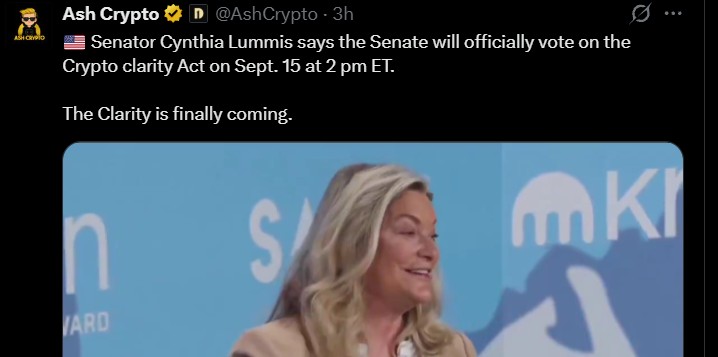
Senator Cynthia Lummis has confirmed the Senate will hold an official vote on September 15 at 2 p.m. ET, stating the chamber will move forward on that date and time. This initial vote is a motion to proceed, opening debate rather than finalizing passage. The crypto bill has spent more than a year in the Senate, and this vote is the clearest signal yet that lawmakers intend to force the issue.
Why the September 15 CLARITY Act Vote Matters for Crypto
The legislation would establish long-awaited market structure rules for digital assets, clarifying which agency oversees which tokens and how exchanges should operate. For an industry that has faced regulatory ambiguity for years, this could be a turning point.
A successful vote could pave the way for greater institutional participation, since banks and asset managers have often cited unclear rules as a barrier to entering crypto at scale.
SEC Chair Paul Atkins Backs Congressional Push for CLARITY Act
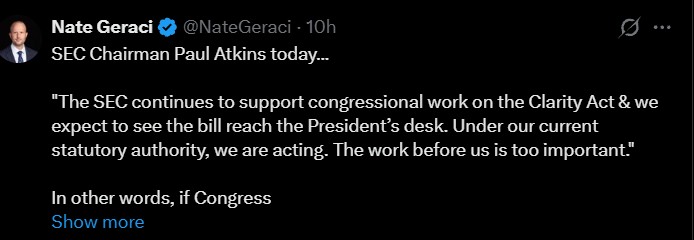
SEC Chairman Paul Atkins recently reinforced the agency's support for the legislative effort, noting the SEC backs congressional work and expects the bill to reach the president's desk.
He also made clear the agency isn't waiting around — it's acting under its existing statutory authority regardless of how Congress proceeds, meaning regulators could keep advancing crypto rules on their own even if the legislative process stalls.
WiseCrypto
White House Crypto Meeting Puts CLARITY Act and Regulation in Focus
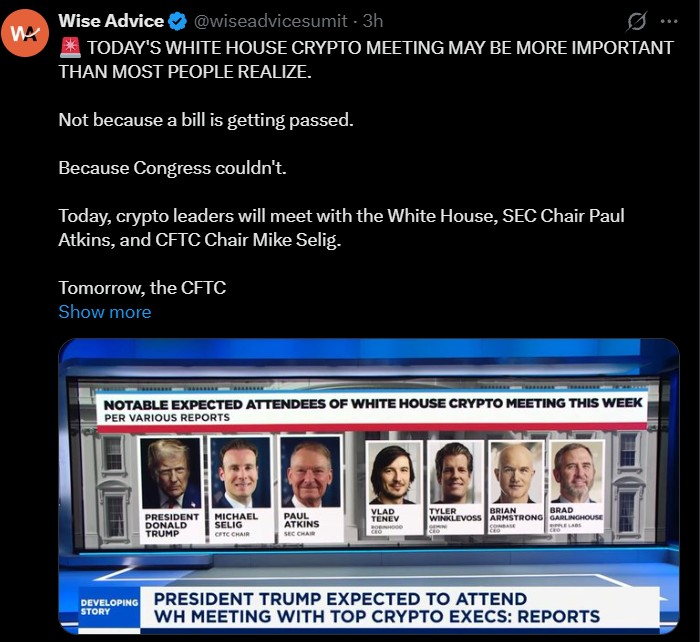
On August 19, crypto industry leaders met with White House officials alongside Atkins and CFTC Chair Mike Selig to discuss the regulatory path forward. The meeting came a day before the CFTC's first Innovation Advisory Committee session, covering crypto regulation, prediction markets, and AI in finance. Notably, executives from prediction market platforms like Kalshi and Polymarket were excluded from the broader White House technology summit, even as core crypto executives stayed on the guest list.
CLARITY Act Faces Passage Doubts Despite September Vote Date
Not everyone is convinced it will become law this year. Solana Policy Institute CEO Miller Whitehouse-Levine estimates only around a 10% chance of passage before the midterms, describing the bill as stuck in "August recess purgatory." Even after September 15, several more Senate votes would be needed, and growing involvement from banks and financial institutions is adding new layers of negotiation.
CLARITY Act Has Grown to More Than 600 Pages After Negotiations
Part of the slowdown comes from the bill's growth. It has expanded from under 300 pages to more than 600 after absorbing over 100 Democratic requests — reflecting deep disagreements over investor protections, banking concerns, and jurisdictional questions that have made consensus harder to reach.
CLARITY Act Timeline: From Senate Stalemate to September 15 Vote
The bill has sat with the Senate for more than 13 months, moving slowly through committee talks and stakeholder negotiations. Momentum stalled repeatedly over the summer, culminating in the recess lawmakers are only now emerging from.
September 15 marks the first concrete deadline in months, following sustained pressure from Lummis and engagement from regulators and the White House.
September 15 CLARITY Act Vote Comes One Day Before Fed Decision
Timing adds intrigue. The Senate vote lands just one day before the FOMC's September 16 rate decision. Some market watchers believe pairing a regulatory catalyst with a potential rate cut could create outsized volatility, with institutions positioning ahead of both events.
Crypto PACs Increase Political Pressure Ahead of 2026 Midterms
Political spending is intensifying too. Fairshake, the PAC backed by Coinbase and Ripple through its Protect Progress arm, has spent over $2 million on ads in Florida's 24th District opposing Democratic candidate Oliver Gilbert, endorsed by Rep. Frederica Wilson, who voted against both the GENIUS Act and this bill. Fairshake reportedly held around $193 million as of January and has deployed over $82 million across 2026 midterm primaries and special elections.
What Happens After the September 15 CLARITY Act Vote?
If the motion to proceed passes, the bill moves into formal debate, followed by more Senate votes on amendments and final passage. It would still need reconciliation with any House version and a presidential signature to become law. Investors should watch vote counts, amendment fights, and continued SEC and CFTC activity as indicators of where regulation is heading.
Conclusion
The September 15 vote is a milestone, not a finish line. Between procedural hurdles, a ballooning bill, regulator activity at the SEC and CFTC, and heavy PAC spending, crypto's regulatory future remains a multi-front story. Whether or not it clears the Senate this year, the direction of travel — more engagement, more rulemaking, more political money — is unmistakable.
Disclaimer: This article is for informational purposes only and does not constitute financial, legal, or investment advice. Cryptocurrency markets are volatile and involve significant risk. Always conduct your own research and consult a qualified professional before making investment decisions.






