CLARITY Act News: What Happens if Senate Fails to Pass Crypto Bill?


CLARITY Act News: CFTC Chair Mike Selig Plans Independent Crypto Rules
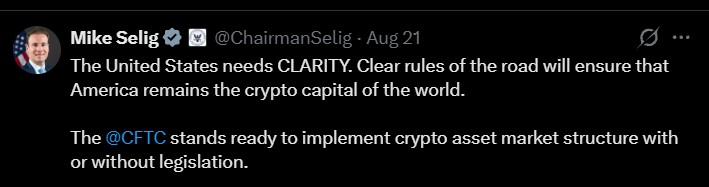
The debate over US crypto regulation has entered a new phase. The latest CLARITY Act News centers on a strong message from Commodity Futures Trading Commission (CFTC) Chairman Michael S. Selig: if Congress fails to move the crypto market structure bill forward, the agency is prepared to use its existing authority to develop rules for the industry.
Selig made the comments around the launch of the CFTC's Innovation Advisory Committee, which is focused on emerging technologies including crypto assets and blockchain. It has also already established an Innovation Task Force aimed at helping develop clearer rules for new financial technologies.
The message is important for companies, exchanges, and traders because it suggests that the industry's long wait for regulatory clarity may not depend entirely on Congress.
What Did the CFTC Chair Say About the CLARITY Act?
Michael S. Selig has made it clear that the United States needs a clearer framework for crypto markets. In a recent public statement, he said the CFTC stands ready to implement cryptocurrency asset market structure "with or without legislation."
The warning comes as the CLARITY Act continues to face political and industry disagreements in Washington. The legislation is designed to create a more comprehensive framework for digital asset markets and provide clearer lines around federal oversight.
Selig's position suggests that if lawmakers cannot reach an agreement, the CFTC could begin building parts of a regulatory framework through the agency's existing powers and rulemaking process.
The CFTC has already identified crypto assets and blockchain technologies as one of its major innovation priorities. Its Innovation Advisory Committee, chaired under Selig's sponsorship, includes major industry figures and is examining issues related to crypto regulation.
CFTC Could Build a Backup Regulatory Framework
According to reports surrounding Selig's remarks, CFTC staff have been instructed to examine specific rules that could be used to regulate parts of the market without waiting for a new law.
One possible approach involves creating a specialized regulatory structure for crypto trading platforms.
This is not to say the CLARITY Act has fallen out of vogue. Congress could pass a law that would offer a more comprehensive and long-term solution than agency regulation. But if the legislative process is stalled, then independent CFTC action may be able to speed things up.
The industry has two options: Congress could pass sweeping legislation, or federal regulators could keep writing rules under their current mandate.

What is a Crypto Asset DCM and why is it important?
One of the concepts under consideration is the creation of specific platforms as Crypto Asset Designated Contract Markets (Crypto Asset DCMs).
A Designated Contract Market is a type of trading venue, in simple terms, that is regulated by the CFTC. A proposed framework for cryptocurrencies would allow qualifying platforms to run under trading regulations.
The proposal may be applicable to existing registered entities and, in some instances, crypto exchanges that aren't registered under the same structure.
Other issues like leveraged and margin trading could also be covered by a regulated framework. The final details, however, would depend on the legal power that the CFTC has and the formal rules that it ultimately proposes.
That distinction is important. At this stage, these ideas should not be treated as finalized regulations.
Issue
If the CLARITY Act Advances
If the CFTC Acts Independently
Regulatory framework
Established through federal legislation
Developed through existing CFTC authority
Market oversight
Potentially broader and more comprehensive
Limited by the agency's statutory powers
Crypto exchanges
Clearer framework could be created by Congress
Platforms may face new registration or designation rules
Speed
Depends on Senate negotiations and votes
Rulemaking could move without waiting for legislation
Legal certainty
Stronger long-term statutory foundation
Could face legal and jurisdictional limitations
Issue
If the CLARITY Act Advances
If the CFTC Acts Independently
Regulatory framework
Established through federal legislation
Developed through existing CFTC authority
Market oversight
Potentially broader and more comprehensive
Limited by the agency's statutory powers
Crypto exchanges
Clearer framework could be created by Congress
Platforms may face new registration or designation rules
Speed
Depends on Senate negotiations and votes
Rulemaking could move without waiting for legislation
Legal certainty
Stronger long-term statutory foundation
Could face legal and jurisdictional limitations
Why Is the Bill Facing Delays?
The path for the crypto market structure legislation has become complicated by disagreements involving politics, banking interests and regulatory policy.
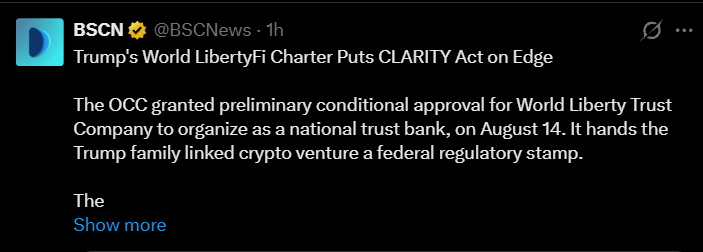
One major area of debate involves ethics and conflict-of-interest concerns. Those concerns received additional attention after the Office of the Comptroller of the Currency (OCC) published its August 14 decision regarding the application to charter World Liberty Trust Company, National Association.
The OCC's official records list Corporate Decision 1385 as an August 14, 2026 decision on the application to charter the company.
The development has added another layer to the political debate, with critics raising concerns about the relationship between crypto policy, financial regulation and potential conflicts of interest.
Banks Are Also Part of the CLARITY Act Debate
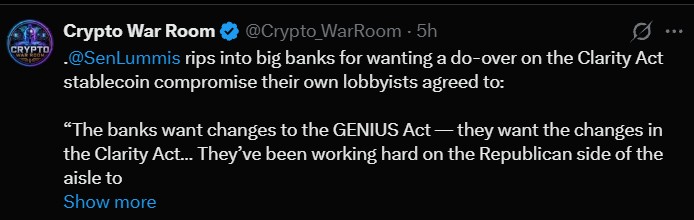
The political dispute is not the only challenge facing the legislation. Senator Cynthia Lummis has argued that banking interests are working against the bill and are seeking changes connected to stablecoin regulation before offering support.
The disagreement reportedly involves provisions related to the GENIUS Act and the broader relationship between banks, stablecoin issuers and the future crypto market structure.
This highlights an important point: the battle over the bill is not simply a Democrat-versus-Republican issue. That means that even if there's a consensus that there need to be clearer cryptocurrency rules, a final compromise could be challenging.
Brian Armstrong Has strong support in the Senate.
In spite of the challenges, Coinbase CEO Brian Armstrong is hopeful about the law's prospects. Armstrong said he believed a bipartisan compromise is still possible, and that the bill will get well over 60 votes in the Senate.
The 60-vote threshold is especially important because it is the minimum number of votes needed to overcome procedural hurdles in the Senate for major legislation.
Armstrong also serves as a member of the CFTC's Innovation Advisory Committee, which brings him into close contact with industry leaders who are engaged in discussions about new financial technologies and crypto regulation.
His optimism contrasts sharply with Selig's warning that they may need to move ahead on their own if Congress remains unable to act.
SEC and CFTC Regulation Could Move in Parallel
The broader push for crypto regulation is not limited to the CFTC. It has been coordinating with the Securities and Exchange Commission on innovation and crypto-related policy issues. In March, the agencies announced cooperation aimed at clarifying the application of federal rules and improving coordination around emerging technologies.
This means the next phase of US crypto regulation could involve several tracks at the same time: congressional legislation, CFTC rulemaking and SEC action.
That could accelerate regulatory progress. However, it could also create new questions if different agencies establish overlapping or inconsistent requirements.
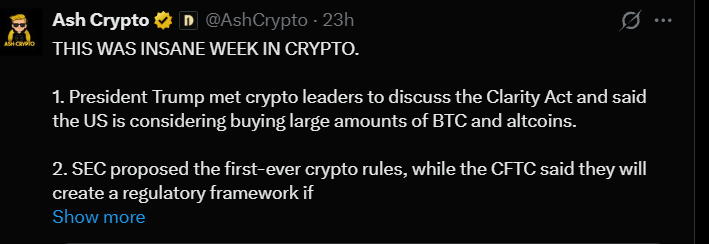
Timeline: Key Developments in the US Regulation Debate
Date | Development |
March 24, 2026 | Selig launches the Innovation Task Force, with assets and blockchain among its focus areas. |
August 10, 2026 | CFTC announces the inaugural Innovation Advisory Committee meeting. |
August 14, 2026 | OCC records Corporate Decision 1385 concerning the application to charter World Liberty Trust Company. |
August 20, 2026 | CFTC Innovation Advisory Committee meets to discuss cryptocurrency assets, AI and prediction markets. |
August 21, 2026 | Selig signals that bill could move forward with or without congressional legislation. |
Next Stage | Senate negotiations and potential rulemaking will determine which path advances first. |
What Happens Next for US Crypto Regulation?
The biggest question is no longer whether US regulators will address markets. The real question is who will establish the framework first.
If Congress resolves its disagreements, the CLARITY Act could provide a comprehensive legislative foundation for the industry. If the bill remains stalled, the CFTC appears prepared to explore how far it can go using existing statutory authority.
For now, the latest CLARITY Act News shows that regulatory momentum is continuing—even if the path through Congress remains uncertain.
Disclaimer: Cryptocurrency and digital asset markets are highly volatile and involve significant financial risk. This article is for informational purposes only and should not be considered financial, investment, legal, or trading advice. Always conduct your own research and consult a qualified professional before making any financial decisions.







